
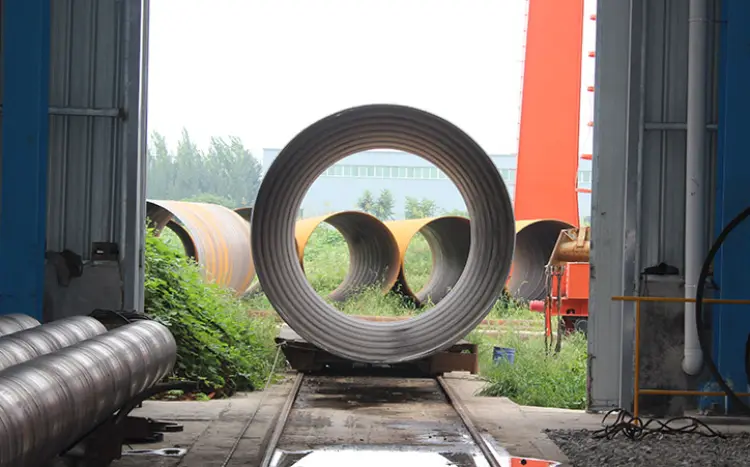
API 5L X46 PSL2 SSAW Pipe
API 5L X46 PSL2 SSAW Pipe - Properties, Chemical Composition & Global Equivalents
Comprehensive material data for API 5L X46 PSL2 steel in spiral submerged arc welded (SSAW) pipes, including chemical composition, mechanical and physical properties, and international equivalents.
Spiral submerged arc welding (SSAW), thermomechanical controlled processing (TMCP) for plate/coil
- Phone : +8618037372205
- Email : [email protected]
- WhatsApp: Contact via Whtsapp
- WeChat: +8618037372205
API 5L X46 PSL2 SSAW Pipe Introduction
API 5L X46 PSL2 SSAW pipe is a high-strength, low-alloy steel line pipe manufactured by spiral submerged arc welding, designed for critical oil and gas transmission applications under the API 5L specification. The 'X46' designation indicates a minimum yield strength of 46 ksi (317 MPa), while PSL2 (Product Specification Level 2) imposes tighter chemical and mechanical limits, mandatory notch toughness testing, and traceability requirements compared to PSL1. SSAW (spiral submerged arc welded) production allows large diameters and long lengths from coiled steel plate, ensuring cost efficiency and uniform properties. This material offers excellent strength, weldability, and fracture resistance, making it suitable for sour service and low-temperature environments when supplementary requirements are met. Typical delivery condition is as‑welded or stress‑relieved, with optional anti‑corrosion coatings.
API 5L X46 PSL2 SSAW Pipe Chemical Composition – API 5L X46 PSL2
The following table lists the chemical composition limits according to API 5L 46th Edition (2018), Table 4 for PSL2 pipe. For SSAW pipe, values apply to the steel plate/coil used. All maximum limits unless stated otherwise. Carbon equivalent values (CEIIW and CEPcm) are restricted based on thickness and product analysis limits.
| Element | Specified Value (wt. %) | Remarks |
|---|---|---|
| Carbon (C) | ≤ 0.22 | Per heat analysis; product analysis limit ≤ 0.24% |
| Manganese (Mn) | ≤ 1.20 | Product analysis limit ≤ 1.25% |
| Phosphorus (P) | ≤ 0.025 | Stringent limit for PSL2 |
| Sulfur (S) | ≤ 0.015 | Stringent limit for PSL2 |
| Silicon (Si) | ≤ 0.45 | May be partly substituted by Al |
| Vanadium (V) | ≤ 0.05 | Optional microalloying element |
| Niobium (Nb) | ≤ 0.05 | Optional microalloying element |
| Titanium (Ti) | ≤ 0.04 | Optional microalloying element |
| Aluminium (Al) | 0.015 – 0.060 | Typically required for grain refinement and deoxidation |
| Nitrogen (N) | ≤ 0.012 | Not normally specified but limited by steelmaking |
| Copper (Cu) | ≤ 0.50 | Residual element; max limit if specified |
| Nickel (Ni) | ≤ 0.50 | Residual element; max limit if specified |
| Molybdenum (Mo) | ≤ 0.50 | Residual element; max limit if specified |
| Boron (B) | ≤ 0.0005 | Trace element; may be present for hardenability |
| Carbon Equivalent (CEIIW) | ≤ 0.43 | Applicable for PSL2 per Annex B; varies with thickness |
| Carbon Equivalent (CEPcm) | ≤ 0.25 | Alternative method for weldability; product dependent |
API 5L X46 PSL2 SSAW Pipe Thermal and Electrical Physical Properties
Physical properties are typical for low‑carbon pipeline steel and are not specified in API 5L. These values are representative for steel grade with similar composition (0.05–0.22% C, low alloy). They should be considered for design calculations and are derived from ASME B31.4/B31.8 and standard steel handbooks. Properties may vary slightly with manufacturing process and temperature.
| Property | Typical Value | Unit | Test Condition / Temperature |
|---|---|---|---|
| Density (ρ) | 7.80 – 7.85 | g/cm³ (kg/m³: 7800–7850) | At 20°C |
| Elastic Modulus (E) | 200 – 210 | GPa (ksi: ~29–30.5 × 10³) | At 20°C, static tensile test |
| Shear Modulus (G) | 80 – 84 | GPa | At 20°C, calculated from E and ν |
| Poisson's Ratio (ν) | 0.28 – 0.30 | – | At 20°C, elastic range |
| Thermal Expansion Coefficient (α) | 11.5 – 12.5 | ×10⁻⁶ /°C (µm/m·°C) | 20°C to 100°C |
| Thermal Conductivity (λ) | 45 – 55 | W/(m·K) | At 20°C |
| Specific Heat Capacity (cp) | 460 – 500 | J/(kg·K) | At 20°C |
| Electrical Resistivity (ρe) | 0.14 – 0.18 | µΩ·m | At 20°C |
| Melting Point | 1450 – 1520 | °C | Approximate |
API 5L X46 PSL2 SSAW Pipe Mechanical Properties – API 5L X46 PSL2 SSAW Pipe
Tensile properties and impact toughness requirements per API 5L Table 5 and Table 6 for PSL2 pipe. The yield and tensile strengths are measured on transverse specimens taken from the pipe body. For SSAW pipe, weld seam tensile strength must satisfy specified values. Elongation is calculated using the minimum required elongation formula or a fixed value for small diameter pipes. PSL2 requires Charpy V‑notch impact testing at a specified temperature (usually 0°C or lower as per supplementary requirements).
| Property | Required Value | Unit | Test Condition |
|---|---|---|---|
| Yield Strength (Rt0.5 or ReH) | 317 – 496 | MPa (ksi: 46 – 72) | Transverse strip specimen, room temperature, 0.2% offset or upper yield |
| Tensile Strength (Rm) | 434 – 758 | MPa (ksi: 63 – 110) | Transverse strip specimen, room temperature |
| Yield-to-Tensile Ratio (Rt0.5 / Rm) | ≤ 0.93 | – | Mandatory for PSL2 |
| Elongation after fracture (A) | ≥ 23 (typical) | % | On gauge length 50 mm (2 in); minimum per formula in API 5L Table 5 |
| Charpy V‑notch Impact Energy (CVN) | ≥ 27 (average), ≥ 20 (single) | J (ft·lbf: ~20/15) | Full‑size specimen (10×10 mm), test temperature as per order (commonly 0°C or –10°C) |
| Weld Seam Tensile Strength | ≥ same as pipe body minimum | MPa | Transverse weld tensile test |
| Bend Test – Weld | No cracks ≥ 3 mm in any direction after 180° bending | – | Guided bend test on weld, mandrel diameter per standard |
API 5L X46 PSL2 SSAW Pipe Fully Equivalent International Standards and Substitutable Grades
| Country/Region | Standard & Grade | Grade/Designation | Remarks |
|---|---|---|---|
| International (ISO) | ISO 3183:2019 | L320 (PSL2) | L320 corresponds to API 5L X46; identical technical delivery conditions for seamless and welded pipe |
| Europe | EN 10208-2:2009 | L320 | Steel pipes for onshore pipeline; M and L grades with similar mechanical properties; PSL2 requirements align |
| China | GB/T 9711-2017 | L320 (PSL2) | National standard adopting ISO 3183; direct equivalent for X46 PSL2 pipe |
| Canada | CSA Z245.1-18 | Grade 317 (PSL2) | Yield strength in MPa; 317 MPa ≈ 46 ksi; same chemical and toughness concept |
| Russia / CIS | ГОСТ 31447-2012 (GOST) | Л320 (K34) | Approximate correspondence; K34 strength class ≈ 317 MPa; may have minor composition differences |
| Australia / New Zealand | AS 2885.1 – Pipe | L320 (API 5L X46) | Recognises API 5L grades; no separate Australian pipe standard for X46 |
API 5L X46 PSL2 SSAW Pipe Application Introduction
API 5L X46 PSL2 SSAW pipe is primarily used in the oil & gas industry for long‑distance transportation of hydrocarbons under high pressure. Due to its excellent weldability, moderate strength, and PSL2 notch toughness, it is also employed in water infrastructure and structural applications. The SSAW manufacturing enables large diameters (up to 100 inches or more) and thick walls (up to 1 inch) economically.
Product Applications: Cross‑country crude oil and natural gas pipelines, Subsea flowlines and marine risers, High‑pressure gas injection lines, Process plant interconnecting piping, Water main transmission mains, Structural columns and piles for marine terminals, Penstock pipes for hydropower plants
Processed into products: Pipe‑to‑pipe girth welds, Hot induction bends (with suitable bendability qualification), Flanged spools and fittings, Reducer and tee joints welded from SSAW pipe shell plates, Clamps and sleeves for repair, Driven piles for maritime structures, Casings for oil and water wells
Application industries: Oil and Gas (upstream & midstream), Petrochemical and Refining, Water Transmission and Distribution, Mining and Slurry Pipeline, Marine and Offshore Structural, Power Generation (cooling water lines)
API 5L X46 PSL2 SSAW Pipe Similar / Closely Related Alternative Materials
| Country/Region | Standard & Grade | Grade Name | Remarks |
|---|---|---|---|
| International | API 5L PSL2 | X42 (L290) | Lower strength grade (290 MPa min YS); often interchangeable for less demanding pressure/loads |
| International | API 5L PSL2 | X52 (L360) | Higher strength grade (360 MPa min YS); can replace X46 where higher strength allows wall thickness reduction |
| International | API 5L PSL2 | X46 PSL1 | Simpler product without mandatory impact testing; suitable for non‑critical applications |
| Europe | EN 10208-2 | L290 or L360 | Neighbouring strength levels; similar chemical philosophy for low‑temperature toughness |
| China | GB/T 9711 | L290 or L360 | Same as ISO; L290 (X42) and L360 (X52) are common alternatives |
| Japan | JIS G 3456 (STPY 400) | STPY 275 to 400 | Equivalent to API X42‑X52 range; STPY 400 is close to X56, may be used with careful substitution |
Notes:
PSL2 supplementary requirements may include: Sour service compliance (HIC/SSC testing per NACE MR0175), tighter carbon equivalent limits for better weldability, through‑thickness testing for offshore structures, and specific coating and lining options (FBE, 3LPE, polyurethane). SSAW pipe may exhibit slight ovality and higher residual stresses compared to LSAW (longitudinal) pipe; post‑weld heat treatment (PWHT) can reduce stresses if required. Typical available sizes: Outer diameter 219.1 mm (8.625 in) to 3048 mm (120 in), wall thickness 5.0 mm to 25.4 mm, length up to 18 m (60 ft). For design using this grade, refer to ASME B31.4/B31.8.
- Share



