
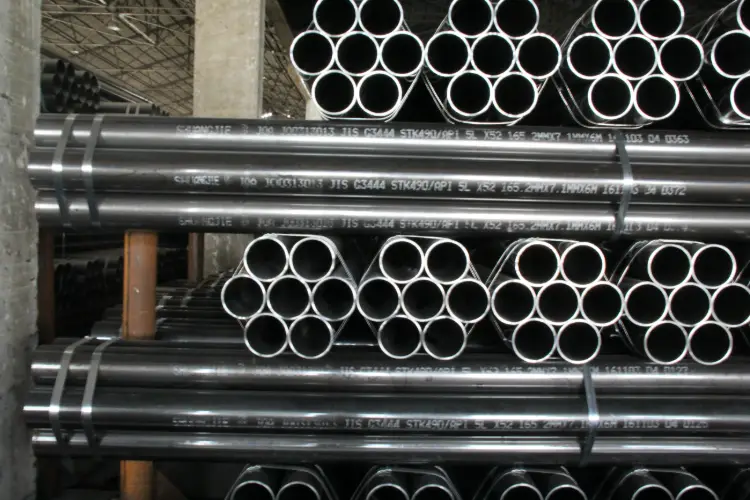
API 5L X52 PSL2 SSAW Pipe
API 5L X52 PSL2 SSAW Pipe - High Strength Carbon Steel Line Pipe for Oil & Gas
Comprehensive material data for API 5L PSL2 X52 spiral submerged arc welded (SSAW) pipe, including chemical composition, mechanical properties, thermal and electrical physical properties, equivalent grades, and application guidance.
Spiral forming, submerged arc welding, as-rolled, normalized or stress-relieved (as per agreement)
- Phone : +8618037372205
- Email : [email protected]
- WhatsApp: Contact via Whtsapp
- WeChat: +8618037372205
API 5L X52 PSL2 SSAW Pipe Introduction
API 5L X52 PSL2 (L360) is a high-strength, low-alloy steel pipe specified under the American Petroleum Institute standard API 5L. It is designed for use in conveying gas, water, and oil in the petroleum and natural gas industries. PSL2 (Product Specification Level 2) imposes stricter chemical composition limits, mandatory notch toughness, and higher quality control compared to PSL1. The SSAW (Spiral Submerged Arc Welded) manufacturing process produces pipes with a helical seam, suitable for large-diameter and long-distance pipelines. Key features include good weldability, excellent strength-to-weight ratio, and reliable low-temperature toughness, making it a cost-effective choice for critical pipeline applications.
API 5L X52 PSL2 SSAW Pipe Chemical Composition
The chemical composition of API 5L X52 PSL2 is strictly controlled to ensure consistent mechanical properties and weldability. Limits apply to both heat and product analyses. For PSL2, the carbon equivalent (CEIIW) is restricted to 0.43% maximum for pipe with thickness ≤ 25 mm (0.984 in). Micro-alloying elements such as Nb, V, and Ti are used for grain refinement and strengthening.
- Heat analysis represents the composition from the steel-making process.
- Product analysis is performed on the finished pipe and has slightly broader tolerances.
| Chemical Element | Standard Value (max, %) | Remarks |
|---|---|---|
| Carbon (C) | 0.22 | Maximum for PSL2, heat analysis |
| Manganese (Mn) | 1.40 | Maximum, heat analysis |
| Phosphorus (P) | 0.025 | Maximum |
| Sulfur (S) | 0.015 | Maximum |
| Silicon (Si) | 0.45 | Maximum |
| Niobium (Nb) | 0.05 | Maximum |
| Vanadium (V) | 0.05 | Maximum |
| Titanium (Ti) | 0.04 | Maximum |
| Niobium + Vanadium + Titanium | 0.15 | Maximum, sum of the three elements |
| Chromium (Cr) | 0.30 | Maximum, unless otherwise agreed |
| Nickel (Ni) | 0.30 | Maximum, unless otherwise agreed |
| Molybdenum (Mo) | 0.15 | Maximum, unless otherwise agreed |
| Copper (Cu) | 0.35 | Maximum, unless otherwise agreed |
| Aluminum (Al) | 0.060 | Total aluminum maximum, or as agreed for fine-grain practice |
| Nitrogen (N) | 0.012 | Maximum, not applicable if Ti/Al is used for nitrogen fixation |
| Boron (B) | 0.0005 | Maximum, unless otherwise agreed |
API 5L X52 PSL2 SSAW Pipe Thermal and Electrical Physical Properties
These values represent typical data for low-carbon, micro-alloyed steel of X52 grade at room temperature, unless otherwise stated. They are not part of API 5L requirements but are provided for design and modeling purposes. Actual properties may vary depending on exact chemical composition and heat treatment condition.
- Density, thermal expansion, and elastic moduli are influenced by carbon content and microstructure.
- Electrical resistivity increases with temperature and alloying elements.
| Property | Typical Value | Unit | Remarks / Conditions |
|---|---|---|---|
| Density (ρ) | 7.85 | g/cm³ | Room temperature |
| Modulus of Elasticity (E) | 205 | GPa | Tension, approximately 0–100 °C |
| Shear Modulus (G) | 80 | GPa | Calculated from E and Poisson's ratio |
| Poisson's Ratio (ν) | 0.29 | — | Within elastic range |
| Thermal Expansion Coefficient (α) | 11.7 × 10⁻⁶ | 1/K | Mean coefficient between 20 °C and 100 °C |
| Thermal Expansion Coefficient (α) | 12.5 × 10⁻⁶ | 1/K | Mean coefficient between 20 °C and 200 °C |
| Thermal Expansion Coefficient (α) | 13.5 × 10⁻⁶ | 1/K | Mean coefficient between 20 °C and 400 °C |
| Thermal Conductivity (λ) | 50 | W/(m·K) | At 20 °C; decreases with temperature increase |
| Specific Heat Capacity (c) | 470 | J/(kg·K) | At 20–100 °C |
| Electrical Resistivity (ρe) | 0.20 × 10⁻⁶ | Ω·m | At 20 °C, typical for low-alloy steel |
API 5L X52 PSL2 SSAW Pipe Mechanical Properties
Mechanical properties are determined on test specimens taken from the pipe body or weld seam. PSL2 requires testing in both transverse and longitudinal directions, and notch toughness (Charpy V-notch) is mandatory. The following values are the minimum requirements unless a range is specified. Yield strength is measured at 0.5% total extension (Rt0.5) for pipe with specified wall thickness.
- For SSAW pipe, the weld seam is also tested for tensile strength and toughness.
- Bend tests and flattening tests are often performed as per the standard to verify soundness.
| Property | Required Value | Unit | Test Condition |
|---|---|---|---|
| Yield Strength (Rt0.5), min | 360 | MPa | Transverse direction, pipe body, room temperature |
| Yield Strength (Rt0.5), max | 530 | MPa | Transverse direction, pipe body, room temperature |
| Tensile Strength (Rm), min | 460 | MPa | Transverse direction, pipe body |
| Tensile Strength (Rm), max | 760 | MPa | Transverse direction, pipe body |
| Elongation (A), min | 21 | % | Gauge length 50 mm (2 in), strip specimen; calculated by formula A=1940*A0.2/U0.9 may give higher values |
| Yield to Tensile Ratio (Rt0.5/Rm), max | 0.93 | - | Only applicable for PSL2 |
| Charpy V-notch Impact Energy, min | 27 | J | Transverse, at 0 °C (32 °F), full-size specimen; other temperatures as agreed |
| Charpy V-notch Impact Energy, min | 40 | J | Longitudinal, at 0 °C, full-size specimen |
| Weld Seam Tensile Strength, min | 460 | MPa | All weld metal tensile test; the weld must at least match the pipe body tensile strength |
| Bend Test | No cracks > 3 mm | — | Guided bend test over 180° on weld seam, mandrel diameter 3t for wall thickness ≤ 12.7 mm |
API 5L X52 PSL2 SSAW Pipe Equivalent Material Standards and Substitute Grades
| Country/Region | Standard | Grade | Remarks |
|---|---|---|---|
| International | ISO 3183 | L360 | Equivalent to X52 PSL2; same minimum yield strength; PSL 2 requirements match API 5L PSL2 |
| Europe | EN 10208-2 | L360MB | Seamless and welded line pipe for combustible fluids; L360MB corresponds to PSL2 with mandatory toughness |
| China | GB/T 9711 | L360 / X52 | Petroleum and natural gas industries – steel pipe for pipelines; L360 is identical in strength, PSL2 specific requirements may differ slightly |
| Norway (DNV) | DNVGL-ST-F101 | SAWL 360 | Submarine pipeline systems – longitudinal or spiral welded pipe with minimum SMYS 360 MPa, similar to X52 PSL2 |
| Russia / CIS | GOST R 52079 | K52 | Similar strength class, may have different toughness requirements |
API 5L X52 PSL2 SSAW Pipe Application Introduction
API 5L X52 PSL2 SSAW pipe is primarily used in high-pressure transmission pipelines for oil, gas, and water. Its enhanced PSL2 requirements make it particularly suited for offshore and harsh environments, where low-temperature toughness and reliable crack arrest properties are essential. The SSAW process allows economical production of large-diameter pipes (typically 16 to 60 inches) with long lengths, reducing the number of on-site girth welds. The material can be formed into cold bends (induction bends) for directional changes, and its weldability is compatible with standard field welding procedures.
Product Applications: Long-distance crude oil and natural gas pipelines, Gas gathering and distribution networks, Subsea flowlines and risers (with appropriate coating), Water injection and produced water lines, Structural piles for bridges, jetties, and offshore platforms, Pipe-type cable systems, Piping for industrial fluids and slurries
Processed into products: Line pipe joints and field girth welds, Induction bends and elbows, Tees, reducers, and caps (welded from plate or as forged fittings), Flanges (welding neck, slip-on) in matching material, Pipeline valves (ball, gate, check) with body material equivalent to X52, Pipe supports, anchors, and sleepers, Piling connectors and driving shoes
Application industries: Oil & Gas (upstream, midstream, downstream), Petrochemical and Refining, Water Transmission and Distribution, Civil Engineering and Construction, Marine and Offshore Engineering, Power Generation (cooling water lines), Mining (slurry pipelines)
API 5L X52 PSL2 SSAW Pipe Similar/Comparable Materials with Close Properties
| Country/Region | Standard | Grade | Analysis & Comparison |
|---|---|---|---|
| International | API 5L / ISO 3183 | X46 / L320 | Lower yield strength (320 MPa min). Slightly leaner chemistry. Suitable for lower pressure pipelines where X52 is over-specified; offers cost savings but with reduced load capacity. |
| International | API 5L / ISO 3183 | X56 / L390 | Higher yield strength (390 MPa min). Comparable chemistry but may require additional micro-alloying. Provides up to 8% higher operating pressure, but slightly reduced toughness and weldability margin. |
| Europe | EN 10208-2 | L360NB | Same strength level as L360MB but for non-sour service and without mandatory low-temperature toughness (PSL1 equivalent). Can be considered for non-critical applications with relaxed toughness demands. |
| USA | ASTM A572 / A572M | Grade 50 (345 MPa) | Structural steel plate with similar tensile properties but not intended for pressure containment. Used in structural components and piling; can sometimes replace X52 pipe in non-pipeline structural applications. |
| China | GB/T 1591 | Q345 | General low-alloy steel with yield ~345 MPa. Similar strength range, but controlled rolling and delivery condition are different. Acceptable for structural use but lacks the stringent notch toughness and quality testing of API 5L PSL2 line pipe. |
Notes:
Special considerations:
- For sour service (H2S containing environments), API 5L X52 PSL2 pipes can be ordered with supplementary requirements such as HIC/SWC resistance, and stricter chemistry (e.g., low sulfur, controlled Ca/S ratio).
- Strain-based design applications may require additional properties like uniform elongation above the minimum and specified stress-strain curves.
- Coating and internal lining are often applied to SSAW pipe; the surface condition must be compatible and free from excessive mill scale.
- Third-party inspection and testing beyond API 5L minimum are common; always confirm the data to the applicable purchase specification and revision year of the standard.
- Share



