
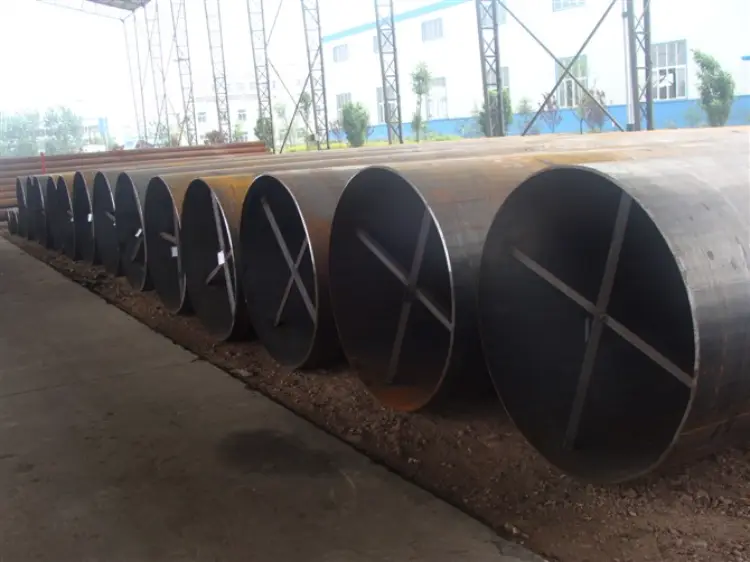
API 5L X56 PSL2 SSAW Pipe
API 5L X56 PSL2 SSAW Pipe: High-Strength Line Pipe for Oil & Gas Transmission
Comprehensive material analysis of API 5L X56 PSL2 spiral submerged arc welded (SSAW) pipe including chemical composition, mechanical properties, thermal and electrical data, equivalent grades, and application guidance.
Hot strip rolling, forming, submerged arc welding, and optional heat treatment (normalizing, thermomechanical rolling)
- Phone : +8618037372205
- Email : [email protected]
- WhatsApp: Contact via Whtsapp
- WeChat: +8618037372205
API 5L X56 PSL2 SSAW Pipe Introduction
API 5L X56 PSL2 SSAW pipe is a high-strength low-alloy steel line pipe designed for the transportation of oil, gas, and other fluids. It is manufactured by spiral submerged arc welding (SSAW) from hot-rolled coils, making it suitable for large-diameter pipelines. Conforming to Product Specification Level 2 (PSL2) under API Specification 5L, the pipe offers enhanced toughness, stricter chemical composition limits, and mandatory impact testing compared to PSL1. X56 designates a minimum yield strength of 56 ksi (386 MPa), ensuring reliable performance in high-pressure transmission systems. Its typical delivery condition is as-rolled, thermomechanically rolled, or normalized, depending on the manufacturer and wall thickness. This grade is widely used in onshore and offshore pipeline projects.
API 5L X56 PSL2 SSAW Pipe Chemical Composition for API 5L X56 PSL2
The chemical composition of API 5L X56 PSL2 conforms to Table 4 of API Specification 5L, which imposes limits on carbon, manganese, phosphorus, sulfur, and micro-alloying elements. The exact values may vary between heat analysis (ladle) and product analysis. A maximum carbon equivalent (CEIIW or CEPcm) is often specified by the purchaser to ensure weldability. The values below represent the standard maxima for PSL2 X56 unless otherwise agreed.
| Element | Max % (Heat Analysis) | Remarks |
|---|---|---|
| Carbon (C) | 0.22 | For grades ≥ L415 or X56, maximum carbon may be reduced by agreement for improved weldability |
| Manganese (Mn) | 1.40 | Minimum may be specified by the manufacturer; typical range for X56 is 1.00–1.40 |
| Phosphorus (P) | 0.025 | PSL2 maximum; lower than PSL1 (0.030) |
| Sulfur (S) | 0.015 | PSL2 maximum; lower than PSL1 (0.030) |
| Silicon (Si) | 0.45 | Common range 0.15–0.35 |
| Niobium (Nb) | 0.05 (V+Nb+Ti ≤ 0.15) | Micro-alloying for grain refinement and strength; typical Nb 0.02–0.05 |
| Vanadium (V) | 0.05 (as above) | Often used in combination with Nb |
| Titanium (Ti) | 0.04 (as above) | Controlled to optimize toughness |
| Copper (Cu) | 0.35 (if specified) | May be added for corrosion resistance |
| Nitrogen (N) | 0.012 (max) | Unless aluminium is present for grain refinement |
| Aluminium (Al) | 0.060 total Al (min when used for grain refinement) | Typically 0.015–0.060 for deoxidation and nitrogen binding |
| Carbon equivalent CEIIW | Typically 0.43 max (by agreement) | Calculated as C + Mn/6 + (Cr+Mo+V)/5 + (Ni+Cu)/15 |
API 5L X56 PSL2 SSAW Pipe Thermal and Electrical Physical Properties
The following physical properties are not specified in API 5L but represent typical values for low-alloy carbon-manganese steel such as X56 at room temperature. These values are useful for design calculations involving thermal expansion, heat transfer, and electrical resistivity. They may vary slightly depending on the exact chemical composition and microstructure.
| Property | Typical Value | Unit | Test Conditions / Remarks |
|---|---|---|---|
| Density (ρ) | 7.85 | g/cm³ | At 20°C |
| Modulus of Elasticity (E) | 205 | GPa | At 20°C, dynamic method |
| Shear Modulus (G) | 80 | GPa | Approximated from E and Poisson's ratio |
| Poisson's Ratio (ν) | 0.30 | — | At 20°C, within elastic range |
| Thermal Expansion Coefficient (α) | 12.0×10⁻⁶ | K⁻¹ | Average between 20°C and 200°C |
| Thermal Conductivity (λ) | 50 | W/(m·K) | At 20°C; decreases with increasing temperature |
| Specific Heat Capacity (cp) | 480 | J/(kg·K) | At 20°C; increases to about 550 J/(kg·K) at 400°C |
| Electrical Resistivity (ρe) | 0.20 | μΩ·m | At 20°C; typical for low-alloy steel |
API 5L X56 PSL2 SSAW Pipe Mechanical Properties for API 5L X56 PSL2 SSAW Pipe
Mechanical properties are determined on the pipe body or from test rings taken from the pipe. The values apply to transverse specimens for welded pipes unless otherwise specified. The yield strength and tensile strength ranges are mandatory for PSL2, and the yield-to-tensile ratio is limited to ensure ductile behavior. Impact toughness (Charpy V-notch) is required for PSL2 at the design temperature, typically 0°C or lower, with minimum absorbed energy values depending on specimen size. Bend tests are replaced by flattening tests for welded pipes as per API 5L.
| Property | Required Value | Unit | Test Conditions / Remarks |
|---|---|---|---|
| Yield Strength (ReH or Rt0.5) | 386–530 | MPa | Minimum 56 ksi, maximum 77 ksi; for pipe body transverse strip test |
| Tensile Strength (Rm) | 490–760 | MPa | Minimum 71 ksi, maximum 110 ksi; width of strip 38.1 mm for D<219.1 mm |
| Yield to Tensile Ratio (ReH/Rm) | Max 0.93 | — | Required for PSL2 to ensure strain hardening capacity |
| Elongation after Fracture (A) | ≥ 22 (for L0=50 mm, 12.7 mm wide strip) | % | Minimum as per API 5L Table 11; varies with specimen size. For full-section specimens, min A = 18% (L0=2 in) |
| Charpy V-notch Impact Energy | Average ≥ 27 J at 0°C | J | Single min 20 J; full-size specimen 10×10 mm; for thinner walls reduced-size specimen may be used with adjusted requirements |
| Flattening Test | No cracks or breaks until plates distance ≤ 2/3 specified outside diameter | — | For D>60.3 mm; acceptance criteria per API 5L Clause 9.10 |
| Maximum Hardness (Vickers HV10) | ≤ 250 (PSL2 requirement for sour service) | HV10 | Required when specified for NACE MR0175/ISO 15156 compliant service |
API 5L X56 PSL2 SSAW Pipe Exact International Equivalent Material Standards and Grades
| Country/Region | Standard | Grade | Remarks |
|---|---|---|---|
| International (ISO) | ISO 3183:2019 | L415 PSL2 | Identical technical content; L415 designates minimum yield 415 MPa |
| Europe | EN 10208-2:2009 | L415MB | Steel for pipelines for combustible fluids; M = thermomechanically rolled |
| China | GB/T 9711-2017 | L415 (PSL2) | Adopted from ISO 3183; seamless and welded line pipe |
| Australia | AS 2885.1:2015 | X56 (PSL2) | References API 5L; PSL2 includes similar toughness requirements |
| DNV (offshore) | DNV-OS-F101 | 415 | Yield strength 415 MPa for submarine pipeline systems |
API 5L X56 PSL2 SSAW Pipe Application Introduction
API 5L X56 PSL2 SSAW pipe is engineered for high-reliability pipeline systems requiring a balance of strength, toughness, and weldability. It is the material of choice for long-distance oil and gas transmission lines, where the combination of spiral welding allows cost-effective production of large diameters. The PSL2 qualification ensures compliance with rigorous testing for sour service and low-temperature applications. Detailed design considerations should adhere to pipeline design codes (e.g., ASME B31.8, ASME B31.4, ISO 13623).
Product Applications: Cross-country hydrocarbon transportation pipelines, Subsea flowlines and risers, Gathering lines and distribution networks, Compressor station and pump station piping, Pipe-in-pipe systems for heavy oil transportation, Jacket structures and piles for offshore platforms
Processed into products: Line pipe sections and spool pieces, Induction bends and cold bends for directional changes, Tee fittings and reducers for branching, Weld-on flanges and connectors, Valves body (if made from pipe material), Anchor flanges and support elements
Application industries: Oil and gas onshore transmission, Offshore pipeline systems (shallow and deep water), Petrochemical plants and refinery piping, Water supply and sewage treatment (high-pressure mains), Mining (slurry transport), Structural piling and foundation engineering
API 5L X56 PSL2 SSAW Pipe Similar / Alternative Material Grades with Comparable Strength and Applications
| Country/Region | Standard | Grade | Remarks |
|---|---|---|---|
| International | API 5L / ISO 3183 | X52 (L360) PSL2 | Lower strength, minimum yield 360 MPa; may be substituted for lower pressure lines |
| International | API 5L / ISO 3183 | X60 (L415) PSL2 | Slightly higher strength, minimum yield 415 MPa; direct upgrade |
| International | API 5L / ISO 3183 | X65 (L450) PSL2 | Higher strength for more demanding pipelines; thicker wall achievable |
| Europe | EN 10208-2 | L360MB | Similar to X52, suitable for less aggressive fluids |
| Europe | EN 10208-2 | L450MB | Similar to X65, selected for high-pressure transmission |
| Japan | JIS G 3456 | STPT 410 | Carbon steel for pressure service, comparable strength but not specifically for line pipe |
Notes:
Sour Service Compliance: When designated for sour environments (NACE MR0175/ISO 15156), additional requirements for hardness (max 250 HV10), chemical composition (e.g., S ≤ 0.002%), and HIC/SSC testing may be invoked. Weldability: Preheating and post-weld heat treatment (PWHT) may be required for thick-wall pipes; carbon equivalent values should be kept low to avoid cold cracking. SSAW specifics: The spiral weld seam is 100% inspected by ultrasonic or X-ray methods. Dimensional tolerances are per API 5L Table 9 (diameter, wall thickness, etc.). For further details, refer to the latest edition of API Specification 5L and the relevant design codes.
- Share



