
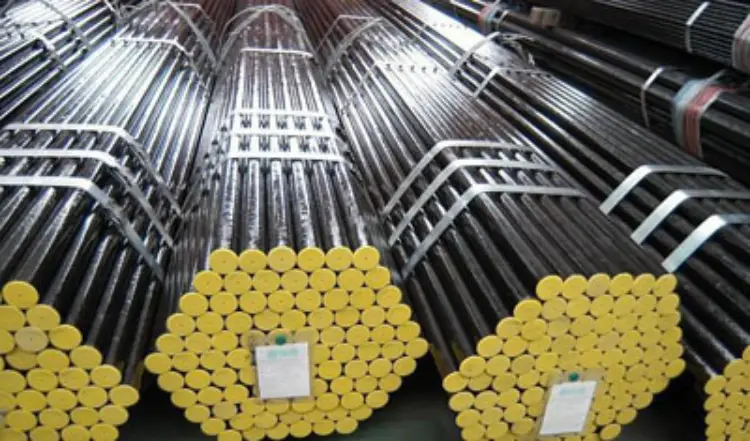
API 5L PSL2 X60 SSAW Pipe
API 5L PSL2 X60 SSAW Pipe - High-Strength Spiral-Welded Steel Line Pipe
Complete technical profile of API 5L PSL2 X60 spiral submerged-arc welded pipe, covering chemical, mechanical, and physical properties according to API 5L standard. Includes international equivalent grades and application guidance for oil & gas transmission pipelines.
Hot-rolled strip/plate, spiral forming, double-sided submerged-arc welding, online ultrasonic/radiography inspection; pipe can be supplied as-rolled, normalized, or thermomechanically processed
- Phone : +8618037372205
- Email : [email protected]
- WhatsApp: Contact via Whtsapp
- WeChat: +8618037372205
API 5L PSL2 X60 SSAW Pipe Introduction
API 5L PSL2 X60 SSAW pipe is a high-strength, low-alloy steel line pipe manufactured by spiral submerged-arc welding. It conforms to the API Specification 5L (product specification level PSL2) for pipeline transportation systems in the petroleum and natural gas industries. The grade X60 (minimum specified yield strength 60 ksi, 415 MPa) offers a balanced combination of strength, toughness, and weldability, making it suitable for high-pressure, large-diameter transmission lines. The spiral welding process provides cost-effective production of large-diameter pipes (typically 16–60 inches) with consistent quality. PSL2 adds stricter controls on chemistry, mechanical testing, and non-destructive inspection compared to PSL1, ensuring superior reliability for demanding service conditions.
API 5L PSL2 X60 SSAW Pipe Chemical Composition
The chemical requirements for API 5L PSL2 X60 welded pipe are given as maximum values based on ladle analysis. Carbon equivalent (CEIIW) is restricted to ensure weldability. Typical microalloying with niobium, vanadium, or titanium is used to achieve strength and toughness. Values listed are for pipe wall thickness ≤ 25.0 mm; for thicker walls, additional phosphorus reduction may apply.
| Chemical Element | Standard Value (max, wt%) | Remarks |
|---|---|---|
| Carbon (C) | 0.22 | Welded pipe PSL2; seamless max 0.26 |
| Silicon (Si) | Not specified | Typically 0.15–0.35 |
| Manganese (Mn) | 1.40 | PSL2 allows higher Mn; for t > 25 mm, max 1.50 |
| Phosphorus (P) | 0.025 | Maximum for PSL2 |
| Sulfur (S) | 0.015 | Maximum for PSL2 |
| Vanadium (V) | 0.06 | Sum V+Nb+Ti ≤ 0.15 |
| Niobium (Nb) | 0.05 | Sum V+Nb+Ti ≤ 0.15 |
| Titanium (Ti) | 0.04 | Sum V+Nb+Ti ≤ 0.15 |
| Aluminum (Al) | Not specified | Typically 0.010–0.050 (acid soluble) for grain refining |
| Nitrogen (N) | Not specified | Usually ≤ 0.012 if not intentionally added |
| Copper (Cu) | 0.50 | Combined Cu+Ni+Cr+Mo ≤ 1.0 for weldability |
| Nickel (Ni) | 0.50 | Part of residual element limit |
| Chromium (Cr) | 0.50 | Part of residual element limit |
| Molybdenum (Mo) | 0.50 | Part of residual element limit |
| Carbon Equivalent (CEIIW) | 0.43 | Maximum for X60 PSL2 with C ≤ 0.12; note different CE limits may apply in customer specifications |
API 5L PSL2 X60 SSAW Pipe Thermal and Electrical Physical Properties
Physical properties are representative for low-alloy carbon steel similar to X60 composition. Actual values can vary slightly with exact chemistry and processing. These are typical engineering data and do not form part of the API 5L mandatory requirements.
| Property | Typical Value | Unit | Test Condition |
|---|---|---|---|
| Density (ρ) | 7850 | kg/m³ | Room temperature |
| Modulus of Elasticity (E) | 200 | GPa | At 20 °C |
| Shear Modulus (G) | 80 | GPa | At 20 °C (calculated from E and Poisson's ratio) |
| Poisson's Ratio (ν) | 0.30 | – | Room temperature |
| Thermal Expansion Coefficient (α) | 11.7 | ×10⁻⁶ /K | Mean value between 20 °C and 100 °C |
| Thermal Expansion Coefficient (α) | 12.5 | ×10⁻⁶ /K | Mean value between 20 °C and 300 °C |
| Thermal Conductivity (λ) | 50 | W/(m·K) | At 20 °C |
| Thermal Conductivity (λ) | 45 | W/(m·K) | At 200 °C |
| Specific Heat Capacity (c) | 480 | J/(kg·K) | Room temperature |
| Electrical Resistivity (ρₑ) | 0.20 | ×10⁻⁶ Ω·m | Room temperature (approx.) |
API 5L PSL2 X60 SSAW Pipe Mechanical Properties
Tensile properties are measured on transverse strip samples (welded pipe) or longitudinal samples as agreed. Charpy V-notch impact tests apply to PSL2 pipe body, weld seam, and HAZ. Bend test (guided 180°) is mandatory for the weld. Values represent minimum or range limits per API 5L (46th edition). Elongation is calculated according to the API formula (A50% = 2000 * (S0/UTS)^{0.2} / UTS^{0.9} in SI units) and is given as a typical minimum.
| Property | Standard Required Value | Unit | Test Condition |
|---|---|---|---|
| Yield Strength (Rt0.5) | 415 – 565 | MPa | Transverse strip, 0.5% total extension under load, room temperature |
| Tensile Strength (Rm) | 520 – 760 | MPa | Transverse strip, room temperature |
| Yield-to-Tensile Ratio (Rt0.5 / Rm) | ≤ 0.93 (when specified) | – | Optional for PSL2, often mandatory for sour service (Annex H) |
| Elongation (A) | ≥ 18 (typical) | % | Transverse; gauge length 50 mm or 2 in.; calculated per API 5L formula (example for UTS = 560 MPa, thickness 10 mm) |
| Elongation (A) | ≥ 22 (typical) | % | Longitudinal; values approximately 2–4% higher than transverse |
| Charpy V-Notch Impact (KV) | ≥ 27 (average of 3) | J | Full-size specimen (10×10 mm), transverse, at 0 °C; individual min 20 J |
| Charpy V-Notch Impact (KV) | ≥ 35 (average of 3) | J | Full-size specimen, weld & HAZ, 0 °C; min individual 28 J |
| Charpy V-Notch Impact (KV) | ≥ 40 (average of 3) | J | Full-size specimen, transverse, at -10 °C (optional for colder service) |
| Bend Test (Weld) | No crack ≥ 3 mm | – | Guided 180° bend, mandrel diameter = 3T for t ≤ 12.7 mm; no failure in weld or HAZ |
| Hardness | ≤ 250 HV10 | HV | Weld and HAZ (if sour service, ≤ 248 HV10 per NACE MR0175) |
API 5L PSL2 X60 SSAW Pipe Fully Equivalent Material Standards & Replaceable Grades
| Country/Region | Standard | Grade | Remarks |
|---|---|---|---|
| International | ISO 3183 (PSL2) | L415 | Identical to API 5L X60 PSL2; fully interchangeable |
| Europe | EN 10208-2 | L415MB | Welded line pipe with M (thermomechanical) or N (normalized) delivery condition; equivalent to X60 |
| China | GB/T 9711 | L415 / X60 | Adopts ISO 3183; PSL2 grade L415 matches X60 properties |
| Canada | CSA Z245.1 | Grade 415 | Fully compatible with X60 for line pipe applications |
| Australia/New Zealand | AS/NZS 2885 | X60 | Referenced directly as API 5L X60 |
| Russia | GOST R 54257 | K60 (К60) | Analogous yield strength class, may require additional verification |
API 5L PSL2 X60 SSAW Pipe Application Introduction
API 5L X60 PSL2 SSAW pipe is primarily designed for high-pressure onshore and offshore oil & gas transmission. Its balanced strength and toughness make it suitable for long-distance lines operating at moderate to high stress levels. Typical applications include:
Product Applications: Mainline transmission pipes (onshore/offshore), Flow lines and gathering pipelines, Station piping (compressor, pump stations), Heavy-wall risers and J-tubes, Water injection and disposal lines, Piling pipes for offshore platforms
Processed into products: Straight pipe sections (welded or integral), Induction bends (hot bends) – typically X60 base material, Pipe fittings (tees, elbows, reducers) – matched to X60 strength, Flanges (A694 F60 or A105 with restriction), Valves bodies – pressure class to match X60 line pipe, Cladding and insulation supports
Application industries: Oil and gas exploration & production, Pipeline transportation (crude oil, natural gas, refined products), Water transmission and distribution, Chemical and petrochemical processing, Marine and subsea piping, Structural engineering and piling
API 5L PSL2 X60 SSAW Pipe Similar / Nearly Equivalent Material Recommendations
| Country/Region | Standard | Grade | Remarks |
|---|---|---|---|
| USA | API 5L PSL2 | X65 | Higher strength (min YS 450 MPa); can be substituted with thicker wall to match pressure rating, but requires welding procedure re-qualification |
| International | ISO 3183 | L450 (X65) | Slightly higher strength; may be used if design allows |
| Europe | EN 10208-2 | L415NB | Normalized condition; slightly different toughness profile, near equivalent |
| China | GB/T 9711 | L450 | Grade L450 corresponds to X65; requires engineering assessment |
| USA | ASTM A572/A572M | Grade 60 | Structural steel plate with similar yield strength but not intended for pressure piping; cannot replace line pipe without design review |
Notes:
Supplementary Requirements: PSL2 pipes often accompany additional testing per customer specification, such as: HIC/SSC tests for sour service (NACE MR0175 / ISO 15156), drop-weight tear testing (DWTT) for brittle fracture arrest, weld seam hardness control, and stricter dimensional tolerances. Coating & Protection: Commonly supplied with 3-layer polyethylene (3LPE), fusion-bonded epoxy (FBE), or coal tar enamel coatings, with internal epoxy linings for corrosion resistance. Traceability: API 5L PSL2 requires full traceability from heat number to final pipe, including positive material identification (PMI).
- Share



