
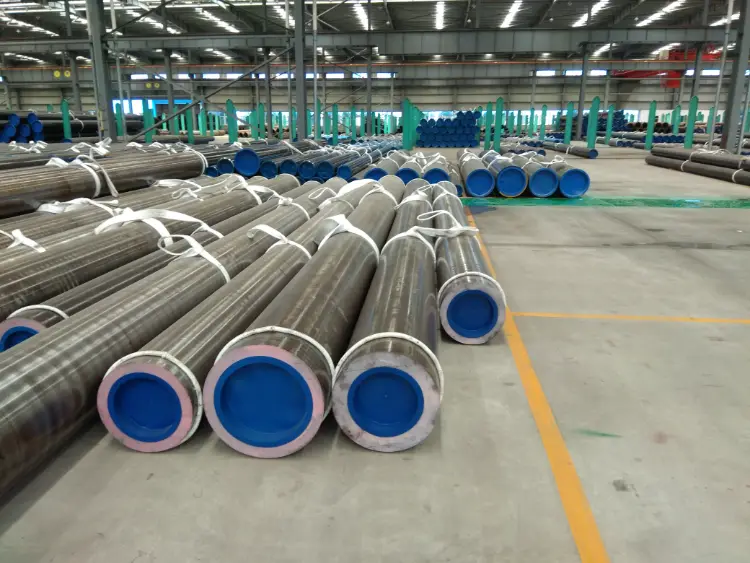
API 5L PSL2 X42 ERW Steel Pipe
API 5L PSL2 X42 ERW Steel Pipe - Material Data, Properties & International Equivalents
Detailed material properties and specifications for API 5L X42 PSL2 electric resistance welded (ERW) pipe, including chemical composition, mechanical properties, thermal/electrical physical properties, equivalent grades worldwide, and application guidance.
Electric resistance welding (ERW) from hot-rolled steel coils/skelp. Further processing may include in-line heat treatment (normalizing) to refine weld zone microstructure, straightening, and hydrostatic testing.
- Phone : +8618037372205
- Email : [email protected]
- WhatsApp: Contact via Whtsapp
- WeChat: +8618037372205
API 5L PSL2 X42 ERW Steel Pipe Introduction
API 5L X42 PSL2 ERW pipe is a carbon steel line pipe produced by the electric resistance welding process, complying with the American Petroleum Institute (API) specification 5L, Product Specification Level 2 (PSL2). It is primarily used for conveying oil, gas, and water in onshore and offshore pipeline systems. PSL2 imposes stricter controls on chemical composition, notch toughness, and non-destructive testing compared to PSL1, ensuring higher reliability and safety. The grade X42 designates a minimum yield strength of 42 000 psi (290 MPa). The ERW manufacturing process forms steel skelp into a round shape and welds the longitudinal seam using high-frequency electric current, creating a high-integrity weld without filler metal. This product combines moderate strength with excellent weldability, good low-temperature toughness, and cost-effectiveness, making it one of the most widely used grades for medium-pressure transmission and distribution pipelines.
API 5L PSL2 X42 ERW Steel Pipe Chemical Composition
The chemical composition of API 5L X42 PSL2 pipe is tightly controlled to ensure weldability and toughness. Limits below are as per API 5L 45th edition Table 4 for PSL2 pipe with wall thickness ≤25 mm. For ERW pipe, carbon equivalent (CEIIW or CEPcm) is controlled to avoid heat-affected zone hardening and hydrogen-induced cracking. Elements like V, Nb, Ti are microalloyed for grain refinement and precipitation strengthening.
| Chemical Element | Standard Value (max %) | Remarks |
|---|---|---|
| Carbon (C) | 0.22 | Max; for improved weldability lower values are often used |
| Silicon (Si) | 0.45 | Max, unless otherwise agreed; not mandatory for reporting |
| Manganese (Mn) | 1.30 | Max; higher Mn may be used with carbon equivalent limits |
| Phosphorus (P) | 0.025 | Max; critical for ductility and toughness |
| Sulfur (S) | 0.015 | Max; low sulfur for HIC resistance if specified |
| Vanadium (V) | 0.05 | Max |
| Niobium (Nb) | 0.05 | Max |
| Titanium (Ti) | 0.04 | Max |
| V + Nb + Ti | 0.15 | Maximum sum, unless otherwise agreed |
| CEIIW (IIW) | 0.43 | Max; calculated as C + Mn/6 + (Cr+Mo+V)/5 + (Ni+Cu)/15 |
| CEPcm (Pcm) | 0.25 | Max; alternative control for low-carbon approach |
API 5L PSL2 X42 ERW Steel Pipe Thermal and Electrical Physical Properties
The following physical properties are typical for API 5L X42 grade carbon steel at room temperature unless otherwise noted. Actual values may vary slightly depending on exact composition and heat treatment condition. These data are useful for pipeline design, thermal stress analysis, and coating/cathodic protection calculations.
| Property | Typical Value | Unit | Test Condition / Temperature |
|---|---|---|---|
| Density (ρ) | 7.85 | g/cm³ | At 20℃ |
| Elastic Modulus (E) | 205 | GPa | At 20℃, longitudinal direction |
| Shear Modulus (G) | 80 | GPa | Calculated from E and Poisson's ratio |
| Poisson's Ratio (ν) | 0.29 – 0.30 | - | Elastic range, room temperature |
| Thermal Expansion Coefficient (α) | 12.0 × 10⁻⁶ | K⁻¹ | 20 – 100℃ mean coefficient |
| Thermal Conductivity (λ) | 50 | W/(m·K) | At 20℃ |
| Specific Heat Capacity (cp) | 470 | J/(kg·K) | At 20℃ |
| Electrical Resistivity (ρe) | 0.16 – 0.20 | μΩ·m | At 20℃ (typical mild steel) |
API 5L PSL2 X42 ERW Steel Pipe Mechanical Properties
Mechanical properties are determined on transverse specimens taken from the pipe body according to API 5L. For ERW pipe, the weld seam must also meet strength and ductility requirements. PSL2 mandates Charpy V-notch impact testing at a specified temperature (usually 0℃ or lower design temperature). Elongation is calculated from the formula but the values in the table provide typical minima for standard specimen dimensions.
| Property | Requirement / Typical Value | Unit | Test Condition |
|---|---|---|---|
| Yield Strength (ReH) | 290 - 495 | MPa | Transverse strip test, 0.5% total extension under load (min-max) |
| Tensile Strength (Rm) | 415 - 760 | MPa | Transverse strip test (minimum specified; typical upper bound) |
| Yield to Tensile Ratio (ReH / Rm) | ≤0.93 | - | PSL2 requirement for some sour service applications; otherwise typical 0.85–0.90 |
| Elongation (A) | ≥22 | % | Transverse strip specimen, gauge length 50 mm (2 in); actual value calculated per API 5L formula |
| Charpy Impact (KV₂) | Min 27 avg / 20 single | J | Transverse specimen, 10×10×55 mm, at 0℃ (may be lower per design); for pipe body |
| Charpy Impact (KV₂) - Weld seam | Min 27 avg / 20 single | J | At same temperature, perpendicular to weld axis; each heat lot |
| D-weight Hardness | ≤22 HRC (or equivalent HV10) | - | For PSL2 pipe in sour service; otherwise not mandatory |
| Guided Bend Test | No cracks after 180° bending | - | Weld seam bend test per API 5L, diameter per standard |
API 5L PSL2 X42 ERW Steel Pipe Direct Equivalent Standards and Substitutable Grades
| Country / Region | Standard | Grade | Remarks |
|---|---|---|---|
| International (ISO) | ISO 3183 | L290 PSL2 | Identical yield strength class; PSL2 quality level matches |
| Europe (CEN) | EN 10208-2 | L290MB | Welded pipe for combustible fluids; technical delivery conditions similar to API 5L PSL2 |
| China | GB/T 9711 | L290 | Equivalent to ISO 3183; PSL2 available with same requirements |
| Canada | CSA Z245.1 | Grade 290 Cat II | Category II corresponds to PSL2 with mandatory CVN and NDE of weld |
| Russia | GOST R 52079 | K42 | Class K42 with strength level 42 kgf/mm²; full equivalence requires additional impact test agreement |
API 5L PSL2 X42 ERW Steel Pipe Application Introduction
API 5L X42 PSL2 ERW pipe is engineered for medium-pressure onshore and shallow offshore pipeline service. Its balanced strength and toughness make it suitable for gathering networks, interfield flowlines, and plant piping. PSL2's mandatory low-temperature impact testing ensures reliable performance in cold climates. The pipe can be field bent, welded with conventional procedures, and lined/coated for corrosion protection.
Product Applications: Cross-country oil and gas trunk pipelines, Offshore risers and infield flowlines (with corrosion allowance), Station piping at compressor and pump stations, Buried water transmission mains, Pipeline scraper traps and pigging loops, Structural tubular members (casing, piling, bracing)
Processed into products: Line pipe segments (12 m and 24 m random lengths), Buttweld fittings (elbows, tees, reducers) made from matching pipe, Flanges (welded neck) of compatible material, Hot induction bends (conforming to API 5L bending limits), Pup pieces and spools for tie-in assemblies, Casing pipes for road and river crossings
Application industries: Oil & Gas Upstream (gathering, flowlines, water injection), Oil & Gas Midstream (long-distance transmission lines), Petrochemical plants and refineries (process piping, off-sites), Water and wastewater (raw water mains), Construction and civil engineering (piling, structural supports), Power generation (cooling water systems, ash slurry lines)
API 5L PSL2 X42 ERW Steel Pipe Similar or Comparable Materials for Substitution
| Country / Region | Standard | Grade | Remarks |
|---|---|---|---|
| USA (API) | API 5L | X46 PSL2 | Higher strength (min yield 46 ksi); can substitute if design allows overmatching; similar toughness |
| USA (API) | API 5L | X52 PSL2 | Even higher strength; use only if wall thickness reduction is feasible and welding procedures adapted |
| International (ISO) | ISO 3183 | L245 PSL2 | Lower strength (yield 245 MPa); may be used if operating pressure is reduced accordingly |
| China | GB/T 9711 | L320 | Slightly higher strength; used for higher pressure systems; requires verification of rupture ductility |
| USA (ASTM) | ASTM A53 Grade B | Type E (ERW) | Lower yield (240 MPa); not a direct strength substitute; for non-pipeline structural use |
Notes:
- PSL2 material must undergo mandatory hydrostatic testing and non-destructive testing of the weld seam (ultrasonic or radiographic).
- For sour service applications (H₂S containing environments), supplementary requirements to API 5L Annex H (PSL2) may be specified, including hardness control (HRC ≤22) and sulphide stress cracking (SSC) tests.
- The carbon equivalent is controlled to prevent heat-affected zone cracking during field welding.
- ERW pipes are typically supplied with a mill-applied epoxy coating (FBE) or wrapping for anti-corrosion protection.
- If the pipe is to be cold expanded (UOE process), additional strain aging considerations apply; for ERW pipes, cold expansion is not common but may be used to achieve tighter dimensional tolerances.
- Share



