
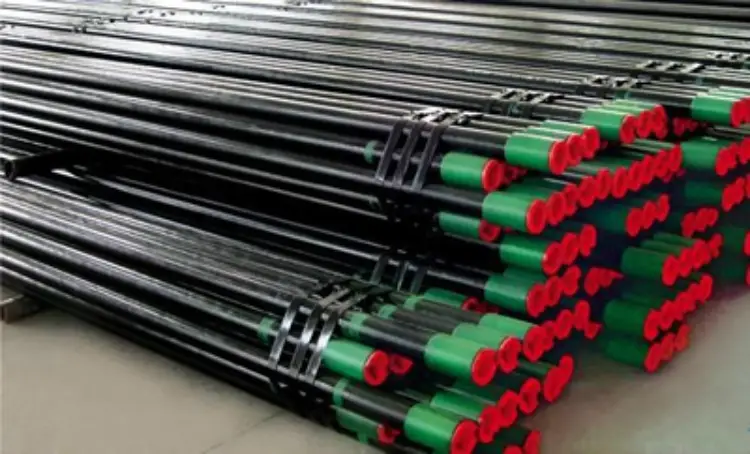
API 5L X46 PSL2 ERW Steel Pipe
API 5L X46 PSL2 ERW Steel Pipe: Mechanical & Physical Properties (Equivalent L360)
Complete material data for API 5L X46 PSL2 electric resistance welded (ERW) line pipe, including chemical composition, tensile and impact properties, thermal and electrical characteristics.
Welding, hot‑forming, cold‑bending, cutting, threading, coating
- Phone : +8618037372205
- Email : [email protected]
- WhatsApp: Contact via Whtsapp
- WeChat: +8618037372205
API 5L X46 PSL2 ERW Steel Pipe Introduction
API 5L X46 PSL2 ERW pipe is a medium‑strength welded steel line pipe grade per API Spec 5L, with mandatory supplementary requirements for fracture toughness and non‑destructive inspection. Its minimum specified yield strength is 360 MPa (52.2 ksi), which gives the equivalent ISO designation L360. The "ERW" manufacturing process ensures a consistent, high‑quality longitudinal seam suitable for
- long‑distance oil and gas transmission
- water and slurry pipelines
- structural and piling applications
. PSL2 imposes tighter chemical composition limits, Charpy V‑notch impact testing, and restricted yield‑to‑tensile ratio when required, guaranteeing safe service in moderate sour or low‑temperature environments.
API 5L X46 PSL2 ERW Steel Pipe Chemical Composition
Typical limits for X46 PSL2 ERW pipe according to API 5L Table 1 (welded pipe with wall thickness ≤ 25 mm). Carbon equivalent values (CEIIW, CEPcm) are often mandatory for PSL2 to ensure weldability and resistance to HIC. All values are maximum unless stated otherwise.
| Chemical Element | Standard Value (max %) | Remarks |
|---|---|---|
| Carbon (C) | ≤ 0.22 | For t ≤ 25 mm |
| Manganese (Mn) | ≤ 1.40 | |
| Phosphorus (P) | ≤ 0.025 | |
| Sulfur (S) | ≤ 0.015 | |
| Vanadium (V) | ≤ 0.05 | Optional microalloy |
| Niobium (Nb) | ≤ 0.05 | Optional microalloy |
| Titanium (Ti) | ≤ 0.04 | Optional microalloy |
| Copper (Cu) | ≤ 0.50 | Residual max |
| Nickel (Ni) | ≤ 0.50 | Residual max |
| Chromium (Cr) | ≤ 0.50 | Residual max |
| Molybdenum (Mo) | ≤ 0.50 | Residual max |
| Carbon Equivalent (CEIIW) | ≤ 0.43 | Typical PSL2 requirement |
| Carbon Equivalent (CEPcm) | ≤ 0.25 | Typical PSL2 requirement |
API 5L X46 PSL2 ERW Steel Pipe Thermal & Electrical Physical Properties
These physical constants are typical for carbon steel line pipe grade X46/L360 at room temperature. Slight variations may occur depending on the exact chemistry and manufacturing process. The data are derived from standard references for low‑alloy carbon steel.
| Property | Typical Value | Unit | Condition |
|---|---|---|---|
| Density (ρ) | 7.85 | g/cm³ | At 20 °C |
| Elastic Modulus (E) | 205 | GPa | At room temperature |
| Shear Modulus (G) | 80 | GPa | Typical |
| Poisson's Ratio (ν) | 0.3 | dimensionless | Typical |
| Thermal Expansion Coefficient (α) | 11.7 | 10⁻⁶ /K | 20 – 100 °C |
| Thermal Expansion Coefficient (α) | 12.2 | 10⁻⁶ /K | 20 – 200 °C |
| Thermal Conductivity (λ) | 51 | W/(m·K) | At 20 °C |
| Specific Heat Capacity (c) | 486 | J/(kg·K) | At 20 °C |
| Electrical Resistivity (ρe) | 0.165 | 10⁻⁶ Ω·m | At 20 °C (≈ 16.5 μΩ·cm) |
API 5L X46 PSL2 ERW Steel Pipe Mechanical Properties
Tensile and impact requirements for X46 PSL2 ERW pipe per API 5L Table 6 and Table 9. Testing is transverse to the pipe axis, using strip specimens from the base metal. Charpy V‑notch tests are mandatory at 0 °C (or lower as agreed) for PSL2; average absorbed energy shall be at least 27 J with no single value below 22 J for full‑size (10×10 mm) specimens. Hardness limits are normally applied for sour service (supplement HIC/SSC tests).
| Property | Standard Requirement | Unit | Test Condition |
|---|---|---|---|
| Yield Strength (Rt0.5) | 360 – 530 | MPa | Transverse strip test, base metal |
| Tensile Strength (Rm) | 460 – 760 | MPa | Transverse strip test, base metal |
| Elongation (A) | As per API formula (typ. ≥ 22) | % | 2 in (50.8 mm) gauge length, base metal |
| Yield‑to‑Tensile Ratio (Rt0.5/Rm) | ≤ 0.93 | ‑ | Required for PSL2 if sour service specified |
| Charpy V‑Notch Impact (KV) – average | ≥ 27 | J | At 0 °C, transverse, full‑size (10×10 mm) |
| Charpy V‑Notch Impact (KV) – individual min | ≥ 22 | J | At 0 °C, transverse, full‑size |
| Hardness (HV10) | ≤ 250 | HV | Mandatory only for sour service / HIC requirements |
API 5L X46 PSL2 ERW Steel Pipe Full Equivalent Material Standards & Replaceable Grade Designations
| Country/Region | Standard | Grade | Remarks |
|---|---|---|---|
| International | ISO 3183:2019 | L360 | PSL2; identical to API 5L X46 |
| Europe | EN 10208‑2:2009 | L360GA / L360NB | PSL2; welded pipe options |
| China | GB/T 9711:2017 | L360 | PSL2; welded line pipe |
API 5L X46 PSL2 ERW Steel Pipe Application Introduction
X46 PSL2 ERW pipe is widely used in the midstream oil & gas sector for long‑distance pipelines. Its moderate strength and good weldability make it suitable for a range of services:
- Onshore & offshore pipelines: Crude oil, natural gas, and refined products.
- Water infrastructure: Transmission mains, fire water circuits, and slurry lines.
- Structural applications: Piling, jetties, and structural supports.
- Process plants: Interconnecting piping for petrochemical and power generation facilities.
Product Applications: Long-distance cross‑country pipelines, Subsea flowlines, Water transmission mains, Slurry and hydraulic transport lines, Structural tubular piles, Fire water ring mains
Processed into products: Line pipe spools and sections, Field cold‑bent pipe, Induction bends (after PWHT if required), Weld‑on flanges and connectors, Reducer fittings, Anchor flanges and pup pieces
Application industries: Oil & Gas (transportation and distribution), Water & Wastewater, Mining (slurry and tailings), Civil Engineering & Infrastructure, Power Generation, Petrochemical & Refinery
API 5L X46 PSL2 ERW Steel Pipe Similar / Alternative Material Recommendations
| Country/Region | Standard | Grade | Remarks |
|---|---|---|---|
| International | API 5L / ISO 3183 | X42 (L290) | Lower strength, higher ductility; suitable for less demanding pressure service |
| International | API 5L / ISO 3183 | X52 (L360) | Higher strength; often used when wall thickness needs to be reduced |
| Europe | EN 10217‑1 | P355N | Non‑alloy quality pressure steel pipe; similar yield strength, not intended for oil/gas transmission |
| USA | ASTM A139 / A53 | Grade B | General welded pipe; lower yield (240 MPa) but may be used for structural or water service |
Notes:
Welding: X46 ERW pipe is readily weldable using all common field welding methods (SMAW, GMAW, SAW). Preheating is generally not required for wall thicknesses below 25 mm when using low‑hydrogen electrodes. Heat treatment: The pipe is typically supplied in the as‑welded or normalized condition; post‑weld heat treatment (PWHT) of field welds is performed only when mandated by service conditions (e.g., HIC‑resistant service). Corrosion protection: External coating (3‑LPE, 3‑LPP, FBE) and internal linings are applied according to project specifications. Testing: All PSL2 pipe undergoes a mill hydrostatic test and a full‑body ultrasonic/seismic inspection of the weld seam.
- Share



