
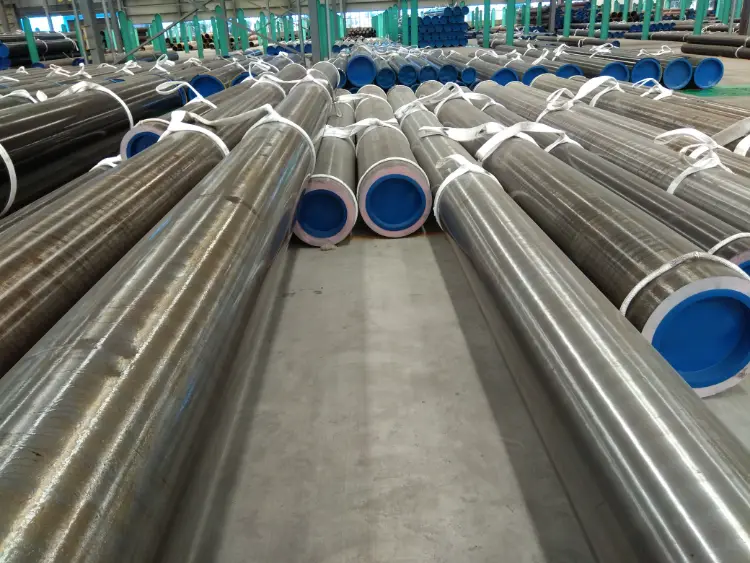
API 5L PSL2 Grade B ERW Pipe
API 5L PSL2 Grade B ERW Pipe – Composition, Properties, Equivalents & Applications
Complete material data for API 5L PSL2 Grade B ERW pipe, including chemical composition, mechanical properties, thermal and electrical physical properties, international equivalents, similar grades, and application guidance.
Electric resistance welding (ERW), hot-rolled forming, cold sizing, end finishing (beveling, threading), hot-dip galvanizing, epoxy coating
- Phone : +8618037372205
- Email : [email protected]
- WhatsApp: Contact via Whtsapp
- WeChat: +8618037372205
API 5L PSL2 Grade B ERW Pipe Introduction
API 5L PSL2 Grade B ERW pipe is a carbon steel line pipe manufactured by the electric resistance welding (ERW) process in accordance with the American Petroleum Institute specification 5L, Product Specification Level 2 (PSL2). This grade, designated as L245B in ISO 3183, is widely used for conveying oil, gas, and water in the petroleum and natural gas industries.
- Chemical composition features tightly controlled carbon and manganese levels, along with strict limits on phosphorus and sulfur to ensure good weldability and toughness. The carbon equivalent (CEIIW) is limited to a maximum of 0.43% for PSL2.
- Mechanical properties include a minimum yield strength of 245 MPa (35.5 ksi) and a minimum tensile strength of 415 MPa (60.2 ksi), combined with reliable elongation and mandatory impact toughness requirements.
- ERW pipe is produced from hot-rolled coil, formed into a cylindrical shape, and welded longitudinally using high-frequency electric resistance welding, followed by post-weld heat treatment of the weld zone. The pipe is commonly supplied in plain ends, beveled ends, or threaded ends, and can be coated for corrosion protection.
- Typical applications cover cross-country pipelines, gathering systems, distribution networks, and structural supports in onshore and offshore environments.
API 5L PSL2 Grade B ERW Pipe Chemical Composition
Chemical composition requirements for API 5L PSL2 Grade B pipe based on API Spec 5L 46th edition. The values below represent ladle analysis. Product analysis tolerances apply per the standard. The carbon equivalent CEIIW shall not exceed 0.43%. For wall thicknesses greater than 25.4 mm, slightly modified carbon content limits may apply, but the typical maximum remains 0.22%.
| Element | Composition (max, wt%) | Remarks |
|---|---|---|
| Carbon (C) | 0.22 | For PSL2, also CEIIW ≤ 0.43% |
| Manganese (Mn) | 1.20 | May be increased by 0.05% above maximum for each 0.01% decrease of carbon below maximum |
| Phosphorus (P) | 0.025 | Product analysis maximum 0.030% |
| Sulfur (S) | 0.015 | Product analysis maximum 0.020% |
| Silicon (Si) | Not specified (typical 0.15–0.35%) | Required for deoxidation; for fully killed steel Si ≥ 0.10% |
| Niobium (Nb) + Vanadium (V) + Titanium (Ti) | ≤ 0.15 | Sum of micro-alloying elements, if intentionally added |
| Copper (Cu) | ≤ 0.50 (when specified) | Only for sour service or special requirements |
| Nickel (Ni) | ≤ 0.50 (when specified) | Only for sour service or special requirements |
| Chromium (Cr) | ≤ 0.50 (when specified) | Only for sour service or special requirements |
| Molybdenum (Mo) | ≤ 0.50 (when specified) | Only for sour service or special requirements |
| Residual elements | Per standard | Total of unspecified elements ≤ 0.05% each |
API 5L PSL2 Grade B ERW Pipe Thermal and Electrical Physical Properties
Typical physical properties for carbon steel (comparable to API 5L Grade B). These values are not specified in API 5L but are representative of structural carbon‑manganese steel. They are suitable for engineering calculations such as thermal expansion stress analysis, heat transfer, and electrical grounding designs. Properties are given at room temperature unless noted otherwise.
| Property | Typical value | Unit | Condition / Remarks |
|---|---|---|---|
| Density (ρ) | 7.85 | g/cm³ | At 20°C; carbon steel typical |
| Elastic modulus (E) | 200 – 210 | GPa | Room temperature; decreases with increasing temperature |
| Shear modulus (G) | 80 – 84 | GPa | Room temperature; calculated from E and ν |
| Poisson's ratio (ν) | 0.29 – 0.30 | — | Elastic range, room temperature |
| Coefficient of thermal expansion (α) | 11.7 (20–100°C); 12.2 (20–200°C); 13.1 (20–400°C) | 10⁻⁶/K | Mean linear expansion; applicable for piping stress analysis |
| Thermal conductivity (λ) | 51.9 (20°C); 48.5 (100°C); 42.0 (300°C) | W/(m·K) | Typical for low-carbon steel; decreases at elevated temperatures |
| Specific heat capacity (cp) | 486 (20°C); 515 (100°C); 560 (300°C) | J/(kg·K) | Increases with temperature |
| Electrical resistivity (ρe) | 0.142 – 0.180 | μΩ·m | At 20°C; varies slightly with composition and heat treatment |
API 5L PSL2 Grade B ERW Pipe Mechanical Properties
Mechanical properties for API 5L PSL2 Grade B ERW pipe at room temperature. Tensile testing is performed on longitudinal strip specimens (transverse or full-section tests per agreement). Yield strength is 0.5% total extension under load for PSL2. Elongation values depend on specimen area; the formula e = 1940 A0.2/U0.9 applies (A: cross-section area in mm², U: specified minimum tensile strength in MPa). Impact testing at the design temperature or at 0°C is mandatory for PSL2 with certain dimensions – typical Charpy V-notch (CVN) values are listed for a commonly specified temperature of 0°C.
| Property | Value (minimum unless range) | Unit | Test conditions / Remarks |
|---|---|---|---|
| Yield strength (Rt0.5) | 245 – 450 | MPa (N/mm²) | Transverse or longitudinal strip, 0.5% total extension |
| Tensile strength (Rm) | 415 – 760 | MPa (N/mm²) | Room temperature, strip specimen |
| Yield to tensile ratio (Rt0.5/Rm) | ≤ 0.93 (typical max for PSL2) | — | May be specified by purchaser for some applications |
| Elongation (A50) | 22 (typical for 12.7 mm wall thickness) | % | Longitudinal specimen, gauge length 50 mm; precise value calculated by formula |
| Elongation (A2) | 28 (typical for 12.7 mm wall thickness) | % | Longitudinal specimen, gauge length 2 in. (50.8 mm) |
| Bend test (weld and base metal) | No cracks or openings ≥ 3.2 mm | — | Mandrel diameter 3T (T = specimen thickness) for base metal; 6T for weld for certain grades; 90° bend |
| Charpy impact (CVN), 10×10 mm specimen | Average ≥ 27; Single ≥ 20 | J | At 0°C (typical); other test temperatures as per purchase order |
| Charpy impact (CVN), 7.5×10 mm sub-size | Average ≥ 22; Single ≥ 16 | J | At 0°C, when wall thickness < 10 mm; conversion based on area |
| Charpy impact (CVN), 5×10 mm sub-size | Average ≥ 15; Single ≥ 11 | J | At 0°C, when wall thickness < 8 mm |
| Shear area (DWTT if required) | ≥ 85% average | % | Drop-weight tear test at design temperature, for thick wall or critical applications |
API 5L PSL2 Grade B ERW Pipe Completely Equivalent Material Standards and Substitutable Grades
| Country / Region | Standard | Grade | Remarks |
|---|---|---|---|
| International | ISO 3183 | L245B | Identical technical delivery conditions; PSL2 corresponds to Annex J level |
| European Union | EN 10208-1 | L245MB | M indicates TMCP or normalized delivery; chemical and mechanical requirements align with PSL2 |
| United States | ASTM A53 | Grade B (Type E or S) | Seamless or ERW pipe; limits on C and Mn slightly wider; not all PSL2 toughness requirements automatically met; supplementary agreement needed for Charpy |
| United States | ASTM A106 | Grade B | Seamless carbon steel pipe for high-temperature service; chemical composition similar; PSL2 impact requirements not inherent; may be used with additional testing |
| Canada | CSA Z245.1 | Grade 241 | Line pipe standard; essentially equivalent to API 5L PSL2 Grade B |
| Japan | JIS G3454 | STPG370 (Sch 40/80) | Carbon steel pressure pipe; tensile properties align with Grade B, but PSL2 toughness and chemical limits may differ; considered functional equivalent for non-sour moderate-pressure service |
| China | GB/T 9711 | L245B | Chinese national standard for line pipe; incorporates API 5L requirements |
API 5L PSL2 Grade B ERW Pipe Application Introduction
API 5L PSL2 Grade B ERW pipe is a versatile carbon steel product primarily employed in the energy and water sectors. Its combination of moderate strength, good toughness, and reliable weldability makes it ideal for long-distance transmission and structural applications. When specifying PSL2, the material guarantees stricter chemical control and mandatory fracture toughness, which is required for most modern pipeline projects.
Product Applications: Long-distance cross-country oil and gas pipelines, Flowlines and gathering lines for wellhead production, Steel casing pipes for water wells, Fire main and sprinkler systems in commercial buildings, Structural pipe for bridge piers, pile foundations, and sheet piling, Conduits for electrical and fiber optic cables
Processed into products: Line pipe sections (plain end, beveled end, threaded & coupled), Induction bends and cold-formed elbows, Tees, reducers, and caps (welded from pipe or forged), Stub ends and lap joint flanges, Pipe supports and sleepers, Anchor flanges and pup pieces, ERW pipe can be further fabricated into welded assemblies such as manifolds and templates
Application industries: Oil & gas gathering and transmission, Water and wastewater treatment, Petrochemical and refinery plant piping, Fire protection systems, Civil engineering and structural piling, Compressed air and industrial gas distribution
API 5L PSL2 Grade B ERW Pipe Similar / Alternative Material Recommendations
| Country / Region | Standard | Grade | Remarks |
|---|---|---|---|
| United States | API 5L PSL1 | Grade B | Lower specification level with less stringent chemical, mechanical and NDE requirements; suitable for lower consequence service |
| United States | API 5L PSL2 | X42 (L290) | Higher strength grade with minimum yield 290 MPa; provides similar weldability when chemistry is controlled; often used for higher pressure pipelines |
| European Union | EN 10208-2 | L290MB | Corresponds to API X42; higher strength alternative with slightly leaner chemistry; can replace Grade B if design permits thinner wall |
| United States | ASTM A135 | Grade B | Electric-resistance-welded pipe for moderate duty; lower strength (241 MPa min yield) and less stringent toughness; may be considered for non-critical water/air systems |
| United States | ASME B36.10M | ASTM A53 Gr. B (ERW) | Standard wall pipe for general structural and pressure applications; toughness testing not inherent; alternative for non-pipeline structural uses |
Notes:
Additional considerations:
- For sour service applications (H2S-containing environments), use supplementary requirements from NACE MR0175 / ISO 15156 and order API 5L Grade B with HIC/SSC testing and restricted chemistry (typically C ≤ 0.14%, S ≤ 0.003%, and micro-alloy control).
- ERW pipe weld seam should be ultrasonically or radiographically inspected as per API 5L PSL2 requirements. The weld zone undergoes heat treatment to restore toughness.
- Coating and lining options (3LPE, FBE, liquid epoxy, cement mortar lining) are frequently applied for corrosion protection.
- CEIIW limit of 0.43% ensures excellent field weldability; preheat is generally not required for wall thicknesses under 25 mm when ambient temperature is above 0°C.
- Pipe dimensions are in accordance with API 5L and ASME B36.10M. Common diameters range from 2" to 24" (DN 50 – DN 600) with wall thicknesses from Schedule 10 to XXS, or specified by the buyer.
- Share



