
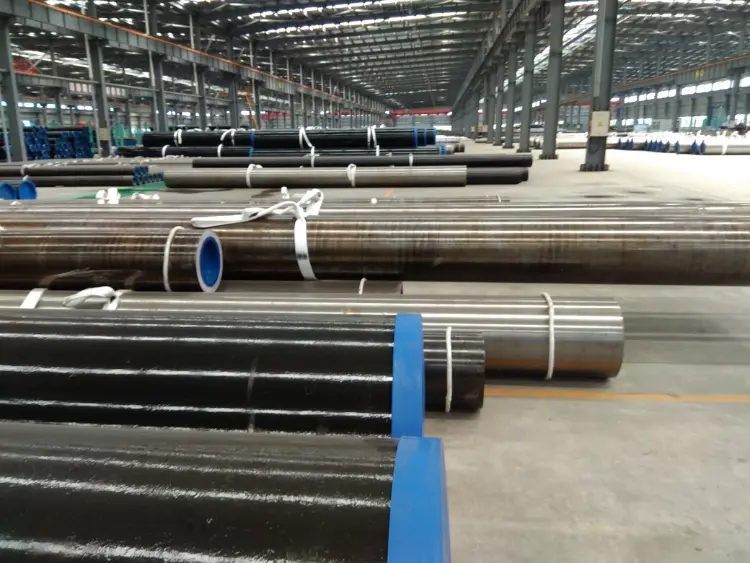
API 5L X70 PSL1 ERW Pipe
API 5L X70 PSL1 ERW Pipe: High-Strength Line Pipe for Oil and Gas Transmission
Explore the material data, chemical composition, mechanical properties, and international equivalents of API 5L X70 PSL1 ERW pipe for pipeline applications.
Electric Resistance Welding (ERW), cold forming, hot expanding (optional), and normalizing rolling or thermo-mechanical controlled process (TMCP) for the hot-rolled coil or plate.
- Phone : +8618037372205
- Email : [email protected]
- WhatsApp: Contact via Whtsapp
- WeChat: +8618037372205
API 5L X70 PSL1 ERW Pipe Introduction
API 5L X70 PSL1 ERW pipe is a high-strength carbon-manganese steel line pipe manufactured by the electric resistance welding (ERW) process. Conforming to the American Petroleum Institute (API) Specification 5L, Product Specification Level 1 (PSL1), this grade is widely used for the transportation of oil, gas, and water in pipeline systems. The minimum yield strength is 70 ksi (485 MPa), offering excellent strength-to-weight ratio and good weldability. PSL1 provides basic quality requirements without mandatory impact testing, making it suitable for applications where notch toughness is not a critical requirement. The ERW forming method ensures tight dimensional tolerances and a smooth surface finish, contributing to reliable field performance.
API 5L X70 PSL1 ERW Pipe Chemical Composition
The chemical composition for API 5L X70 PSL1 is defined by maximum limits for carbon, manganese, phosphorus, and sulfur, with additional microalloying elements used to achieve the required strength.
- The carbon equivalent is not mandatory under PSL1 unless agreed between purchaser and manufacturer, but typical CEIIW values are in the range of 0.40–0.45%.
- Residual elements (Cu, Ni, Cr, Mo) are restricted to the maximums listed, and they are not intentionally added.
- Microalloying elements (V, Nb, Ti) are added individually or in combination to refine grain size and ensure strength; the sum of these elements must not exceed 0.15%.
| Chemical Element | Standard Value (max, %) | Remark |
|---|---|---|
| Carbon (C) | 0.26 | Maximum, for welded pipe, the reduction in carbon near the weld may be lower |
| Manganese (Mn) | 1.40 | Maximum, for PSL1 this limit applies for all grades up to X70 |
| Phosphorus (P) | 0.030 | Maximum, element considered detrimental to toughness |
| Sulfur (S) | 0.030 | Maximum, element controlled for cleanliness |
| Vanadium (V) | 0.06 | Maximum when added individually; if combined with Nb or Ti, total V+Nb+Ti ≤ 0.15 |
| Niobium (Nb) | 0.06 | Maximum when added individually; combined limit 0.15 |
| Titanium (Ti) | 0.06 | Maximum when added individually; combined limit 0.15 |
| Copper (Cu) | 0.50 | Maximum, residual element |
| Nickel (Ni) | 0.50 | Maximum, residual element |
| Chromium (Cr) | 0.50 | Maximum, residual element |
| Molybdenum (Mo) | 0.15 | Maximum, residual element |
| Nitrogen (N) | 0.012 | Maximum, not listed if Al-killed, but general limit for PSL1 (optional, not mandatory) |
API 5L X70 PSL1 ERW Pipe Typical Physical Properties
The following physical properties are typical for API 5L X70 line pipe steel at ambient temperature (20 °C). These values are not specified by API 5L but are provided for reference in design and thermal analysis.
- The density of 7.85 g/cm³ is standard for carbon steel.
- Elastic and shear moduli are typical for ferritic‑pearlitic microstructures.
- Thermal expansion and conductivity depend on temperature; the listed values apply to the range 20–100 °C.
- Electrical resistivity is representative for this grade and may vary slightly with microstructure.
| Property | Typical Value | Unit | Condition / Temperature |
|---|---|---|---|
| Density (ρ) | 7.85 | g/cm³ | Room temperature |
| Elastic Modulus (E) | 205 | GPa | Room temperature, tensile |
| Shear Modulus (G) | 78 | GPa | Calculated from E and ν |
| Poisson's Ratio (ν) | 0.30 | - | Room temperature |
| Mean Coefficient of Thermal Expansion (α) | 12.0 | µm/m·°C | 20–100 °C |
| Thermal Conductivity (λ) | 45 | W/m·K | Room temperature, typical |
| Specific Heat Capacity | 486 | J/kg·K | Room temperature, typical |
| Electrical Resistivity (ρe) | 0.15 | µΩ·m | Room temperature |
API 5L X70 PSL1 ERW Pipe Mechanical Properties
The mechanical properties are determined on transverse full‑section specimens or flattened strip specimens taken from the pipe. PSL1 requires only yield strength, tensile strength, and elongation. No mandatory bend test or Charpy impact test is required for PSL1, though supplementary impact testing may be specified by the purchaser. The elongation formula for X70 depends on wall thickness; the values below represent minimum requirements for common wall thicknesses (≤ 12.7 mm).
| Property | Standard Required Value (min) | Unit | Test Condition |
|---|---|---|---|
| Yield Strength (Rt0.5) | 485 (70) | MPa (ksi) | At room temperature, transverse, 0.5% total extension under load |
| Tensile Strength (Rm) | 570 (83) | MPa (ksi) | At room temperature, transverse |
| Elongation (A50) | 22 | % | Gauge length 50 mm (2 in), wall thickness ≤ 12.7 mm; for other thicknesses refer to API 5L Table 4 |
| Yield to Tensile Ratio (Rt0.5/Rm) | 0.85 (max) | - | Not mandatory for PSL1, but often controlled to 0.85–0.93 |
| Hardness | — | HV / HRC | PSL1 has no hardness limits; typical values around 200 HV10 |
API 5L X70 PSL1 ERW Pipe Fully Equivalent Material Standards and Replaceable Grades
| Country/Region | Standard | Grade | Remark |
|---|---|---|---|
| International | ISO 3183:2019 | L485M (PSL1) | Identical mechanical and chemical requirements; M stands for thermomechanical rolling or normalizing rolling |
| China | GB/T 9711-2017 | L485M (PSL1) | Equivalent to ISO 3183, widely used for domestic pipeline projects |
| Europe | EN 10208-2:2009 | L485A | Basic quality grade comparable to PSL1, with slight differences in residual element limits and optional toughness |
| Russia | GOST R 52079-2003 | K60 (Class 1) | Similar yield strength category, but may have different chemical limits; often supplied to specific project requirements |
| India | IS 12778:2004 | X70 PSL1 | Based on API 5L; the specification mirrors the API requirements |
API 5L X70 PSL1 ERW Pipe Application Introduction
API 5L X70 PSL1 ERW pipe is primarily employed in oil and gas transmission pipelines, both onshore and offshore, where moderate strength and acceptable toughness over a wide temperature range are needed. Its good balance of strength and ductility also makes it suitable for structural applications.
- The ERW process allows cost-effective production of long pipes with consistent wall thickness, ideal for long-distance pipelines.
- PSL1 material is typically selected for low–populated areas or where governmental regulations do not require fracture propagation control.
- The pipe can be coated with fusion‑bonded epoxy (FBE), 3‑layer polyethylene, or other anti‑corrosion systems for buried service.
Product Applications: Onshore and offshore pipelines, Flowlines and gathering lines, Pipeline risers (with additional coating), Water injection lines, Casing pipes for horizontal directional drilling (HDD), Structural tubular sections (e.g., bridge supports, sign poles)
Processed into products: Line pipe segments, Pipe bends (hot induction bends) and elbows, Reducers and tees, Flanges (weld-neck) attached to the pipe, Pre-insulated bundles for subsea installations, Riser clamps and guiding supports
Application industries: Oil and gas exploration and production, Pipeline transmission (liquid and gas), Water infrastructure and utilities, Civil and structural engineering, Piling and foundation construction
API 5L X70 PSL1 ERW Pipe Close/Similar Substitute Materials and Analysis
| Country/Region | Standard | Grade | Remark / Comparison |
|---|---|---|---|
| International | API 5L PSL2 | X70M (PSL2) | Same strength level but with mandatory low-temperature impact toughness, tighter chemistry, and non-destructive testing; suitable when toughness is required |
| International | ISO 3183 PSL2 | L485M PSL2 | PSL2 equivalent with notch toughness; requires Charpy values and stricter carbon equivalent limits |
| Europe | EN 10208-2 | L485MB | PSL‑2 type with guaranteed impact properties at -20 °C or lower; the "B" suffix indicates mandatory toughness |
| USA | ASTM A572/A572M | Grade 65 (450 MPa yield) | Structural steel plate with lower strength; not suited for line pipe but usable for non‑welded structural components in contact with soil |
| International | API 5L | X65 (PSL1/PSL2) | One grade lower in strength; may be substituted if design allows lower stress, but wall thickness must be re‑evaluated |
| International | API 5L | X80 (PSL1/PSL2) | Higher strength grade, often used for high-pressure pipelines; field welding requires stricter procedures |
Notes:
- Welding considerations: ERW pipe is not seamless; the weld seam has slightly different mechanical properties and may require post-weld heat treatment for sour service or critical applications.
- Supplementary requirements: Although PSL1 does not mandate Charpy testing, many pipeline operators specify supplementary impact toughness at a defined temperature (e.g., 27 J at -10 °C) and additional NDT on the weld seam.
- Hydrostatic testing: Each length of pipe is hydrostatically tested per API 5L requirements, typically at a pressure that develops a hoop stress of 60% to 90% of specified minimum yield strength.
- Sour service: For applications involving hydrogen sulfide (H₂S), X70 PSL1 is generally not recommended because hardness and chemistry limits needed for HIC/SOHIC resistance are not guaranteed. In such cases, PSL2 with appropriate testing (e.g., HIC, SSC) should be considered.
- The data provided are based on API 5L 46th edition and typical published information; specific project requirements may differ and should be verified with the material test certificate.
- Share



