
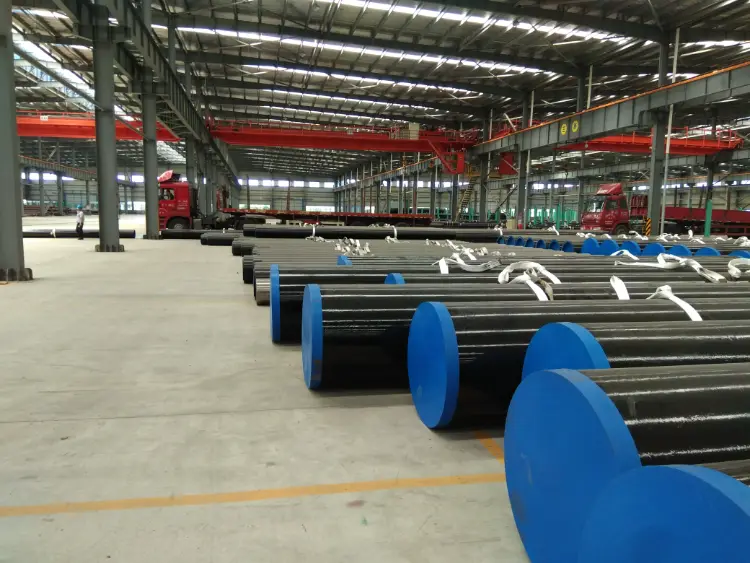
API 5L PSL1 X65 ERW Pipe
API 5L PSL1 X65 ERW Pipe - High-Strength Line Pipe for Oil & Gas Transmission
Comprehensive technical data for API 5L PSL1 Grade X65 electric-resistance-welded (ERW) pipe: chemical composition, mechanical properties, physical constants, international equivalents, and application guidance.
Hot-rolled coil → electric resistance welding → online induction heat treatment of weld seam → sizing → finishing. Secondary processes may include cold bending, beveling, coating, and threading.
- Phone : +8618037372205
- Email : [email protected]
- WhatsApp: Contact via Whtsapp
- WeChat: +8618037372205
API 5L PSL1 X65 ERW Pipe Introduction
API 5L X65 PSL1 is a high-strength, low-alloy (HSLA) line pipe steel intended for conveyance of oil, gas, and water in onshore and offshore pipelines. Produced via electric resistance welding (ERW) of hot-rolled strip, it offers a minimum yield strength of 450 MPa (65 ksi) and excellent weldability. PSL1 represents the basic product specification level, focusing on essential requirements for chemical composition and tensile properties with no mandatory impact testing. Common applications include long-distance gas transmission lines, gathering systems, and structural tubulars. The steel is generally supplied in the as-rolled or normalized condition, with the ERW seam heat-treated to ensure uniform properties around the circumference. Its balanced chemistry—with controlled carbon, manganese, phosphorus, and sulfur—provides good ductility and field weldability, making it a cost-effective choice for moderate environments where additional toughness requirements (as in PSL2) are not specified.
API 5L PSL1 X65 ERW Pipe Chemical Composition according to API 5L PSL1 X65
The ladle analysis limits for API 5L X65 PSL1 are straightforward, reflecting the less stringent PSL1 chemistry restrictions. Only carbon, manganese, phosphorus, and sulfur are regulated. Other elements may be added as micro-alloying additions (Nb, V, Ti, etc.) but are not mandated by the standard. A maximum carbon equivalent (CEIIW) of 0.43% may be applied when specified by the purchaser.
| Element | Standard Value (max, wt%) | Remarks |
|---|---|---|
| Carbon (C) | 0.26 | Ladle analysis |
| Manganese (Mn) | 1.40 | Ladle analysis |
| Phosphorus (P) | 0.030 | Ladle analysis |
| Sulfur (S) | 0.030 | Ladle analysis |
API 5L PSL1 X65 ERW Pipe Typical Physical Properties
The physical constants are not specified in API 5L and are provided here as approximate values for generic low-carbon HSLA steel. These values are useful for design calculations involving thermal expansion, heat transfer, and dynamic analysis.
| Property | Typical Value | Unit | Test Condition |
|---|---|---|---|
| Density (ρ) | 7.85 | g/cm³ | 20 °C |
| Elastic modulus (E) | 200 | GPa | Room temperature |
| Shear modulus (G) | 80 | GPa | Room temperature |
| Poisson's ratio (ν) | 0.30 | – | Room temperature |
| Thermal expansion coefficient (α) | 12.0 | 10⁻⁶/K | 20–100 °C temperature range |
| Thermal conductivity (λ) | 50 | W/(m·K) | At 100 °C |
| Specific heat capacity (cᵨ) | 460 | J/(kg·K) | At 100 °C |
| Electrical resistivity (ρₑ) | 0.15 | μΩ·m | 20 °C |
API 5L PSL1 X65 ERW Pipe Mechanical Properties
The tensile properties are mandatory for API 5L X65 PSL1. No minimum impact energy requirement exists for PSL1 unless otherwise agreed. Elongation is calculated per the standard formula A = 1940 Ax0.2 / U0.9, where Ax is the cross-sectional area of the test piece (in2) and U is the specified minimum tensile strength (ksi). For a typical longitudinal strip specimen, the minimum elongation is around 22%. The bend test shall be performed with a mandrel diameter of 2× the wall thickness for wall thickness ≤ 12.7 mm, and 2.5× for wall thickness >12.7 mm.
| Property | Standard Requirement | Unit | Test Condition |
|---|---|---|---|
| Yield strength (ReH) | min 450 (65 ksi) | MPa | Transverse or longitudinal, 0.5% total extension |
| Tensile strength (Rm) | 535 – 760 (78 – 110 ksi) | MPa | Transverse or longitudinal |
| Elongation (A) | min 22 (typical, varies with specimen area) | % | 50 mm (2 in) gauge length, longitudinal strip specimen |
| Bend test | No cracks or openings | – | 180° guided bend; mandrel diameter = 2t (t ≤ 12.7 mm) or 2.5t (t > 12.7 mm) |
API 5L PSL1 X65 ERW Pipe Fully Equivalent Material Standards & Replaceable Grades
| Country/Region | Standard | Grade | Remarks |
|---|---|---|---|
| International | ISO 3183 | L450 PSL1 | Same chemistry and tensile requirements |
| Europe | EN 10208-2 | L450OB | Basic requirement (OB) matches PSL1 |
| China | GB/T 9711 | L450 PSL1 | Direct equivalent |
API 5L PSL1 X65 ERW Pipe Application Introduction
API 5L X65 PSL1 ERW pipe is widely used in oil and gas midstream infrastructures where moderate service conditions prevail. Its weldable carbon-manganese chemistry and controlled sulfur/phosphorus levels ensure good field assembly and reliability. Typical deployment includes cross-country transmission lines, flow lines, and gathering networks for both sweet and slightly corrosive media. Owing to the ERW process, the pipe is available in long lengths with consistent dimensions, making it ideal for high-speed automatic welding and coiled pipe applications.
Product Applications: Onshore and offshore gas transmission pipelines, Crude oil and refined product flow lines, Water injection and brine disposal lines, Tubular structural elements, posts, and bollards, Coiled tubing for rehabilitation and relining
Processed into products: Pipe lengths (ERW) for mainline construction, Bends and elbows (cold formed from ERW pipe), Flanges and connectors welded to pipe ends, Supports, sleeves, and repair clamps, Roof tubes and tension members in buildings
Application industries: Oil & Gas Transmission, Water & Wastewater Transport, Petrochemical and Refinery Piping, Structural & Offshore Jackets, Piling and Foundation Support
API 5L PSL1 X65 ERW Pipe Similar/Comparable Material Alternatives
| Country/Region | Standard | Grade | Remarks |
|---|---|---|---|
| USA | ASTM A572 | Grade 65 | Structural steel with similar yield strength (450 MPa) but different chemistry and carbon equivalent limits |
| USA | API 5L | X65 PSL2 | Higher specification level with mandatory toughness and lower sulfur; suitable for tougher service |
| Europe | EN 10208-2 | L450MB | PSL2 equivalent, requiring Charpy impact and lower sulfur |
| Japan | JIS G 3474 | STKN 490W | Welded structural tube; not designed for pressure pipeline applications |
Notes:
Carbon equivalent (CEIIW) for PSL1 X65: When chemical analysis is provided for carbon equivalent compliance, the maximum limit is 0.43%. This is typically calculated as CE = C + Mn/6 + (Cr+Mo+V)/5 + (Ni+Cu)/15.
ERW Weld Integrity: The longitudinal seam is subjected to an online induction heat treatment (≥ 540 °C) to restore a fine-grained normalized microstructure and eliminate hard zones. NDT inspection (ultrasonic or eddy current) is mandated to verify seam quality.
- Share



