
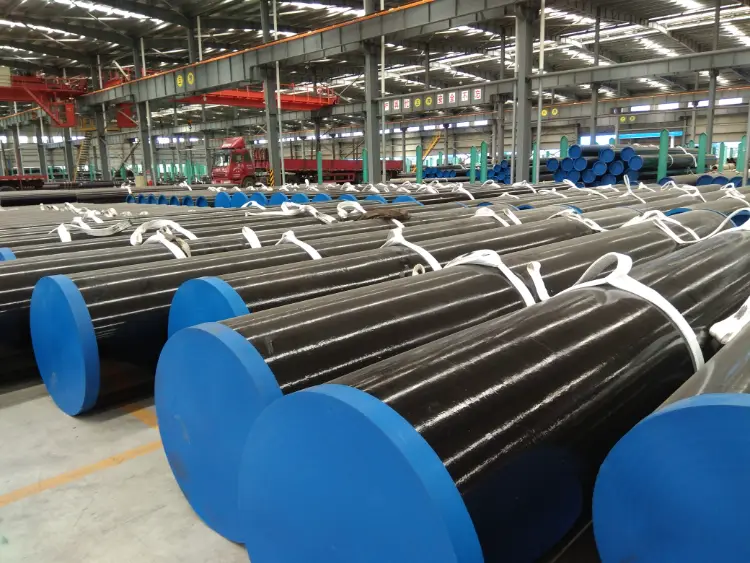
API 5L X60 PSL1 ERW Line Pipe Steel
API 5L X60 PSL1 ERW Line Pipe Steel - Properties, Equivalents & Applications
Comprehensive technical data for API 5L X60 PSL1 grade steel used in electric resistance welded (ERW) pipes for oil and gas transmission.
Welding, bending, cold expansion, hydrostatic testing, coating
- Phone : +8618037372205
- Email : [email protected]
- WhatsApp: Contact via Whtsapp
- WeChat: +8618037372205
API 5L X60 PSL1 ERW Line Pipe Steel Introduction
API 5L X60 PSL1 is a high-strength low-alloy (HSLA) steel primarily designed for welded line pipes used in transporting oil, gas, and water. With a minimum yield strength of 60,000 psi (415 MPa), it offers an excellent strength-to-weight ratio, good weldability, and adequate toughness for moderate service conditions. The PSL1 (Product Specification Level 1) designation indicates standard quality requirements without mandatory impact testing or strict chemical restrictions beyond basic limits. ERW (electric resistance welded) pipe is produced by cold-forming hot-rolled coils into a cylindrical shape and welding the longitudinal seam using high-frequency electric resistance welding. This steel grade is widely adopted globally and has equivalent designations in ISO, EN, and GB standards.
API 5L X60 PSL1 ERW Line Pipe Steel Chemical Composition
The chemical requirements for API 5L X60 PSL1 are based on cast (heat) analysis. For PSL1, only carbon, manganese, phosphorus, and sulfur are mandatory maximum limits. Other alloying elements such as niobium, vanadium, and titanium may be added at the manufacturer's discretion to meet mechanical properties. Residual elements (Cr, Ni, Cu, Mo) are typically controlled without explicit maximums in PSL1, but common industry practices limit them to ensure weldability.
| Element | Standard Requirement (wt%) | Remarks |
|---|---|---|
| C (Carbon) | ≤ 0.26 | Maximum for pipe (seamless or welded); may be lower for improved toughness and weldability |
| Mn (Manganese) | ≤ 1.35 | Maximum; typically in range 1.00–1.35 for strength |
| P (Phosphorus) | ≤ 0.030 | Maximum; lower values improve resistance to cold cracking |
| S (Sulfur) | ≤ 0.030 | Maximum; lower values improve formability and weld soundness |
| Si (Silicon) | Not specified (typical 0.15–0.35) | Added for deoxidation; not restricted by API 5L PSL1 |
| Nb (Niobium) | 0.005–0.05 (typical) | Optional microalloy for grain refinement and strength |
| V (Vanadium) | 0.02–0.10 (typical) | Optional microalloy; may be used alone or with Nb |
| Ti (Titanium) | 0.005–0.04 (typical) | Optional; for sulfide shape control and toughness |
| Cr (Chromium) | Residual ≤ 0.30 (typical) | Not normally specified; kept low for weldability |
| Ni (Nickel) | Residual ≤ 0.30 (typical) | Not normally specified |
| Cu (Copper) | Residual ≤ 0.35 (typical) | Minimal effect; sometimes added for corrosion resistance |
| Mo (Molybdenum) | Residual ≤ 0.10 (typical) | Not normally specified in PSL1 |
API 5L X60 PSL1 ERW Line Pipe Steel Physical Properties
The physical properties listed below are representative of typical carbon-manganese steel grades such as API 5L X60. These values are derived from room-temperature measurements and standard literature for similar HSLA steels. Actual properties may vary slightly depending on exact composition, heat treatment, and testing method. They are provided for engineering calculations and comparative purposes.
| Property | Standard Value | Unit | Test Condition |
|---|---|---|---|
| Density (ρ) | 7.85 | g/cm³ | At 20 °C |
| Elastic Modulus (E) | 205 | GPa | At room temperature |
| Shear Modulus (G) | 80 | GPa | At room temperature |
| Poisson's Ratio (ν) | 0.29 | — | Elastic range |
| Thermal Expansion Coefficient (α) | 11.7 × 10⁻⁶ | K⁻¹ | From 20 °C to 100 °C |
| Thermal Conductivity (λ) | 50 | W/(m·K) | At 20 °C |
| Specific Heat Capacity | 486 | J/(kg·K) | At 20 °C |
| Electrical Resistivity (ρ_e) | 0.15 × 10⁻⁶ | Ω·m | At 20 °C |
API 5L X60 PSL1 ERW Line Pipe Steel Mechanical Properties
Mechanical tests are performed on the pipe body in accordance with API 5L. For PSL1, requirements cover yield strength (Rt0.5), tensile strength (Rm), elongation (A), and bend test. Impact toughness (Charpy V-notch) is not required for PSL1 unless specified by the purchaser. Testing is usually conducted at room temperature. The yield strength is determined at 0.5% total extension under load (Rt0.5). Elongation is measured on a gauge length of 2 in. (50 mm) for rectangular specimens; minimum elongation is calculated using the API formula.
| Property | Standard Value | Unit | Test Condition |
|---|---|---|---|
| Yield Strength (Rt0.5) | ≥ 415 (60,000) | MPa (psi) | Transverse or longitudinal; for pipe body |
| Tensile Strength (Rm) | ≥ 520 (75,000) | MPa (psi) | Transverse or longitudinal; for pipe body |
| Elongation (A) | ≥ 22 (for typical wall thickness) | % | Longitudinal, 50 mm (2 in.) gauge; calculated per API formula: e = 1940 A^0.2 / UTS^0.9 |
| Bend Test | 180° bend; no cracks | — | Bend diameter = 3 × wall thickness (for t ≤ 25.4 mm) or 4 × t (for t > 25.4 mm) |
| Hydrostatic Test | 100% SMYS, minimum 20 bar | bar | Each pipe tested at mill; test pressure based on wall thickness and diameter |
| Weld Ductility | Weld seam must pass flattening test or guided bend test | — | ERW pipe – weld integrity demonstrated by flattening or bend specimens |
API 5L X60 PSL1 ERW Line Pipe Steel Exact Equivalent Material Standards and Replaceable Grades
| Country/Region | Standard | Grade | Remarks |
|---|---|---|---|
| International | ISO 3183 | L415 (formerly L415M / L415Q) | PSL 1 equivalent; L415M for pipe produced via thermomechanical rolling; L415Q for quenched and tempered (not typical for ERW) |
| Europe | EN 10208-2 | L415MB | Equivalent for welded pipes (ERW/HFI); MB denotes thermomechanical rolling |
| China | GB/T 9711 | L415 | Line pipe steel; equivalent to API 5L X60 PSL1 |
| Russia | GOST R 52079 | K60 (approximate) | Yield strength class equivalent |
| India | IS: 3589 | Fe 415 (Gr. 410) | Comparable grade for welded pipes; close but not an exact match |
API 5L X60 PSL1 ERW Line Pipe Steel Application Introduction
API 5L X60 PSL1 ERW pipes are extensively used in onshore and offshore pipeline systems for transporting natural gas, crude oil, and petroleum products. Their balanced combination of strength, weldability, and cost-effectiveness makes them a preferred choice for medium-pressure transmission lines, gathering systems, and distribution networks. The material can be fabricated into a variety of pipeline components and supports standard field coating and cathodic protection systems required for buried or submerged service.
Product Applications: Long-distance transmission pipelines, Flowlines and gathering lines, Risers (with appropriate protective coating), Water injection lines, Casing and tubular structures, Pipe piling and foundation elements
Processed into products: Line pipe spools and bends (induction bends), Tees, elbows, and reducers (hot-formed or welded), Flanges and weld-neck connectors, Anchor flanges and pig launcher/receiver barrels, Repair sleeves and mechanical connectors, Pipe bends for compressor and pump stations
Application industries: Oil & Gas (upstream, midstream), Petrochemical & Refining, Water & Wastewater Transmission, Structural and Civil Engineering (piling, jackets), Mining (slurry pipelines)
API 5L X60 PSL1 ERW Line Pipe Steel Similar or Alternative Material Recommendations
| Country/Region | Standard | Grade | Remarks |
|---|---|---|---|
| International | API 5L | X52 PSL1 | Lower strength (yield 360 MPa); may be used where lower pressure rating is acceptable |
| International | API 5L | X65 PSL1 | Higher strength (yield 450 MPa); suitable for increased operating pressure with slightly reduced toughness |
| International | API 5L | X60 PSL2 | Same strength but with enhanced chemistry, mandatory impact testing, and tighter manufacturing controls |
| Europe | EN 10208-2 | L360NB | Lower strength category; used in lieu of X52 |
| Europe | EN 10208-2 | L450MB | Close to X65; alternative for higher strength requirements |
| ISO | ISO 3183 | L360 | Lower minimum yield strength; acceptable substitute for lower pressure applications |
Notes:
Welding considerations: API 5L X60 can be welded using all common arc welding processes (SMAW, GMAW, SAW). Preheating is generally not required for wall thicknesses below 25 mm, but low-hydrogen practices are recommended to avoid hydrogen-induced cracking.
Non-destructive testing (NDT): The ERW weld seam is typically inspected by ultrasonic or electromagnetic methods; repair by welding is permitted under strict controls.
Supplementary requirements: PSL1 pipes may be ordered with optional Charpy impact tests (at 0 °C or -10 °C) and tighter chemistry limits for sour service (NACE MR0175/ISO 15156) upon agreement, requiring careful control of hardness and sulfur content.
- Share



