
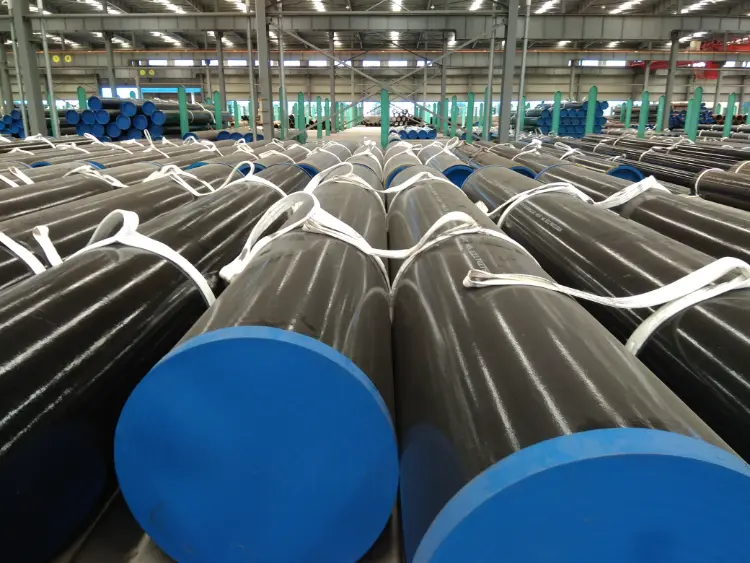
API 5L PSL1 X56 ERW Pipe
API 5L PSL1 X56 ERW Pipe: High-Strength Carbon Steel for Line Pipe Applications
Comprehensive material analysis of API 5L PSL1 X56 ERW pipe, covering chemical composition, mechanical properties, thermal and electrical physical properties, fully equivalent grades, similar alternatives, and application guidelines.
Electric Resistance Welding (ERW); cold forming, welding, possible cold expansion; suitable for bending, welding, threading, and coating.
- Phone : +8618037372205
- Email : [email protected]
- WhatsApp: Contact via Whtsapp
- WeChat: +8618037372205
API 5L PSL1 X56 ERW Pipe Introduction
API 5L X56 PSL1 ERW pipe is a high-strength carbon-manganese steel line pipe manufactured by the Electric Resistance Welding (ERW) process. It conforms to the American Petroleum Institute (API) 5L specification, Product Specification Level 1 (PSL1), which defines standard quality requirements for pipelines transporting oil, gas, and water. Grade X56 offers a minimum yield strength of 56,000 psi (386 MPa) and a minimum tensile strength of 71,000 psi (490 MPa). The steel combines good weldability, formability, and toughness, making it suitable for moderate-pressure onshore and offshore pipeline systems. PSL1 imposes less stringent chemistry and testing requirements compared to PSL2, and is typically selected for non-sour, lower-risk applications. The material is normally supplied in as-rolled or normalized condition, with options for cold expansion to improve dimensional accuracy.
API 5L PSL1 X56 ERW Pipe Chemical Composition
The chemical composition of API 5L X56 PSL1 pipe is based on heat analysis with maximum limits as shown. Only carbon, manganese, phosphorus, and sulfur are explicitly restricted for PSL1. Other elements such as silicon, niobium, vanadium, or titanium are not mandated but may be present by agreement; their addition can enhance strength and toughness. Carbon equivalent (CE) is not controlled by PSL1 unless specified by the purchaser. The values below ensure good weldability and adequate mechanical properties.
| Element | Standard Value (max %) | Remarks |
|---|---|---|
| Carbon (C) | 0.26 | For welded pipe, heat analysis |
| Manganese (Mn) | 1.35 | |
| Phosphorus (P) | 0.030 | |
| Sulfur (S) | 0.030 |
API 5L PSL1 X56 ERW Pipe Thermal and Electrical Physical Properties
The following physical properties are typical for carbon‑manganese steels similar to X56 and are not part of the API 5L specification. They serve as engineering reference data. Variations may occur based on exact chemical composition, manufacturing process, and heat treatment condition. Values are valid for room temperature unless stated otherwise.
| Property | Typical Value | Unit | Condition / Reference Temperature |
|---|---|---|---|
| Density (ρ) | 7.85 | g/cm³ | 20°C |
| Elastic Modulus (E) | 205 | GPa | 20°C |
| Shear Modulus (G) | 80 | GPa | 20°C |
| Poisson's Ratio (ν) | 0.3 | — | 20°C |
| Thermal Expansion Coeff. (α) | 11.7 | 10⁻⁶/K | 20–100°C |
| Thermal Conductivity (λ) | ≈50 | W/m·K | 20°C |
| Specific Heat Capacity | 470 | J/kg·K | 20°C |
| Electrical Resistivity (ρₑ) | ≈0.20 | µΩ·m | 20°C |
API 5L PSL1 X56 ERW Pipe Mechanical Properties
The mechanical properties are determined from tensile tests on transverse or longitudinal specimens, depending on pipe size. Yield and tensile strengths are given as minimum values; no upper limit is specified for PSL1. Elongation is calculated using the API 5L formula; a typical minimum is shown for a standard strip specimen. Bend testing is only mandatory for cold-expanded pipe. Charpy V-notch impact testing is not required for PSL1 unless agreed by the purchaser, making the material suitable for moderate-temperature, non-fracture-critical services.
| Property | Standard Requirement | Unit | Test Condition |
|---|---|---|---|
| Yield Strength (ReH/Rp0.2) | ≥386 (≥56,000) | MPa (psi) | Transverse or longitudinal strip test, room temperature |
| Tensile Strength (Rm) | ≥490 (≥71,000) | MPa (psi) | Room temperature |
| Elongation (A) | ≥22 (typical calculated value) | % | 50 mm gauge length, longitudinal strip specimen with cross-sectional area ~484 mm² (0.75 in²) |
| Guided Bend Test | No cracks | — | 180° bend, bend diameter as per API 5L; required only for cold-expanded pipe |
| Charpy V‑notch Impact (KV) | Not required | J | By agreement only; PSL1 does not mandate impact testing |
API 5L PSL1 X56 ERW Pipe Fully Equivalent Material Standards and Substitute Grades
| Country/Region | Standard | Grade | Remarks |
|---|---|---|---|
| USA / International | API 5L | X56 | Original specification, PSL1 |
| International | ISO 3183 | L386 | Technically identical to API 5L X56 |
| Canada | CSA Z245.1 | Grade 386 | Equivalent requirements for line pipe |
API 5L PSL1 X56 ERW Pipe Application Introduction
API 5L X56 PSL1 ERW pipe is widely utilized in the energy, water, and construction sectors. Its balanced strength and ductility allow it to handle moderate internal pressures and external loads. Typical applications range from large-diameter transmission lines to small-diameter gathering networks. PSL1 is often chosen for non‑critical, non‑sour environments. The pipe can be coated and field‑welded using conventional methods.
Product Applications: Cross‑country oil and gas trunk lines, Gas distribution mains, Water injection and produced water lines, Firewater ring mains, Structural pipe piles, Casing / tubing in low‑pressure wells, Offshore platform piping (non‑sour)
Processed into products: Butt‑welded pipe spools, Fittings (elbows, tees, reducers) fabricated from pipe, Flanged connections when welding neck flanges are used, Pipeline valve bodies (when supplied as pipe), Pipe piling segments, Handrail and structural tubular members (secondary)
Application industries: Oil & Gas (upstream, midstream, downstream), Water and wastewater transmission, Construction and civil engineering, Mining (slurry and water transport), Power generation (cooling water, firewater lines), Industrial process piping
API 5L PSL1 X56 ERW Pipe Similar / Alternative Material Recommendations
| Country/Region | Standard | Grade | Remarks |
|---|---|---|---|
| USA / International | API 5L | X52 | Lower yield strength (360 MPa), same PSL1 category; suitable for lower pressure applications |
| USA / International | API 5L | X60 | Higher yield strength (415 MPa); may be substituted where strength is critical |
| Europe | EN 10208-2 | L415MB | Slightly higher strength (min 415 MPa); no direct EN equivalent for 386 MPa, this is the nearest higher grade |
| Europe | EN 10208-2 | L360NB | Lower strength alternative (min 360 MPa) |
| Japan | JIS G 3444 | STK 490 | Structural carbon steel tube; not identical but similar strength range |
Notes:
Certification: All properties shall be verified by a Material Test Certificate (MTC) in accordance with API 5L.
Additional tests: PSL1 does not mandate Charpy impact, hardness, or non‑destructive electric testing; however, the purchaser may specify these as supplementary requirements.
Weld seam treatment: ERW pipe welds must be properly heat‑treated as per the standard to avoid hard zones.
Sour service limitation: X56 PSL1 is generally not intended for sour service (H2S environments). Qualification according to NACE MR0175 / ISO 15156 is required for such applications.
PSL2 upgrade: For higher integrity, fracture toughness, or sour service, consider specifying API 5L X56 PSL2 (if available from the manufacturer).
- Share



