
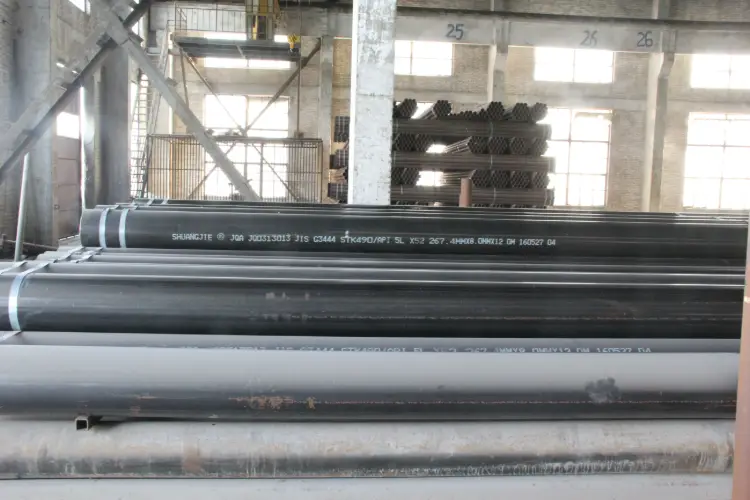
API 5L X52 PSL1 ERW Pipe
API 5L X52 PSL1 ERW Pipe: Chemical & Mechanical Properties for Line Pipe Applications
Detailed material data sheet for API 5L X52 PSL1 ERW line pipe, including chemical composition, mechanical properties, physical properties, equivalent grades, and applications.
Electric Resistance Welding (ERW)
- Phone : +8618037372205
- Email : [email protected]
- WhatsApp: Contact via Whtsapp
- WeChat: +8618037372205
API 5L X52 PSL1 ERW Pipe Introduction
API 5L X52 PSL1 ERW pipe is a medium-strength line pipe grade specified by the American Petroleum Institute standard API 5L for conveying gas, water, and oil in both onshore and offshore pipelines. It is manufactured by electric resistance welding (ERW) and belongs to product specification level 1 (PSL1), which defines basic quality requirements without mandatory impact toughness testing or restricted chemical composition limits. Typical features include:
- Minimum yield strength of 359 MPa (52 ksi) and tensile strength of 455 MPa (66 ksi)
- Good weldability and formability for pipe manufacturing
- Suitable for a wide range of wall thicknesses and diameters
- Widely used in pipeline systems for oil & gas transmission, water mains, and structural applications
API 5L X52 PSL1 ERW Pipe Chemical Composition
Chemical composition requirements for API 5L X52 PSL1 according to API 5L 46th Edition Table 5. The standard specifies only the maximum limits for carbon, manganese, phosphorus, and sulfur. Other elements such as vanadium, niobium, or titanium may be present but are not mandated or restricted for PSL1. Actual values are controlled by the manufacturer to meet mechanical properties.
| Element | Standard Value (max) | Remarks |
|---|---|---|
| Carbon (C) | 0.28 % | Ladle analysis, max |
| Manganese (Mn) | 1.40 % | Ladle analysis, max |
| Phosphorus (P) | 0.030 % | Ladle analysis, max |
| Sulfur (S) | 0.030 % | Ladle analysis, max |
API 5L X52 PSL1 ERW Pipe Thermal and Electrical Physical Properties
Typical physical properties for carbon-manganese steel similar to API 5L X52. These values are not mandatory in API 5L but are representative of the material class. They serve as guidance for engineering design, thermal analysis, and electrical applications.
| Property | Reference Value | Unit | Test Condition |
|---|---|---|---|
| Density (ρ) | 7.85 | g/cm³ | Typical for carbon steel |
| Elastic Modulus (E) | 205 | GPa | Room temperature |
| Shear Modulus (G) | 79 | GPa | Room temperature |
| Poisson's Ratio (ν) | 0.3 | — | Room temperature |
| Thermal Expansion Coefficient (α) | 12 | 10⁻⁶/K | 20°C to 100°C |
| Thermal Conductivity (λ) | 50 | W/(m·K) | Room temperature |
| Specific Heat Capacity | 486 | J/(kg·K) | Room temperature |
| Electrical Resistivity (ρₑ) | 0.15 | μΩ·m | Room temperature |
API 5L X52 PSL1 ERW Pipe Mechanical Properties
Tensile requirements for API 5L X52 PSL1 per Table 7 of API 5L 46th Ed. The yield strength is measured at 0.5% total extension under load; tensile strength is the minimum required. Elongation is calculated according to the formula in Table 8 and depends on specimen cross-sectional area. Bend test is mandatory for PSL1 pipe; impact test is not required unless by agreement. All values are for room temperature.
| Property | Standard Requirement | Unit | Test Condition |
|---|---|---|---|
| Yield Strength (ReH) | ≥359 | MPa | Transverse, 0.5% total extension under load |
| Tensile Strength (Rm) | ≥455 | MPa | Transverse, room temperature |
| Elongation (A) | According to API 5L formula | % | 50 mm gauge length, transverse specimen |
| Bend Test (Mandrel Diameter) | No cracks or openings in weld | — | 180° bend per API 5L, mandrel diameter per standard |
API 5L X52 PSL1 ERW Pipe Exact Equivalent Standards and Replaceable Grades
| Country/Region | Standard | Grade | Remarks |
|---|---|---|---|
| International | ISO 3183 | L360 | PSL1 equivalent |
| European Union | EN 10208-2 | L360 | Line pipe grade |
| China | GB/T 9711 | L360 | Equivalent to API X52 |
| Russia | GOST 52079 | K52 | Similar strength level |
API 5L X52 PSL1 ERW Pipe Application Introduction
API 5L X52 PSL1 ERW pipe is primarily used in welded pipelines for the transportation of gaseous and liquid hydrocarbons, water, and other fluids under moderate pressure conditions. It is also employed in structural applications where good weldability and mechanical strength are required. The material can be easily cut, welded, and bent for on-site fabrication.
Product Applications: Cross-country oil and gas pipelines, Gathering and distribution lines, Water mains and supply lines, Structural tubular components, Process piping in refineries and chemical plants
Processed into products: Line pipe segments (straight and spool pieces), Elbows, tees, reducers (fittings), Flanges and connectors, Casing and risers, Pipe piles and structural supports
Application industries: Oil & Gas, Petrochemical, Water & Wastewater, Construction & Infrastructure, Marine & Offshore
API 5L X52 PSL1 ERW Pipe Similar or Alternative Material Grades
| Country/Region | Standard | Grade | Remarks |
|---|---|---|---|
| USA | API 5L | X46 | Lower strength, same PSL1 |
| USA | API 5L | X56 | Higher strength line pipe |
| USA | API 5L | X52 PSL2 | Higher toughness and chemistry requirements |
Notes:
PSL1 vs PSL2: X52 PSL1 is the basic delivery condition with no mandatory Charpy impact test and only limited chemical restrictions. For applications requiring better fracture toughness, sour service resistance, or tighter chemistry, the PSL2 designation (API 5L X52 PSL2) should be considered.
Welding: ERW pipes exhibit a longitudinal weld seam; NDT of the weld is required. For critical service, supplementary testing (e.g., ultrasonic inspection of weld, hardness testing) can be specified.
Coating and lining: Often supplied with external anti-corrosion coating (3LPE, FBE) or internal epoxy lining as per project specification.
- Share



