
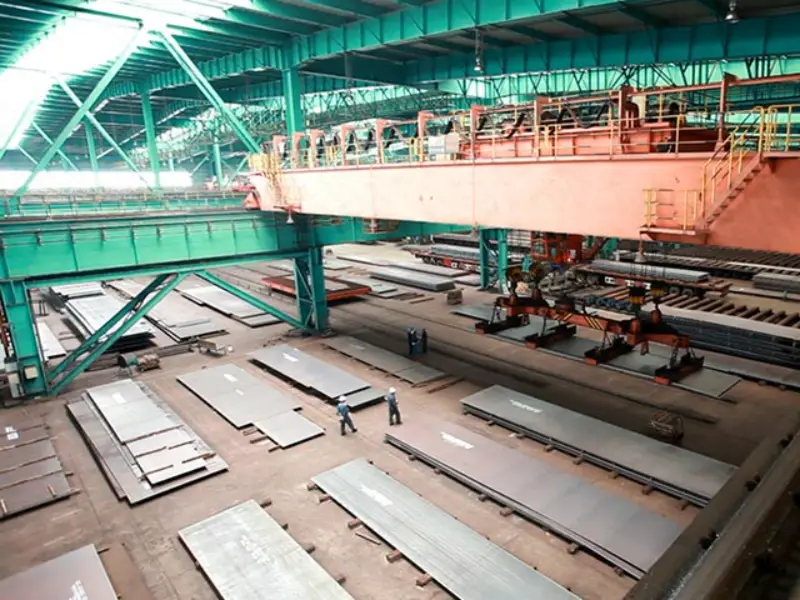
37CrS4 Steel Plate
37CrS4 Alloy Steel (EN 10083-3) - Properties, Equivalents & Applications
Detailed material data for 37CrS4 high alloy steel plate according to EN 10083-3, including chemical composition, mechanical and thermal properties, international equivalents and application guidance.
Hot rolling, forging, cold drawing, machining, quenching and tempering, induction hardening, nitriding
- Phone : +8618037372205
- Email : [email protected]
- WhatsApp: Contact via Whtsapp
- WeChat: +8618037372205
37CrS4 Steel Plate Introduction
37CrS4 is a heat-treatable chromium alloy steel defined in European standard EN 10083-3. It belongs to the quenched and tempered steels group, offering high strength, good toughness, and moderate hardenability. The material is suitable for medium to highly stressed components in automotive and general engineering.
- Nominal carbon content ~0.37% and chromium ~1.05%
- Delivers tensile strengths from 900 to 1300 MPa depending on section size
- Widely used for shafts, gears, bolts, and steering components
37CrS4 Steel Plate Chemical Composition
Chemical requirements according to EN 10083-3:2006 for heat analysis. The steel is microalloyed with chromium to improve hardenability. Sulphur content is controlled for machinability in some variants but standard limits apply.
- Carbon provides base strength and hardenability
- Chromium increases strength and wear resistance
| Element | Min (%) | Max (%) | Remarks |
|---|---|---|---|
| Carbon (C) | 0.34 | 0.41 | |
| Silicon (Si) | - | 0.40 | |
| Manganese (Mn) | 0.60 | 0.90 | |
| Phosphorus (P) | - | 0.025 | For quality classification see standard |
| Sulfur (S) | - | 0.035 | Controlled sulphur for machinability (0.020-0.040 common) |
| Chromium (Cr) | 0.90 | 1.20 | Primary alloying element |
| Molybdenum (Mo) | - | - | Not specified, may be residual |
| Nickel (Ni) | - | - | Not specified |
| Copper (Cu) | - | - | Not specified |
37CrS4 Steel Plate Thermal and Electrical Physical Properties
Typical physical properties for 37CrS4 alloy steel at room temperature unless noted. These values are derived from standard alloy steel references and are valid for the quenched and tempered condition.
- Values may vary slightly with heat treatment condition
| Property | Typical Value | Unit | Test Condition |
|---|---|---|---|
| Density (ρ) | 7.85 | g/cm³ | 20 °C |
| Modulus of elasticity (E) | 210 | GPa | 20 °C |
| Shear modulus (G) | 80 | GPa | 20 °C (estimated) |
| Poisson's ratio (ν) | 0.30 | - | 20 °C |
| Thermal expansion coefficient (α) | 11.1 × 10⁻⁶ | K⁻¹ | 20 - 100 °C |
| Thermal expansion coefficient (α) | 12.2 × 10⁻⁶ | K⁻¹ | 20 - 200 °C |
| Thermal expansion coefficient (α) | 13.5 × 10⁻⁶ | K⁻¹ | 20 - 400 °C |
| Thermal conductivity (λ) | 42 | W/(m·K) | 20 °C |
| Specific heat capacity | 460 | J/(kg·K) | 20 °C |
| Electrical resistivity (ρe) | 0.20 × 10⁻⁶ | Ω·m | 20 °C |
37CrS4 Steel Plate Mechanical Properties
Minimum mechanical properties in quenched and tempered condition (+QT) according to EN 10083-3. Values depend on ruling section diameter. Testing is performed at room temperature unless stated otherwise.
- Quenching temperature: 840-870 °C (oil or water)
- Tempering temperature: 540-680 °C depending on required strength
| Property | Standard Requirement | Unit | Test Condition |
|---|---|---|---|
| Yield strength (ReH) ≥ 900 | 900 | MPa | Diameter ≤ 16 mm |
| Tensile strength (Rm) | 1100 - 1300 | MPa | Diameter ≤ 16 mm |
| Elongation (A) ≥ 9 | 9 | % | Diameter ≤ 16 mm |
| Reduction of area (Z) ≥ 35 | 35 | % | Diameter ≤ 16 mm |
| Impact energy (KV) ≥ 25 | 25 | J | Diameter ≤ 16 mm, -20 °C |
| Yield strength (ReH) ≥ 800 | 800 | MPa | Diameter >16 ≤ 40 mm |
| Tensile strength (Rm) | 1000 - 1200 | MPa | Diameter >16 ≤ 40 mm |
| Elongation (A) ≥ 10 | 10 | % | Diameter >16 ≤ 40 mm |
| Reduction of area (Z) ≥ 40 | 40 | % | Diameter >16 ≤ 40 mm |
| Impact energy (KV) ≥ 25 | 25 | J | Diameter >16 ≤ 40 mm, -20 °C |
| Yield strength (ReH) ≥ 700 | 700 | MPa | Diameter >40 ≤ 100 mm |
| Tensile strength (Rm) | 900 - 1100 | MPa | Diameter >40 ≤ 100 mm |
| Elongation (A) ≥ 12 | 12 | % | Diameter >40 ≤ 100 mm |
| Reduction of area (Z) ≥ 45 | 45 | % | Diameter >40 ≤ 100 mm |
| Impact energy (KV) ≥ 25 | 25 | J | Diameter >40 ≤ 100 mm, -20 °C |
37CrS4 Steel Plate Full Equivalent Standards and Replaceable Grades
| Country/Region | Standard | Grade | Remarks |
|---|---|---|---|
| European Union | EN 10083-3 | 37CrS4 (1.7038) | Identical, the base standard |
| Germany | DIN EN 10083-3 | 37CrS4 (1.7038) | Direct adoption; former DIN 17200 37CrS4 |
| France | NF EN 10083-3 | 37CrS4 | Adopted European standard |
| United Kingdom | BS EN 10083-3 | 37CrS4 | Adopted European standard |
| International | ISO 683-11 | 37CrS4 | ISO equivalent; chemical and mechanical requirements match |
| Italy | UNI EN 10083-3 | 37CrS4 | Adopted European standard |
| Spain | UNE EN 10083-3 | 37CrS4 | Adopted European standard |
| Sweden | SS-EN 10083-3 | 37CrS4 | Adopted European standard |
37CrS4 Steel Plate Application Introduction
37CrS4 steel is primarily used in automotive and general mechanical engineering for components subjected to medium to high stresses. Its good combination of strength, toughness, and wear resistance after quenching and tempering makes it suitable for a wide range of dynamically loaded parts. Through-hardening up to approximately 40 mm diameter is feasible.
Typical applications include:
Product Applications: Axles and shafts, Gears and pinions, Steering knuckles, Crankshafts (medium-duty), Connecting rods, High-strength bolts and studs, Hydraulic cylinder rods
Processed into products: Transmission shafts (splined shafts), Differential gears, Steering columns, Piston rods, Flange bolts (grade 10.9/12.9 after heat treatment), Crankshaft belt pulleys, Spindles
Application industries: Automotive (powertrain, chassis), Agricultural machinery, Construction equipment, General mechanical engineering, Fastener manufacturing, Hydraulic systems
37CrS4 Steel Plate Similar/Substitute Materials Recommendations
| Country/Region | Standard | Grade | Remarks |
|---|---|---|---|
| USA | ASTM A29/A29M, SAE J404 | 5140 (UNS G51400) | Close match: C 0.38-0.43, Cr 0.70-0.90; slightly higher carbon, lower chromium. Suitable for similar applications. |
| China | GB/T 3077 | 40Cr | C 0.37-0.44, Cr 0.80-1.10; slightly higher carbon range; widely used equivalent with comparable hardenability. |
| Japan | JIS G4104 | SCr440 | C 0.38-0.43, Cr 0.90-1.20; very similar composition, replaceable in most designs. |
| Russia | GOST 4543 | 40Kh (40Х) | C 0.36-0.44, Cr 0.80-1.10; commonly used substitute. |
| Brazil | ABNT NBR 6589 | 40Cr (abnt 5140) | Similar to AISI 5140. |
Notes:
- For optimal mechanical properties, the steel should be quenched and tempered precisely following the recommended temperatures. Over-tempering may lead to loss of strength, while under-tempering may reduce toughness.
- Surface hardening by induction or flame is possible; the core remains tough.
- For improved fatigue resistance, components are often shot-peened after finishing.
- Welding is generally not recommended in the hardened and tempered condition; if necessary, preheating and post-weld heat treatment are required.
- Share



