
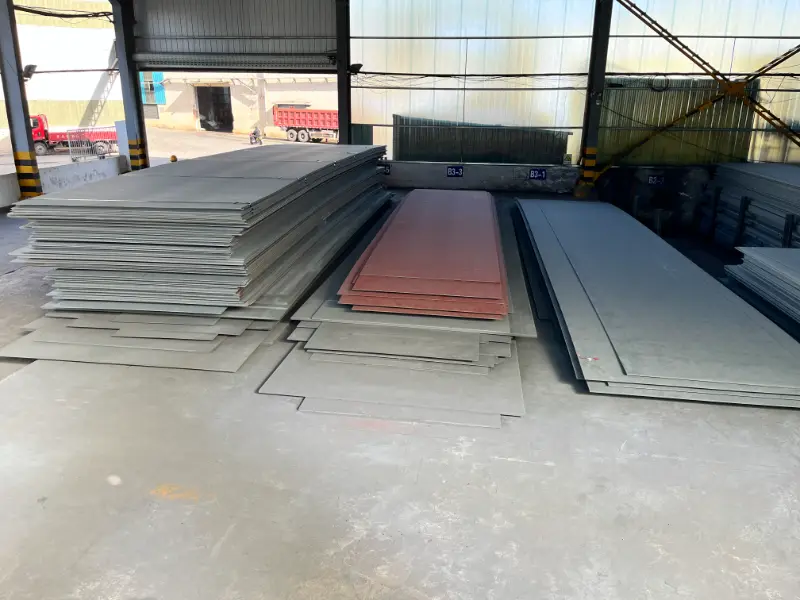
EN 10083-3 41Cr4 Alloy Steel Plate
41Cr4 High Alloy Steel Plate – EN 10083-3 Properties, Equivalents & Applications
Explore the technical profile of 41Cr4 alloy steel under EN 10083-3. Complete chemical composition, mechanical properties for quenched and tempered condition, thermal and electrical data, international equivalents, and application guidance.
Hot rolling, forging, quenching, tempering, induction hardening, machining, welding (with preheating)
- Phone : +8618037372205
- Email : [email protected]
- WhatsApp: Contact via Whtsapp
- WeChat: +8618037372205
EN 10083-3 41Cr4 Alloy Steel Plate Introduction
41Cr4 is a chromium-alloyed quenched and tempered steel defined in EN 10083-3 (material number 1.7035). It delivers a balanced combination of high strength, good toughness, and moderate hardenability, making it a cost-effective choice for medium-stressed engineering components. In the heat-treated condition, this steel exhibits minimum yield strengths of 660 MPa and tensile strengths between 800 and 950 MPa for smaller sections. Its chemical design, centered on 0.38–0.45% carbon and 0.90–1.20% chromium, ensures reliable hardenability while maintaining acceptable machinability after softening. Typical applications span the automotive and mechanical engineering sectors, including shafts, gears, connecting rods, and bolts. The grade is widely available as hot-rolled plate, bar, and forgings, and can be induction hardened for local wear resistance.
- Chromium-alloyed quenched & tempered steel
- Good strength–toughness balance
- Hardenable in water or oil
- Weldable with precautions
EN 10083-3 41Cr4 Alloy Steel Plate Chemical Composition
The ladle analysis according to EN 10083-3:2006 for grade 41Cr4. Phosphorus and sulfur are restricted to ensure cleanliness and toughness. The chromium content is optimized for hardenability.
- Data based on +QT condition requirements
- Product analysis tolerances apply per standard
| Element | Standard Value (%) | Remarks |
|---|---|---|
| Carbon (C) | 0.38 – 0.45 | Hardenability and strength |
| Silicon (Si) | ≤ 0.40 | Deoxidation element |
| Manganese (Mn) | 0.60 – 0.90 | Enhances hardenability |
| Phosphorus (P) | ≤ 0.035 | Maximum; limits embrittlement |
| Sulfur (S) | ≤ 0.035 | Maximum; improves machinability when controlled |
| Chromium (Cr) | 0.90 – 1.20 | Principal alloying element for hardenability |
| Iron (Fe) | Balance | Base element |
EN 10083-3 41Cr4 Alloy Steel Plate Thermal and Electrical Physical Properties
These physical properties are typical for Cr-Mo low-alloy steels in the quenched and tempered condition. Actual values may vary slightly depending on heat treatment and exact composition. Data compiled from EN 10083-3 supplementary technical literature and general engineering references.
- Density measured at 20 °C
- Thermal expansion values averaged over temperature ranges
- Electrical resistivity at room temperature
| Property | Standard Requirement / Typical Value | Unit | Test Condition / Reference |
|---|---|---|---|
| Density (ρ) | 7.85 | g/cm³ | 20 °C |
| Elastic modulus (E) | 210 | GPa | 20 °C |
| Shear modulus (G) | 81 | GPa | 20 °C (calculated from E and ν) |
| Poisson's ratio (ν) | 0.30 | — | Room temperature |
| Thermal expansion coefficient (α) | 11.5 | 10⁻⁶/K | 20 – 100 °C |
| Thermal expansion coefficient (α) | 12.3 | 10⁻⁶/K | 20 – 200 °C |
| Thermal expansion coefficient (α) | 13.0 | 10⁻⁶/K | 20 – 300 °C |
| Thermal conductivity (λ) | 42 | W/(m·K) | 100 °C |
| Thermal conductivity (λ) | 38 | W/(m·K) | 200 °C |
| Specific heat capacity (cp) | 460 | J/(kg·K) | 20 °C |
| Electrical resistivity (ρ_e) | 0.20 | μΩ·m | 20 °C |
EN 10083-3 41Cr4 Alloy Steel Plate Mechanical Properties
Room-temperature tensile and impact properties for quenched and tempered (+QT) condition according to EN 10083-3. Properties apply to ruling sections up to 16 mm. For thicker sections, strength values decrease; the standard provides separate tables.
- Testing on longitudinal specimens
- Charpy V-notch impact energy (ISO-V) at 20 °C
| Property | Standard Requirement | Unit | Test Condition |
|---|---|---|---|
| Yield strength (ReH) | ≥ 660 | MPa | QT, section ≤ 16 mm, room temperature |
| Tensile strength (Rm) | 800 – 950 | MPa | QT, section ≤ 16 mm, room temperature |
| Elongation after fracture (A) | ≥ 13 | % | QT, section ≤ 16 mm, room temperature (L0=5.65√S0) |
| Reduction of area (Z) | ≥ 35 | % | QT, section ≤ 16 mm |
| Impact energy (KV) (ISO-V) | ≥ 35 | J | QT, section ≤ 16 mm, +20 °C, longitudinal |
EN 10083-3 41Cr4 Alloy Steel Plate Direct Equivalent Grades and Substitution Recommendations
| Country / Region | Standard | Grade | Remarks |
|---|---|---|---|
| Germany | DIN 17200 / EN 10083-3 | 41Cr4 (1.7035) | Identical chemical and mechanical requirements |
| China | GB/T 3077 | 40Cr | Slightly different Mn range but fully interchangeable after same heat treatment |
| Japan | JIS G4053 | SCr440 | Closely matches 41Cr4; minor adjustment in carbon range |
| USA | ASTM A29 / AISI | 5140 | Similar chromium steel; equivalent properties in QT condition |
| International | ISO 683-1 | 41Cr4 | Same designation as EN; chemical composition harmonized |
EN 10083-3 41Cr4 Alloy Steel Plate Application Introduction
41Cr4 is a versatile alloy steel used primarily in the quenched and tempered condition. It provides reliable mechanical properties for a wide range of medium-duty components. Because of its balanced hardenability, it can be through-hardened in small sections or surface-hardened by induction or flame. Soft-annealed machining is possible, while welding requires preheating and post-weld heat treatment to avoid cold cracking. The steel is commonly employed where a tensile strength of 800–1000 MPa is required.
- Suitable for oil and water quenching
- Good fatigue strength after proper heat treatment
- Can be nitrided to improve surface wear resistance
Product Applications: Drive shafts and axles, Transmission shafts, Steering knuckles, Connecting rods, Crankshafts (medium size), Gears and pinions, Bolts, studs and high-strength fasteners, Hydraulic cylinder rods, Machine tool spindles
Processed into products: Automotive half shafts and propeller shafts, Forged steering arms, Compressor crankshafts, Induction-hardened gear wheels, Piston rods for shock absorbers, High-strength dowel pins and U-bolts, Machine leadscrews, Coupling hubs and splined shafts
Application industries: Automotive and transportation, General mechanical engineering, Drive and gear technology, Agricultural machinery, Oil and gas equipment (limited corrosive environment)
EN 10083-3 41Cr4 Alloy Steel Plate Nearest Alternative / Similar Materials
| Country / Region | Standard | Grade | Remarks |
|---|---|---|---|
| Germany / EU | EN 10083-3 | 42CrMo4 (1.7225) | Higher hardenability due to Mo addition; used for thicker sections or higher strength demands |
| Germany / EU | EN 10083-3 | 34Cr4 (1.7033) | Lower carbon version; better weldability and toughness, lower strength |
| USA | ASTM A29 | 5145 | Slightly higher carbon; can reach greater surface hardness after induction hardening |
| Japan | JIS G4053 | SCr435 | 0.33–0.38% C; often used where 41Cr4 strength is not required but similar chromium level needed |
| China | GB/T 3077 | 45Cr | Higher carbon (0.42–0.49%); comparable after quenching but slightly more brittle |
Notes:
- Heat treatment: austenitize at 830–860 °C, quench in oil or water, temper according to desired strength (typically 540–660 °C tempering for maximum toughness).
- Hardness in +QT condition: about 245–295 HBW (depending on tempering temperature).
- Surface hardening: flame or induction hardening to 56–62 HRC possible after quenching and tempering.
- Weldability: limited; preheating to 200–300 °C and stress-relief annealing recommended.
- Deliverable forms: hot-rolled plate up to 150 mm thickness; round bars up to 500 mm diameter.
- For sections >16 mm, the mechanical property requirements are reduced; refer to EN 10083-3 tables.
- Share



