
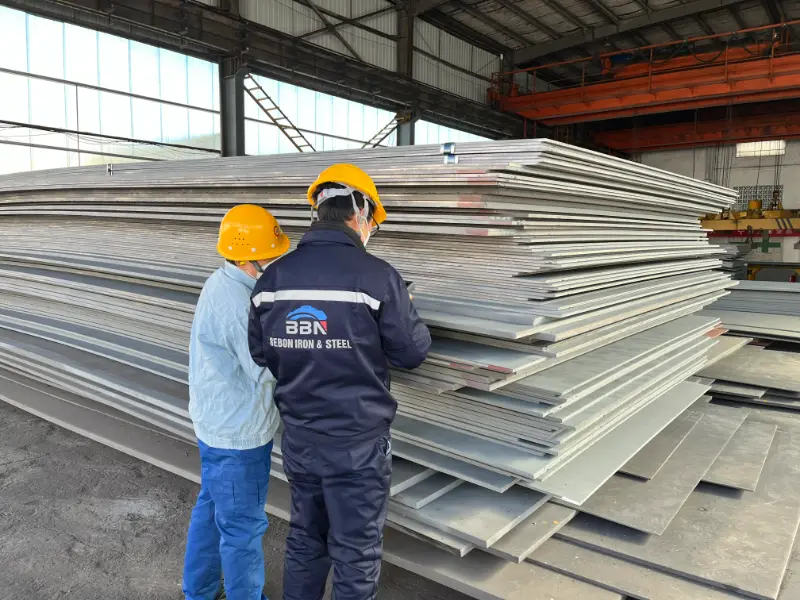
17Mn4 Pressure Vessel Steel Plate
17Mn4 Pressure Vessel Steel Plate - DIN 17155 Analysis
Detailed analysis of 17Mn4 steel plate per DIN 17155 standard, including chemical composition, mechanical and thermal properties, international equivalents, and application guidance for pressure vessel and boiler manufacturing.
Welding, hot forming, cold forming, machining
- Phone : +8618037372205
- Email : [email protected]
- WhatsApp: Contact via Whtsapp
- WeChat: +8618037372205
17Mn4 Pressure Vessel Steel Plate Introduction
17Mn4 is a normalized carbon-manganese steel specified in DIN 17155 for welded pressure vessels and boilers. It offers good weldability, moderate strength, and excellent toughness at service temperatures up to 400°C. The steel is characterized by its fine grain structure and controlled composition, ensuring reliable performance under pressure.
- Key features: high yield strength (≥295 MPa for thin plates), good ductility, and impact resistance at low temperatures.
- Suitable for fabricating boiler drums, pressure vessels, and heat exchangers.
17Mn4 Pressure Vessel Steel Plate Chemical Composition
The chemical composition of 17Mn4 steel according to DIN 17155 ensures balanced properties for pressure vessel service. The controlled carbon and manganese contents provide the required strength and weldability, while low levels of sulfur and phosphorus guarantee good ductility and toughness. Aluminum is added as a grain refiner.
| Chemical Element | Typical Value (wt%) | Remarks |
|---|---|---|
| Carbon (C) | 0.14 – 0.20 | Strengthener; higher carbon increases hardness. |
| Silicon (Si) | ≤ 0.50 | Deoxidizer; improves strength. |
| Manganese (Mn) | 0.90 – 1.20 | Increases hardenability and wear resistance. |
| Phosphorus (P) | ≤ 0.035 | Impurity; limited for toughness. |
| Sulfur (S) | ≤ 0.030 | Impurity; limited for ductility. |
| Aluminum (Altotal) | ≥ 0.020 | Grain refiner; ensures fine grain structure. |
| Chromium (Cr) | ≤ 0.30 | Residual element; not deliberately added. |
| Nickel (Ni) | ≤ 0.30 | Residual element. |
| Copper (Cu) | ≤ 0.30 | Residual element; can affect hot workability. |
| Molybdenum (Mo) | ≤ 0.10 | Residual element. |
| Nitrogen (N) | ≤ 0.012 | Usually bound by aluminum as nitride. |
17Mn4 Pressure Vessel Steel Plate Thermal and Electrical Physical Properties
Typical physical properties at room temperature unless otherwise stated. These values are for estimation purposes and may vary slightly depending on exact composition and heat treatment.
| Property | Typical Value | Unit | Conditions |
|---|---|---|---|
| Density (ρ) | 7850 | kg/m³ | At 20 °C |
| Modulus of Elasticity (E) | 200 – 210 | GPa | At 20 °C, static |
| Shear Modulus (G) | 80 | GPa | Calculated |
| Poisson's Ratio (ν) | 0.30 | – | Elastic range |
| Thermal Expansion Coefficient (α) | 11.5 | 10⁻⁶/K | 20–100 °C |
| Thermal Expansion Coefficient (α) | 12.5 | 10⁻⁶/K | 20–200 °C |
| Thermal Expansion Coefficient (α) | 13.0 | 10⁻⁶/K | 20–300 °C |
| Thermal Conductivity (λ) | 50 | W/(m·K) | At 20 °C |
| Specific Heat Capacity (cp) | 460 | J/(kg·K) | At 20 °C |
| Electrical Resistivity (ρe) | 0.23 | 10⁻⁶ Ω·m | At 20 °C |
17Mn4 Pressure Vessel Steel Plate Mechanical Properties
Mechanical properties are determined at room temperature on transverse test pieces according to EN 10002-1. The minimum values for yield strength and tensile strength vary with plate thickness. Impact tests are performed on Charpy-V specimens at specified temperatures. Bend tests demonstrate formability.
| Property | Required Value | Unit | Test Conditions |
|---|---|---|---|
| Yield Strength (ReH) | ≥ 295 | MPa | Thickness ≤ 16 mm, room temperature, transverse |
| Tensile Strength (Rm) | 460 – 580 | MPa | Thickness ≤ 16 mm, room temperature, transverse |
| Elongation (A5) | ≥ 22 | % | Gauge length 5.65√S0, room temperature |
| Yield Strength (ReH) | ≥ 285 | MPa | 16 < t ≤ 40 mm, room temperature, transverse |
| Tensile Strength (Rm) | 450 – 570 | MPa | 16 < t ≤ 40 mm, room temperature, transverse |
| Elongation (A5) | ≥ 22 | % | Gauge length 5.65√S0, room temperature |
| Yield Strength (ReH) | ≥ 275 | MPa | 40 < t ≤ 60 mm, room temperature, transverse |
| Tensile Strength (Rm) | 450 – 570 | MPa | 40 < t ≤ 60 mm, room temperature, transverse |
| Elongation (A5) | ≥ 21 | % | Gauge length 5.65√S0, room temperature |
| Impact Energy (KV, 0°C) | ≥ 27 | J | Charpy-V, longitudinal, average of 3 specimens |
| Impact Energy (KV, -20°C) | ≥ 27 | J | Charpy-V, longitudinal, optional requirement (if specified) |
| Bend Test (180°) | No cracks | Bend mandrel diameter D=2a for t ≤ 20 mm, D=3a for t > 20 mm |
17Mn4 Pressure Vessel Steel Plate Exact Equivalent Material Standards and Replaceable Grades
| Country/Region | Standard | Grade | Remarks |
|---|---|---|---|
| Europe | EN 10028-2 | P295GH | Direct replacement for 17Mn4; harmonized European standard. |
| Germany (original) | DIN 17155 | 17Mn4 | Original standard, now superseded by EN 10028-2. |
17Mn4 Pressure Vessel Steel Plate Application Introduction
17Mn4 steel plates are extensively used in the fabrication of welded pressure vessels, boilers, and industrial tanks for the energy and process industries. Its balanced properties allow safe operation under elevated temperatures and moderate pressures. The steel can be cold or hot formed and welded using standard procedures, requiring preheating for thick sections and subsequent stress relief if necessary.
Product Applications: Boiler drums and headers, Pressure vessel shells and heads, Heat exchangers, Storage tanks (ammonia, LPG, etc.), Autoclaves and reactors, Pipe components and flanges
Processed into products: Shell plates rolled and welded, Dished ends (spun or pressed), Tube sheets, Nozzles and reinforcement pads, Support skirts and saddles, Manhole and handhole frames
Application industries: Power generation (thermal, nuclear, combined heat and power), Petrochemical and chemical processing, Oil and gas (storage, separation vessels), Pulp and paper (digesters, recovery boilers), Food and beverage (sterilizers, brewing kettles)
17Mn4 Pressure Vessel Steel Plate Similar/Alternative Materials with Comparable Properties
| Country/Region | Standard | Grade | Remarks |
|---|---|---|---|
| USA | ASTM A516/A516M | Grade 70 | Similar Mn content and tensile properties; normalized, for pressure vessels at moderate and lower temperatures. |
| Japan | JIS G3103 | SB480M | Carbon-manganese boiler steel; comparable strength, normally supplied normalized. |
| China | GB/T 713 | Q345R (formerly 16MnR) | Chinese pressure vessel steel with nominal C-Mn composition, similar yield strength and weldability. |
| UK (obsolete) | BS 1501 | 224-490A | Historical equivalent to 17Mn4; now replaced by EN standards. |
Notes:
Post-weld heat treatment (PWHT) may be required per application codes (e.g., ASME, EN 13445) to relieve residual stresses. Maximum service temperature is typically limited to 400 °C due to creep considerations. For sour service or hydrogen-induced cracking resistance, additional testing per NACE MR0175 may be specified. The plate surface is usually supplied as-rolled, blasted, or primed. Warning: This data is based on the superseded DIN 17155 standard; current projects should reference EN 10028-2 for compliance.
- Share



