
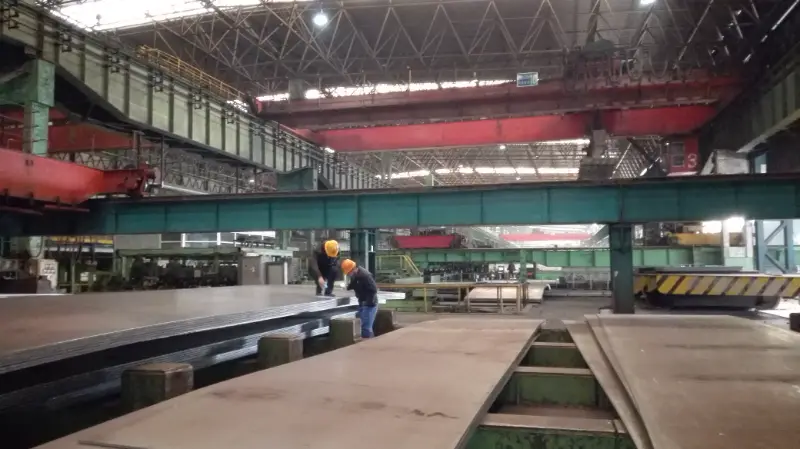
16MnDR Low Temperature Pressure Vessel Steel
16MnDR Low Temperature Pressure Vessel Steel - Complete Material Data & International Equivalents
In-depth analysis of GB/T 3531 16MnDR: chemical composition, mechanical properties at low temperature, thermal and electrical physical data, full international equivalents, and application guide for pressure vessels and boilers.
Hot rolling, normalizing, normalizing and tempering
- Phone : +8618037372205
- Email : [email protected]
- WhatsApp: Contact via Whtsapp
- WeChat: +8618037372205
16MnDR Low Temperature Pressure Vessel Steel Introduction
16MnDR is a China-originated low-alloy steel plate designed for low-temperature pressure vessels and boilers, standardized under GB/T 3531. The designation "DR" specifies its suitability for low temperature service (down to -40°C). It combines a manganese-silicon base with microalloying elements to achieve a fine-grained ferritic-pearlitic structure after normalizing. The steel is characterized by
- Excellent notch toughness at low temperatures with guaranteed Charpy impact energy ≥47 J at -40°C
- Good weldability with proper preheat and post-weld heat treatment procedures
- Moderate strength levels (yield ≥315 MPa for thickness ≤16 mm) and fine ductility (elongation ≥21%)
- Uniform properties through normalizing or normalizing-plus-tempering heat treatments
- Widely used in petrochemical, energy and gas storage sectors for LPG tanks, reactors and cryogenic equipment
16MnDR Low Temperature Pressure Vessel Steel Chemical Composition
The composition of 16MnDR as required by GB/T 3531-2014. Maximum limits for impurities and residual elements are tight to ensure cleanliness and low-temperature toughness. Total aluminium (Alt) is specified to guarantee fine grain practice. No intentional addition of boron or calcium.
| Element | Specified Value (wt.%) | Remarks |
|---|---|---|
| Carbon (C) | ≤ 0.20 | |
| Silicon (Si) | 0.15 – 0.50 | |
| Manganese (Mn) | 1.20 – 1.60 | |
| Phosphorus (P) | ≤ 0.020 | Low P for cold toughness |
| Sulfur (S) | ≤ 0.010 | Very low S for cleanliness |
| Nickel (Ni) | ≤ 0.40 | Residual/tramp |
| Chromium (Cr) | ≤ 0.30 | |
| Copper (Cu) | ≤ 0.25 | |
| Molybdenum (Mo) | ≤ 0.08 | |
| Niobium (Nb) | ≤ 0.05 | Microalloy for grain refinement |
| Vanadium (V) | ≤ 0.05 | |
| Titanium (Ti) | ≤ 0.030 | |
| Aluminium total (Alt) | ≥ 0.020 | Grain refining element |
16MnDR Low Temperature Pressure Vessel Steel Thermal and Electrical Physical Properties
The following physical constants are not specified in the product standard but are representative of normalized 16MnDR (0.20% C, 1.4% Mn) steel in the temperature range of interest. These values are useful for design calculations including heat transfer, thermal stress, and electrical applications.
| Property | Typical Value | Unit | Test Condition / Remarks |
|---|---|---|---|
| Density (ρ) | 7.85 | g/cm³ | At 20°C |
| Elastic modulus (E) | 205 | GPa | At room temperature |
| Shear modulus (G) | 79 | GPa | Calculated from E and ν |
| Poisson's ratio (ν) | 0.3 | — | In elastic range |
| Thermal expansion coefficient (α), 20–100°C | 11.5 | 10⁻⁶/K | Average linear expansion |
| Thermal expansion coefficient (α), 20–200°C | 12.0 | 10⁻⁶/K | |
| Thermal expansion coefficient (α), 20–300°C | 12.5 | 10⁻⁶/K | |
| Thermal conductivity (λ) | 53 | W/(m·K) | At 20°C; value decreases with temperature |
| Specific heat capacity (cp) | 480 | J/(kg·K) | At 20–100°C |
| Electrical resistivity (ρe) | 0.18 | μΩ·m | At 20°C |
16MnDR Low Temperature Pressure Vessel Steel Mechanical Properties
Mechanical properties per GB/T 3531-2014. The steel must fulfill both tensile and Charpy V-notch impact requirements at -40°C. Test specimens are taken in the transverse direction unless otherwise agreed. Bending test is required for quality verification.
| Property & Condition | Required Value | Unit | Test Condition / Remarks |
|---|---|---|---|
| Yield strength ReH (thickness ≤16 mm) | ≥ 315 | MPa | Room temperature, transverse |
| Yield strength ReH (thickness >16–36 mm) | ≥ 295 | MPa | Room temperature, transverse |
| Yield strength ReH (thickness >36–60 mm) | ≥ 285 | MPa | Room temperature, transverse |
| Yield strength ReH (thickness >60–100 mm) | ≥ 265 | MPa | Room temperature, transverse |
| Yield strength ReH (thickness >100–120 mm) | ≥ 255 | MPa | Room temperature, transverse |
| Tensile strength Rm (thickness ≤16 mm) | 490 – 620 | MPa | Room temperature, transverse |
| Tensile strength Rm (thickness >16–36 mm) | 470 – 600 | MPa | |
| Tensile strength Rm (thickness >36–60 mm) | 460 – 590 | MPa | |
| Tensile strength Rm (thickness >60–100 mm) | 450 – 580 | MPa | |
| Tensile strength Rm (thickness >100–120 mm) | 440 – 570 | MPa | |
| Elongation after fracture A (all thicknesses) | ≥ 21 | % | Gauge length 5.65√S0 |
| Charpy impact energy KV2 at -40°C | ≥ 47 (individual min. 33) | J | Longitudinal, V-notch |
| Bend test (thickness ≤16 mm) | d = 2a | — | Bend angle 180° ; no cracks |
| Bend test (thickness >16 mm) | d = 3a | — | d: former diameter, a: specimen thickness |
16MnDR Low Temperature Pressure Vessel Steel Fully Equivalent Material Standards and Substitute Grades
| Country/Region | Standard | Grade | Remarks |
|---|---|---|---|
| China | GB/T 3531 | 16MnDR | Original specification; -40°C impact |
| European Union | EN 10028-3 | P355NL1 (1.0566) | Matched chemical and mechanical properties; specifies -40°C impact |
| International | ISO 9328-3 | P355NL1 | Harmonized with EN 10028-3, identical requirements |
| USA | ASTM A537/A537M | Class 1 (with supplementary S5 impact test at -40°C) | By ordering with Charpy test at -34°C or -40°C; chemistry slightly different but performance equivalent after normalizing |
| Japan | JIS G3115 | SPV355 (with low-temperature qualification) | Must specify Charpy at -40°C and restrict thickness to ensure equivalence |
16MnDR Low Temperature Pressure Vessel Steel Application Introduction
16MnDR is engineered for welded pressure-containing components that operate at sub-zero temperatures down to -40°C. Its good balance of strength, ductility and low-temperature toughness makes it a workhorse in the following fields:
Product Applications: Liquefied petroleum gas (LPG) spherical and bullet tanks, Cryogenic pressure vessels for liquid ethylene or propylene, Low-temperature heat exchangers and condensers, Boiler shells and steam drums for refrigeration plants, Storage tanks for anhydrous ammonia and other liquefied gases
Processed into products: Vessel shells and heads (dished, elliptical), Nozzle reinforcement pads and flanges, Tube sheets for shell-and-tube heat exchangers, Structural supports and skirts for cryogenic equipment, Manway covers and access doors
Application industries: Oil & Gas (LPG, LNG, and ammonia storage), Petrochemical and chemical processing (low-temperature reactors, separation columns), Power generation (boiler drums, economizers in cryogenic circuits), Industrial gas manufacture and distribution (air separation units, ethylene storage), Food and beverage (CO₂ storage vessels)
16MnDR Low Temperature Pressure Vessel Steel Similar/Comparable Materials with Close Properties
| Country/Region | Standard | Grade | Remarks |
|---|---|---|---|
| China | GB/T 3531 | 09MnNiDR | Lower Mn, contains Ni; designed for -70°C service; a colder-service alternative to 16MnDR |
| China | GB/T 713 | Q345R | Common pressure vessel steel for moderate temperatures (impact usually at 0°C or -20°C); not for -40°C unless specially tested |
| USA | ASTM A516/A516M | Grade 70 | Similar tensile properties but impact test normally at -46°C only when specified; may replace 16MnDR after supplementary agreement |
| European Union | EN 10028-3 | P275NL1 | Lower strength grade (yield ~275 MPa) for low temperature; a weaker but tough alternative |
| European Union | EN 10028-3 | P460NL1 | Higher strength grade (yield ~460 MPa) for low temperature; for demanding designs where strength is critical |
Notes:
- All mechanical test data refer to room temperature unless stated otherwise.
- The impact test temperature of -40°C is a mandatory requirement; values must be met both on individual specimens (min 33 J) and as an average (≥47 J).
- Welding procedures must follow appropriate standards such as AWS D1.1 or EN ISO 15614, with low-hydrogen consumables and controlled preheat (typically 100–150°C depending on thickness).
- Post-weld heat treatment (PWHT) may be required by design codes (e.g., ASME BPVC Section VIII) for thick sections or service conditions.
- Surface condition: plates are delivered with mill scale unless shot blasted or primed by agreement.
- For vacuum service or hydrogen service, additional tests such as ultrasonic testing (UT) to ASTM A435 or A578 may be specified.
- Share



