
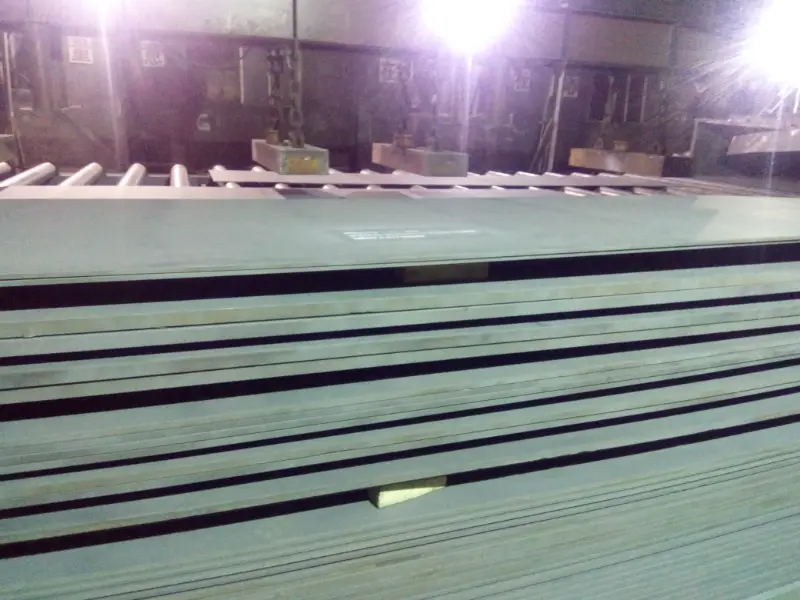
GB713 12Cr1MoVR Pressure Vessel Steel
GB713 12Cr1MoVR Pressure Vessel & Boiler Steel Plate | Cr-Mo-V Alloy for High-Temperature Service
Explore detailed data on 12Cr1MoVR steel plate under GB713 standard: chemical composition, mechanical properties, thermal and electrical physical properties, international equivalents, and application guide for pressure vessels and boilers.
Hot rolling, controlled rolling, normalizing + tempering, welding, cold forming (limited)
- Phone : +8618037372205
- Email : [email protected]
- WhatsApp: Contact via Whtsapp
- WeChat: +8618037372205
GB713 12Cr1MoVR Pressure Vessel Steel Introduction
GB713 12Cr1MoVR is a chromium-molybdenum-vanadium alloy steel plate designed for pressure vessels and boilers operating at elevated temperatures. It is produced in accordance with the Chinese standard GB/T 713-2014. The addition of vanadium refines the grain structure and enhances high-temperature strength and creep resistance, making it suitable for service up to approximately 550°C. The steel offers a balanced combination of strength, toughness, and weldability, and is typically supplied in the normalized plus tempered condition. It is widely used in the fabrication of steam drums, reactors, heat exchangers, and other critical pressure-containing components in the power generation, petrochemical, and chemical processing industries.
GB713 12Cr1MoVR Pressure Vessel Steel Chemical Composition
The chemical composition of 12Cr1MoVR steel plate as specified in GB/T 713-2014. Vanadium is added to improve high-temperature strength and creep resistance. Strict limits on phosphorus and sulfur ensure good toughness and weldability. The total aluminum content is specified to guarantee fine grain size.
| Element | Standard Value (wt%) | Remarks |
|---|---|---|
| Carbon (C) | 0.08 - 0.15 | Key strengthening element |
| Silicon (Si) | 0.15 - 0.40 | Deoxidizer, improves strength |
| Manganese (Mn) | 0.40 - 0.70 | Contributes to hardenability and strength |
| Phosphorus (P) | ≤ 0.025 | Controlled for toughness |
| Sulfur (S) | ≤ 0.010 | Controlled for ductility and weldability |
| Chromium (Cr) | 0.90 - 1.20 | Provides oxidation and corrosion resistance, enhances hardenability |
| Molybdenum (Mo) | 0.25 - 0.35 | Increases high-temperature strength and creep resistance |
| Vanadium (V) | 0.15 - 0.30 | Grain refiner, improves high-temperature strength |
| Copper (Cu) | ≤ 0.20 | Residual element |
| Nickel (Ni) | ≤ 0.25 | Residual element |
| Aluminum (Alt) | ≥ 0.020 | Total aluminum for grain refinement |
GB713 12Cr1MoVR Pressure Vessel Steel Thermal and Electrical Physical Properties
Typical physical properties for 12Cr1MoVR steel at room temperature and elevated temperatures. These values are representative of the 12Cr1MoV grade and may vary slightly depending on the exact heat treatment condition. Data are useful for design calculations involving thermal stress, heat transfer, and electrical resistance.
| Property | Typical Value | Unit | Test Condition / Temperature |
|---|---|---|---|
| Density (ρ) | 7.85 | g/cm³ | 20°C |
| Modulus of Elasticity (E) | 210 | GPa | 20°C |
| Shear Modulus (G) | 81 | GPa | 20°C |
| Poisson's Ratio (ν) | 0.30 | - | 20°C |
| Coefficient of Thermal Expansion (α) | 11.2 | 10⁻⁶/K | 20 - 100°C |
| Coefficient of Thermal Expansion (α) | 11.9 | 10⁻⁶/K | 20 - 200°C |
| Coefficient of Thermal Expansion (α) | 12.5 | 10⁻⁶/K | 20 - 300°C |
| Coefficient of Thermal Expansion (α) | 13.0 | 10⁻⁶/K | 20 - 400°C |
| Coefficient of Thermal Expansion (α) | 13.4 | 10⁻⁶/K | 20 - 500°C |
| Thermal Conductivity (λ) | 36.0 | W/(m·K) | 20°C |
| Thermal Conductivity (λ) | 34.0 | W/(m·K) | 100°C |
| Thermal Conductivity (λ) | 31.5 | W/(m·K) | 200°C |
| Thermal Conductivity (λ) | 29.0 | W/(m·K) | 300°C |
| Thermal Conductivity (λ) | 27.0 | W/(m·K) | 400°C |
| Thermal Conductivity (λ) | 25.5 | W/(m·K) | 500°C |
| Specific Heat Capacity (c) | 460 | J/(kg·K) | 20°C |
| Electrical Resistivity (ρ_e) | 0.25 | 10⁻⁶ Ω·m | 20°C |
GB713 12Cr1MoVR Pressure Vessel Steel Mechanical Properties
Tensile properties and impact toughness at room temperature per GB/T 713-2014. The test specimens are taken in the transverse direction. Yield strength is the lower yield strength (ReL). Charpy V-notch impact test is performed at 0°C on standard 10x10 mm specimens. Bend test demonstrates good formability without cracking.
| Property | Specified Value | Unit | Test Condition |
|---|---|---|---|
| Tensile Strength (Rm) | 440 - 590 | MPa | Room temperature, transverse |
| Yield Strength (ReL), thickness ≤ 60 mm | ≥ 255 | MPa | Room temperature, transverse |
| Yield Strength (ReL), thickness > 60-100 mm | ≥ 235 | MPa | Room temperature, transverse |
| Elongation (A), thickness ≤ 60 mm | ≥ 19 | % | Gauge length 5.65√So, room temperature |
| Elongation (A), thickness > 60-100 mm | ≥ 19 | % | Gauge length 5.65√So, room temperature |
| Impact Energy (KV2) | ≥ 34 | J | 0°C, Charpy V-notch, transverse |
| Bend Test (Bend Diameter) | d = 3a | - | 180° bending, a = specimen thickness |
GB713 12Cr1MoVR Pressure Vessel Steel Full Equivalent Standards and Replaceable Grades
| Country/Region | Standard | Grade | Remarks |
|---|---|---|---|
| China | GB/T 713-2014 | 12Cr1MoVR | Current standard; identical composition and properties |
| China | GB 713-2008 (obsolete) | 12Cr1MoVR | Previous version; fully equivalent |
GB713 12Cr1MoVR Pressure Vessel Steel Application Introduction
GB713 12Cr1MoVR is specifically engineered for high-temperature pressure equipment. Its vanadium addition provides superior creep strength compared to standard Cr-Mo steels. The steel exhibits good weldability with suitable preheat and post-weld heat treatment. It is suitable for heavy-section plates used in boilers and pressure vessels operating under hydrogen service (with appropriate hydrogen bake-out) and can be formed into cylindrical shells, heads, and tube sheets.
Product Applications: Steam drums and boiler shells, High-pressure reactors, Heat exchangers and condensers, Separators and knock-out drums, Coke drums in delayed coking units
Processed into products: Shell plates (rolled and welded cylinders), Dished and elliptical heads, Tube sheets for heat exchangers, Nozzle reinforcements and flanges (from plate), Skirt support plates for tall columns
Application industries: Power generation (thermal, nuclear), Petrochemical and chemical processing, Oil and gas (refineries, hydrogen plants), Industrial boiler manufacturing
GB713 12Cr1MoVR Pressure Vessel Steel Similar/Alternative Materials Recommendation
| Country/Region | Standard | Grade | Remarks |
|---|---|---|---|
| China | GB 5310 (for seamless tubes) | 12Cr1MoVG | Similar chemistry but for tubes; vanadium content may differ; not directly interchangeable for plates |
| USA | ASTM A387/A387M | Grade 12 Class 2 | 1Cr-0.5Mo without vanadium; lower high-temperature strength; possible alternative for moderate temperature |
| European Union | EN 10028-2 | 13CrMo4-5 (1.7335) | 0.5Mo-1Cr without V; lower creep strength; substitute with design adjustment |
| European Union | EN 10028-2 | 13CrMoV5-10 (1.7703, if available) | Cr-Mo-V grade with similar vanadium effect; check availability |
| Russia | GOST 5520 | 10Kh2M (10Х2М) with vanadium addition | Similar Cr-Mo-V concept; requires verification |
Notes:
- Heat treatment: The plate must be delivered in normalized plus tempered condition. Normalizing temperature typically 930-960°C, tempering 680-720°C.
- Weldability: Preheating (>150°C) and post-weld heat treatment (PWHT at ~650-700°C) are mandatory to avoid cold cracking and restore toughness. Hydrogen bake-out may be required for heavy sections.
- Inspection: Ultrasonic testing per GB/T 2970 or equivalent is often specified for pressure vessel plates. Additional testing (e.g., elevated temperature tensile, creep) may be required by the end user.
- Supply condition: The surface quality and dimensional tolerances comply with GB/T 709. Plates are usually supplied with mill test certificates (EN 10204 3.1 type).
- Share



