
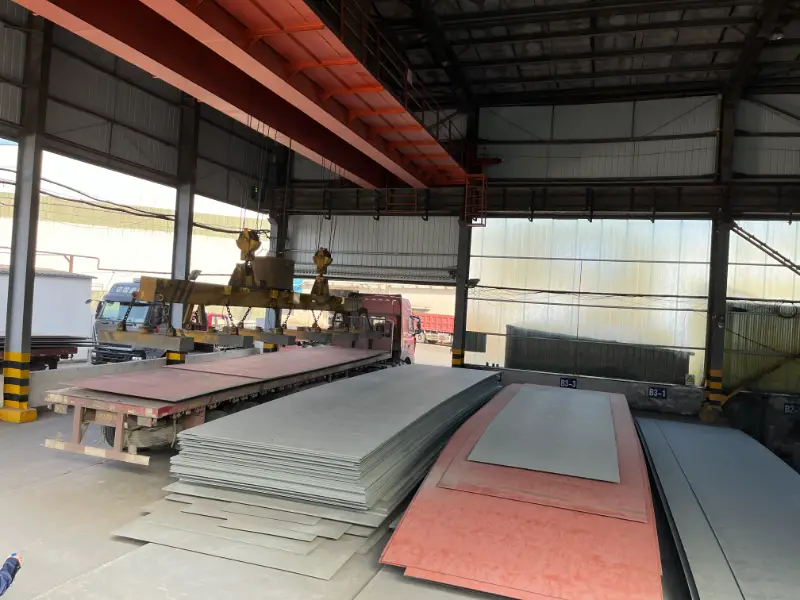
12Cr2Mo1R Pressure Vessel Steel Plate
12Cr2Mo1R Pressure Vessel Steel Plate: Properties, Equivalents & Applications
Explore the chemical composition, mechanical and thermal properties, international equivalents, and typical applications of 12Cr2Mo1R steel plate under GB713 for high-temperature pressure vessels and boilers.
Normalizing + Tempering (N+T); may also be quenched and tempered for heavy sections
- Phone : +8618037372205
- Email : [email protected]
- WhatsApp: Contact via Whtsapp
- WeChat: +8618037372205
12Cr2Mo1R Pressure Vessel Steel Plate Introduction
12Cr2Mo1R is a low-alloy chromium-molybdenum steel plate specified in Chinese standard GB 713 for pressure vessels and boilers. It is designed for elevated-temperature service, offering excellent strength, toughness, and resistance to hydrogen attack and oxidation up to approximately 600 °C. The steel is supplied in the normalized plus tempered (N+T) condition, ensuring a fine-grained bainitic/martensitic microstructure with good weldability.
- Typical yield strength ≥310 MPa at room temperature
- Good creep resistance thanks to 2.25% Cr and 1% Mo
- Widely used in reactor shells, heat exchangers, and thick-wall boiler drums
12Cr2Mo1R Pressure Vessel Steel Plate Chemical Composition
Chemical composition according to GB 713-2014 for 12Cr2Mo1R. The steel must meet strict limits on harmful elements such as sulfur and phosphorus to ensure high hot-workability and weldability. Residual elements are controlled; the sum of Cu+Ni+Cr+Mo shall not exceed specified limits where applicable.
| Element | Specified Value | Remarks |
|---|---|---|
| Carbon (C) | 0.08 – 0.15 | Ladle analysis |
| Silicon (Si) | ≤ 0.50 | |
| Manganese (Mn) | 0.30 – 0.60 | |
| Phosphorus (P) | ≤ 0.025 | |
| Sulfur (S) | ≤ 0.010 | |
| Chromium (Cr) | 2.00 – 2.50 | |
| Molybdenum (Mo) | 0.90 – 1.10 | |
| Copper (Cu) | ≤ 0.20 | Residual element |
| Nickel (Ni) | ≤ 0.25 | Residual element |
| Arsenic (As) | ≤ 0.025 | Residual element (optional) |
| Tin (Sn) | ≤ 0.015 | Residual element (optional) |
| Antimony (Sb) | ≤ 0.010 | Residual element (optional) |
12Cr2Mo1R Pressure Vessel Steel Plate Thermal & Electrical Physical Properties
The data below represent typical physical properties for 12Cr2Mo1R (2.25Cr-1Mo) in the normalized and tempered condition. These values are not mandatory requirements but are useful for design calculations. They are taken from published references for similar Cr-Mo steel grades.
| Property | Typical Value | Unit | Test Condition / Remarks |
|---|---|---|---|
| Density (ρ) | 7.85 | g/cm³ | Room temperature |
| Modulus of Elasticity (E) | 210 | GPa | Room temperature |
| Shear Modulus (G) | 81 | GPa | Room temperature |
| Poisson's Ratio (ν) | 0.3 | Room temperature | |
| Thermal Expansion Coefficient (α) | 11.2 | 10⁻⁶/K | 20–100 °C |
| Thermal Expansion Coefficient (α) | 12.5 | 10⁻⁶/K | 20–300 °C |
| Thermal Expansion Coefficient (α) | 13.1 | 10⁻⁶/K | 20–500 °C |
| Thermal Conductivity (λ) | 36 | W/(m·K) | At 100 °C |
| Thermal Conductivity (λ) | 35 | W/(m·K) | At 300 °C |
| Thermal Conductivity (λ) | 32 | W/(m·K) | At 500 °C |
| Specific Heat Capacity (cp) | 460 | J/(kg·K) | At 20–100 °C |
| Specific Heat Capacity (cp) | 550 | J/(kg·K) | At 500 °C |
| Electrical Resistivity (ρe) | 0.25 | μΩ·m | Room temperature |
12Cr2Mo1R Pressure Vessel Steel Plate Mechanical Properties
Tensile and impact properties as per GB 713-2014, valid for plates in the normalized + tempered condition. Values depend on plate thickness. Impact test temperature is -20 °C; minimum average absorbed energy is 27 J. Bending test required with bend diameter related to plate thickness.
| Property | Required Value | Unit | Test Condition / Thickness Range |
|---|---|---|---|
| Yield Strength (ReL or Rp0.2) | ≥ 310 | MPa | Plate thickness ≤ 100 mm |
| Yield Strength (ReL or Rp0.2) | ≥ 300 | MPa | Plate thickness > 100 to 200 mm |
| Tensile Strength (Rm) | 520 – 680 | MPa | All thicknesses |
| Elongation (A) | ≥ 19 | % | Thickness ≤ 60 mm, gauge length 50 mm |
| Elongation (A) | ≥ 18 | % | Thickness > 60 to 100 mm |
| Elongation (A) | ≥ 17 | % | Thickness > 100 to 200 mm |
| Impact Energy (KV2) | ≥ 27 (average), ≥ 19 (single) | J | -20 °C, Charpy V-notch, transverse |
| Bend Test | d = 3a | 180° bend, thickness ≤ 60 mm, a = plate thickness | |
| Bend Test | d = 4a | 180° bend, thickness > 60 to 100 mm |
12Cr2Mo1R Pressure Vessel Steel Plate Completely Equivalent Material Standards and Replaceable Grades
| Country/Region | Standard | Grade | Remarks |
|---|---|---|---|
| China | GB 713-2014 | 12Cr2Mo1R | Original specification |
| USA | ASME SA387 / ASTM A387 | Grade 22 Class 2 | Closest equivalent, welded pressure vessels |
| EU | EN 10028-2 | 10CrMo9-10 (1.7380) | Identical chemical and mechanical scope |
| Japan | JIS G4109 | SCMV4-2 | Boiler and pressure vessel steel |
| International | ISO 9328-2 | 11CrMo9-10 | Harmonized standard |
12Cr2Mo1R Pressure Vessel Steel Plate Application Introduction
12Cr2Mo1R is specifically designed for high-temperature pressure equipment. It is used where hydrogen, sulfur, and high-pressure steam are present. Its excellent creep strength up to 600 °C and good resistance to hydrogen attack make it a first choice in petrochemical and power industries.
- Always weld with matching filler (e.g., E9018-B3) and apply post-weld heat treatment (PWHT).
- Preheating before welding is essential to avoid hydrogen-induced cracking.
- Can be hot or cold formed, but cold forming may require intermediate stress-relief annealing.
Product Applications: Hydrocracking reactors, High-temperature heat exchangers, Boiler steam drums, Ammonia converters, Methanol synthesis reactors, High-pressure separators, Steam pipelines and headers
Processed into products: Shell courses and heads for thick-wall pressure vessels, Tube sheets for heat exchangers, Flanges and nozzles for high-temperature service, Bolting parts where alloy steel is required, Baffles and supports inside reactors, Adapters and reducers for high-pressure piping
Application industries: Petrochemical refining, Coal gasification, Thermal power generation, Nuclear power (secondary circuit), Chemical processing, Fertilizer production
12Cr2Mo1R Pressure Vessel Steel Plate Similar/Alternative Materials Recommended
| Country/Region | Standard | Grade | Remarks |
|---|---|---|---|
| China | GB 713-2014 | 12Cr1MoVR | 1Cr-0.5Mo grade, lower creep strength, lower cost |
| China | GB 713-2014 | 15CrMoR | 1.0-1.5% Cr steel, used at moderate temperatures |
| USA | ASTM A387 | Grade 11 Class 2 | 1.25Cr-0.5Mo, for less demanding service |
| EU | EN 10028-2 | 13CrMo4-5 (1.7335) | 1Cr-0.5Mo type, good substitute if lower strength is acceptable |
| EU | EN 10028-2 | 11CrMo9-10 (1.7383) | Similar but slightly different heat treatment; can replace under certain thickness limits |
Notes:
Additional remarks: For heavy plates (> 100 mm), the purchaser should agree with the manufacturer on specific mechanical test locations and acceptance criteria. The steel may be supplied with additional requirements such as ultrasonic testing, simulated post-weld heat treatment (SPWHT), or elevated-temperature tensile testing. Contact steel suppliers for the latest mill test certificates. Typical heat treatment involves normalizing at 900–950 °C followed by tempering at 680–740 °C.
- Share



