
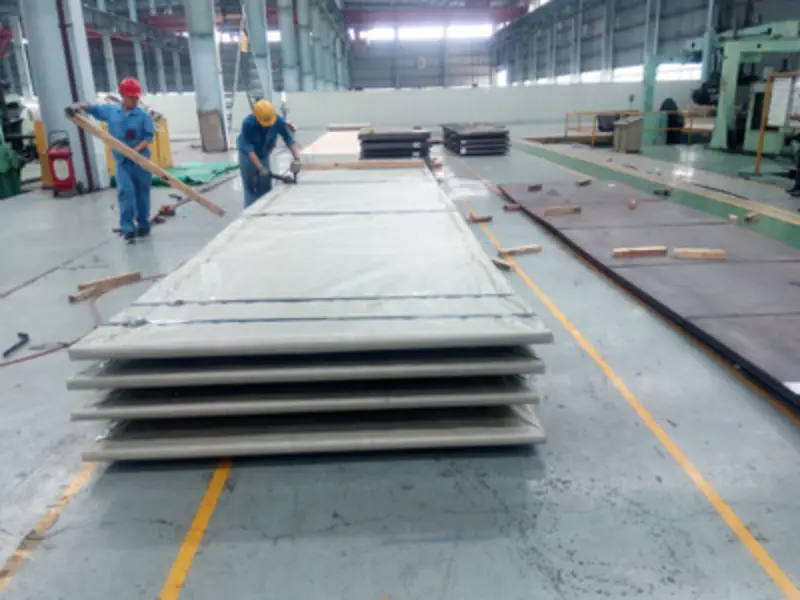
09CuPCrNi-B Weather Resistant Steel Plate
09CuPCrNi-B Weather Resistant Steel Plate | TB/T 1979 Standard
Comprehensive material data for 09CuPCrNi-B atmospheric corrosion resistant steel according to Chinese railway standard TB/T 1979. Includes chemical composition, mechanical and physical properties, equivalent international grades, and detailed application guidance for railway vehicles, containers, and structural engineering.
Hot rolling, controlled rolling, cold forming, bending, welding, machining, thermal cutting
- Phone : +8618037372205
- Email : [email protected]
- WhatsApp: Contact via Whtsapp
- WeChat: +8618037372205
09CuPCrNi-B Weather Resistant Steel Plate Introduction
09CuPCrNi-B is a low-alloy high-strength weather resistant structural steel defined in Chinese standard TB/T 1979, specifically developed for railway rolling stock applications. It offers enhanced atmospheric corrosion resistance through a carefully balanced chemistry of copper, chromium, and nickel, which promotes the formation of a dense protective oxide patina during exposure, drastically reducing corrosion rates compared to plain carbon steel. The low phosphorus content (≤0.030%) ensures good weldability and toughness while maintaining superior weather resistance suitable for both coated and uncoated service environments. Typical mechanical properties include minimum yield strength of 345MPa and tensile strength above 480MPa, combined with excellent notch toughness at low temperatures (KV2 ≥27J at -40°C). The steel is normally supplied in hot-rolled condition as plates, strips or coils, and can be readily formed, welded, and machined using conventional processes. Its balanced composition provides consistent performance in railway freight cars, containers, bridges and other structures exposed to rural, urban and industrial atmospheres, meeting stringent durability and safety requirements.
09CuPCrNi-B Weather Resistant Steel Plate Chemical Composition
Chemical composition of 09CuPCrNi-B according to TB/T 1979 standard. The steel features a low phosphorus content (max 0.030%) for good weldability and low‑temperature toughness, while Cu, Cr and Ni provide the corrosion resistance. Minor residual elements are controlled to ensure consistent properties.
| Element | Standard Value | Remarks |
|---|---|---|
| C | ≤0.12 | Carbon |
| Si | 0.20 – 0.50 | Silicon |
| Mn | 0.25 – 0.60 | Manganese |
| P | ≤0.030 | Phosphorus |
| S | ≤0.030 | Sulfur |
| Cu | 0.25 – 0.50 | Copper |
| Cr | 0.30 – 0.65 | Chromium |
| Ni | ≤0.30 | Nickel |
| Als | ≥0.015 | Acid-soluble aluminum (optional, for grain refinement) |
09CuPCrNi-B Weather Resistant Steel Plate Thermal and Electrical Physical Properties
Typical physical properties for 09CuPCrNi-B at room temperature and elevated temperatures. These values are representative for low-alloy weather resistant steels and may vary slightly with heat treatment and exact composition. Data can be used for thermal and structural analyses.
| Property | Typical Value | Unit | Test Conditions / Remarks |
|---|---|---|---|
| Density (ρ) | 7.85 | g/cm³ | 20°C |
| Modulus of Elasticity (E) | 206 | GPa | 20°C, dynamic method |
| Shear Modulus (G) | 79 | GPa | 20°C, calculated from E and ν |
| Poisson's Ratio (ν) | 0.30 | - | 20°C |
| Thermal Expansion Coefficient (α) | 12.0×10⁻⁶ | 1/K | 20–100°C |
| Thermal Expansion Coefficient (α) | 12.5×10⁻⁶ | 1/K | 20–200°C |
| Thermal Expansion Coefficient (α) | 13.0×10⁻⁶ | 1/K | 20–300°C |
| Thermal Conductivity (λ) | 42 | W/(m·K) | 20°C |
| Thermal Conductivity (λ) | 40 | W/(m·K) | 100°C |
| Thermal Conductivity (λ) | 38 | W/(m·K) | 200°C |
| Specific Heat Capacity (c) | 460 | J/(kg·K) | 20°C |
| Electrical Resistivity (ρe) | 0.25 | μΩ·m | 20°C |
09CuPCrNi-B Weather Resistant Steel Plate Mechanical Properties
Mechanical properties per TB/T 1979 for 09CuPCrNi-B plate in hot-rolled or controlled-rolled condition. Values depend on thickness and specimen orientation. Impact energy is tested on longitudinal V‑notch Charpy specimens at -40°C. Bend test with specified former diameter demonstrates cold formability.
| Property | Standard Required Value | Unit | Test Conditions / Remarks |
|---|---|---|---|
| Yield Strength (ReH / ReL) | ≥345 | MPa | Plate thickness ≤16mm |
| Yield Strength (ReH / ReL) | ≥345 | MPa | Plate thickness >16–40mm |
| Yield Strength (ReH / ReL) | ≥325 | MPa | Plate thickness >40–60mm |
| Tensile Strength (Rm) | 480 – 630 | MPa | Thickness ≤40mm |
| Tensile Strength (Rm) | 470 – 620 | MPa | Thickness >40–60mm |
| Elongation after fracture (A) | ≥22 | % | Thickness ≤16mm, gauge length 5.65√S₀ |
| Elongation after fracture (A) | ≥22 | % | Thickness >16–40mm |
| Elongation after fracture (A) | ≥22 | % | Thickness >40–60mm |
| Bend Test (former diameter) | d = 2a | - | Specimen width b=35mm, bending angle 180°, thickness ≤16mm |
| Bend Test (former diameter) | d = 3a | - | Thickness >16–60mm |
| Impact Energy (KV₂) | ≥27 | J | Longitudinal, -40°C, 10×10mm V‑notch |
09CuPCrNi-B Weather Resistant Steel Plate Fully Equivalent Material Standards & Replaceable Grades
| Country / Region | Standard / Specification | Grade | Remarks |
|---|---|---|---|
| China | TB/T 1979 | 09CuPCrNi-B | Original standard; railway vehicle weather resistant steel |
| China | GB/T 4171 | Q355NH | Nearly identical chemistry and mechanical properties; general structural weather resistant steel; may have slight differences in P and Mn ranges |
| International | ISO 4952 | S355W | Chemical and mechanical equivalence for weather resistant structural steels; Mn range may be broader |
| Japan | JIS G3114 | SMA490BW | Similar yield and tensile levels, weldable; requires verification of impact test conditions |
| Europe | EN 10025-5 | S355J2W | Equivalent strength grade with low‑temperature toughness; small differences in Cu and Ni limits |
| USA | ASTM A588 / A588M | Grade B | Comparable strength and weathering capability; contains vanadium, which may affect weldability slightly |
09CuPCrNi-B Weather Resistant Steel Plate Application Introduction
09CuPCrNi-B is engineered for long‑life durability in railway rolling stock, freight containers, and civil structures exposed to atmospheric corrosion. Its balanced composition permits painting, metalizing, or use in bare 'rust‑stabilising' condition after initial weathering. Typical applications span fully welded freight car bodies, bolted or riveted bridge girders, and welded transmission towers. It can be processed into a wide range of components by thermal cutting, cold bending, punching and robotic welding. When joining, low‑hydrogen welding consumables matching the strength and corrosion resistance of the base metal (e.g., AWS ER80S‑G or J506NiCu covered electrodes) are recommended to maintain joint integrity and weathering performance.
Product Applications: Railway freight cars: open wagons (gondolas), covered wagons, flat cars, hopper cars, tank car underframes, ISO shipping containers and swap bodies, Steel highway and railway bridges (composite and plate girder types), Lattice transmission towers and monopoles, Architectural facades, canopies and entrance structures, Industrial stacks, exhaust ducts and silos
Processed into products: Car body side and end panels, roof sheets, Underframe side sills, centre sills and cross bearers, Container corner posts, rails and corrugated wall panels, Bridge plate girders, crossframes and stiffeners, Tower leg angles, gusset plates and flanges, Welded box sections, tubular members and rolled profiles
Application industries: Railway transport and rolling stock manufacturing, Container shipping and intermodal transport, Civil engineering and bridge construction, Power transmission and telecommunication infrastructure, Architectural exposed structural steelwork, Industrial equipment and chimney fabrication
09CuPCrNi-B Weather Resistant Steel Plate Similar / Alternative Materials for Reference
| Country / Region | Standard / Specification | Grade | Remarks |
|---|---|---|---|
| China | GB/T 4171 | Q345NH (formerly 09CuPCrNi-A) | Higher phosphorus content (0.07–0.12), lower yield strength (≥295 MPa); good weathering but lower strength; may be used in less demanding applications |
| Japan | JIS G3125 | SPA-H | High‑phosphorus Corten A type; superior weathering but lower strength; for uncoated applications |
| USA | ASTM A242 / A242M | Type 1 | High‑strength low‑alloy weathering steel; minimum yield 345 MPa; often used in building and bridge structures; weldable |
| Europe | EN 10025-5 | S355K2W | Similar to S355J2W but with higher impact toughness requirements, suitable for thicker sections and lower service temperatures |
| Russia | GOST 27772 | 10KhSND (10ХСНД) | Low‑alloy structural steel with Cu, Si, Ni; similar strength, used in bridges and construction; requires check of corrosion resistance |
Notes:
Corrosion behaviour: When used without coatings, 09CuPCrNi-B forms a tightly adherent oxide layer after alternating wet/dry cycles, reducing further corrosion to very low rates. In marine or heavily polluted atmospheres, additional paint or metallization is recommended.
Welding: Low‑hydrogen procedures (E8016‑W or ER80S‑G) should be applied to avoid cold cracking. Preheat and interpass temperatures may be required for thick sections (>30mm).
Forming: The steel can be cold‑bent to a tight inside radius (≥2t) for structural corners. Hot forming should be followed by normalizing if specified.
Purchase specifications: Orders should reference TB/T 1979, indicate required thickness, width, length, edge condition (trimmed or mill edge), and optional requirements like improved impact energy, increased sulfur limits for machinability (not typical), or specific surface finish.
- Share



