
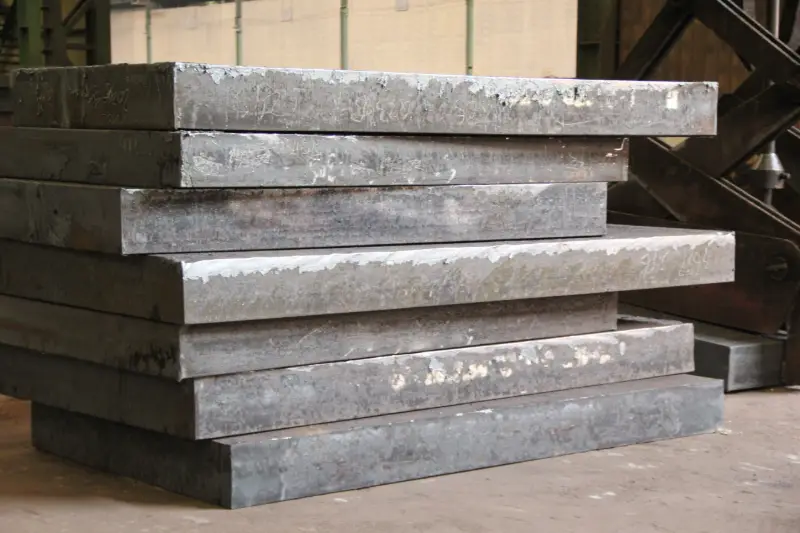
X7CrNiAl17-7 (1.4568) Stainless Steel
X7CrNiAl17-7 (1.4568) Stainless Steel: High-Strength Precipitation-Hardening Plate & Coil
Comprehensive data sheet for X7CrNiAl17-7 (1.4568) stainless steel plate/coil according to EN 10088-1 and EN 10088-2, including chemical composition, mechanical and physical properties, international equivalents, and application guide.
Cold forming, stamping, deep drawing, bending, welding, precipitation hardening heat treatment
- Phone : +8618037372205
- Email : [email protected]
- WhatsApp: Contact via Whtsapp
- WeChat: +8618037372205
X7CrNiAl17-7 Stainless Steel Introduction
X7CrNiAl17-7 (1.4568) is a semi-austenitic precipitation-hardening stainless steel offering a unique combination of high strength, good corrosion resistance, and excellent formability in the solution-annealed condition.
- Excellent fatigue and spring properties after precipitation hardening.
- High strength comparable to martensitic grades while maintaining corrosion resistance similar to Type 304.
- Can be formed into complex shapes in the soft, austenitic condition before hardening.
- Suitable for applications requiring both high mechanical performance and moderate corrosion resistance up to 400°C.
X7CrNiAl17-7 Stainless Steel Chemical Composition
Chemical composition as specified in EN 10088-1:2014 for grade X7CrNiAl17-7 (1.4568). The controlled addition of aluminium enables precipitation hardening by forming NiAl intermetallic phases, while chromium provides corrosion resistance.
| Element | Standard Value (wt%) | Remarks |
|---|---|---|
| Carbon (C) | ≤0.09 | |
| Silicon (Si) | ≤0.70 | |
| Manganese (Mn) | ≤1.00 | |
| Phosphorus (P) | ≤0.040 | |
| Sulfur (S) | ≤0.015 | |
| Chromium (Cr) | 16.00 - 18.00 | |
| Nickel (Ni) | 6.50 - 7.80 | |
| Aluminium (Al) | 0.70 - 1.50 |
X7CrNiAl17-7 Stainless Steel Thermal and Electrical Physical Properties
Physical properties for X7CrNiAl17-7 (1.4568) according to typical data from EN 10088-1 and supplementary literature.
- Values are typical for the solution-annealed condition at room temperature unless otherwise indicated.
- Thermal conductivity and expansion vary with heat treatment condition.
| Property | Typical Value | Unit | Test Condition |
|---|---|---|---|
| Density (ρ) | 7.7 | kg/dm³ | At 20°C |
| Elastic Modulus (E) | 200 | GPa | At 20°C |
| Shear Modulus (G) | 78 | GPa | At 20°C |
| Poisson's Ratio (ν) | 0.30 | - | At 20°C |
| Thermal Expansion Coefficient (α) | 16.0 | 10⁻⁶/K | 20 - 100°C |
| Thermal Expansion Coefficient (α) | 16.5 | 10⁻⁶/K | 20 - 200°C |
| Thermal Expansion Coefficient (α) | 17.0 | 10⁻⁶/K | 20 - 300°C |
| Thermal Expansion Coefficient (α) | 17.5 | 10⁻⁶/K | 20 - 400°C |
| Thermal Expansion Coefficient (α) | 18.0 | 10⁻⁶/K | 20 - 500°C |
| Thermal Conductivity (λ) | 15 | W/(m·K) | At 20°C |
| Specific Heat Capacity | 500 | J/(kg·K) | At 20°C |
| Electrical Resistivity (ρ_e) | 0.80 | Ω·mm²/m | At 20°C |
X7CrNiAl17-7 Stainless Steel Mechanical Properties
Mechanical properties according to EN 10088-2:2014 for X7CrNiAl17-7 (1.4568) in various delivery conditions.
- In the solution annealed condition (+AT), the material is soft and formable.
- Precipitation hardening (+P) dramatically increases strength through controlled heat treatment.
| Property | Required Value | Unit | Test Condition |
|---|---|---|---|
| 0.2% Yield Strength, Rp0.2 | ≥600 | MPa | Solution annealed (+AT), thickness ≤75mm |
| Tensile Strength, Rm | 850 - 1100 | MPa | Solution annealed (+AT), thickness ≤75mm |
| Elongation, A | ≥20 | % | Solution annealed (+AT), thickness ≥3mm |
| Elongation, A80 | ≥15 | % | Solution annealed (+AT), thickness <3mm |
| 0.2% Yield Strength, Rp0.2 | ≥650 | MPa | +P850 (precipitation hardened), thickness ≤75mm |
| Tensile Strength, Rm | 850 - 1100 | MPa | +P850 (precipitation hardened), thickness ≤75mm |
| Elongation, A | ≥15 | % | +P850, thickness ≥3mm |
| Elongation, A80 | ≥10 | % | +P850, thickness <3mm |
| 0.2% Yield Strength, Rp0.2 | ≥750 | MPa | +P950 (precipitation hardened), thickness ≤75mm |
| Tensile Strength, Rm | 950 - 1150 | MPa | +P950 (precipitation hardened), thickness ≤75mm |
| Elongation, A | ≥10 | % | +P950, thickness ≥3mm |
| Elongation, A80 | ≥8 | % | +P950, thickness <3mm |
| 0.2% Yield Strength, Rp0.2 | ≥900 | MPa | +P1050 (precipitation hardened), thickness ≤75mm |
| Tensile Strength, Rm | 1050 - 1250 | MPa | +P1050 (precipitation hardened), thickness ≤75mm |
| Elongation, A | ≥8 | % | +P1050, thickness ≥3mm |
| Elongation, A80 | ≥6 | % | +P1050, thickness <3mm |
| 0.2% Yield Strength, Rp0.2 | ≥1050 | MPa | +P1150 (precipitation hardened), thickness ≤75mm |
| Tensile Strength, Rm | 1150 - 1350 | MPa | +P1150 (precipitation hardened), thickness ≤75mm |
| Elongation, A | ≥6 | % | +P1150, thickness ≥3mm |
| Elongation, A80 | ≥5 | % | +P1150, thickness <3mm |
X7CrNiAl17-7 Stainless Steel Directly Equivalent Material Standards and Alternative Designations
| Country/Region | Standard | Designation | Remarks |
|---|---|---|---|
| Europe | EN 10088-1 | X7CrNiAl17-7 (1.4568) | Original grade |
| International | ISO 15510 | X7CrNiAl17-7 | Identical to EN |
| USA | ASTM A693 | Grade 631 (UNS S17700) | Commercial name: 17-7 PH |
| Japan | JIS G4304 | SUS631 | |
| China | GB/T 20878 | 07Cr17Ni7Al | Former designation: 0Cr17Ni7Al |
X7CrNiAl17-7 Stainless Steel Application Introduction
X7CrNiAl17-7 (1.4568) is widely employed where a combination of high strength, fatigue resistance, and moderate corrosion resistance is required. Its ability to be formed in a soft austenitic condition and subsequently hardened by a simple heat treatment makes it ideal for complex, high-performance components.
- Typically used for flat springs, Belleville washers, and diaphragms subjected to cyclic loading.
- In aerospace, it serves in structural parts, brackets, and honeycomb structures.
- The grade is also specified for surgical instruments and cutlery where edge retention and autoclave resistance are needed.
Product Applications: Flat springs and leaf springs, Belleville spring washers, Flexible metal hoses and diaphragms, Pressure vessel components, Surgical forceps, scissors, and clamps, Welding filler wire, High-strength knife blades, Aircraft structural panels and brackets
Processed into products: Spring clips and retainers, Valve diaphragms, Constant-force springs, Helicopter rotor blade components, Exhaust system flanges, Corrugated tubes and bellows, Precision measuring instrument parts, Fasteners (bolts, screws) exposed to high stress and mild corrosion
Application industries: Aerospace and defense, Medical equipment and surgical instruments, Chemical and petrochemical processing, Spring and fastener manufacturing, Food processing equipment, Automotive (high-performance engine components)
X7CrNiAl17-7 Stainless Steel Near-Similar or Alternative Grade Recommendations
| Country/Region | Standard | Designation | Remarks |
|---|---|---|---|
| Europe | EN 10088-1 | X5CrNiCuNb16-4 (1.4542) - 17-4 PH | Martensitic precipitation-hardening; higher corrosion resistance and different hardening mechanism, but similar high strength. |
| Europe | EN 10088-1 | X5CrNi18-10 (1.4301) - 304 | Austenitic stainless; much lower strength but superior formability and weldability in as-delivered condition; non-hardenable by heat treatment. |
| Europe | EN 10088-1 | X7CrNiAl17-7 (1.4568) cold-worked condition | Alternative delivery state of the same grade; higher strength without full precipitation treatment but lower ductility. |
Notes:
- Heat treatment: Solution annealing at 1065±15°C followed by water quenching or rapid air cooling produces a soft, austenitic structure. Precipitation hardening is performed at 760°C (condition +P760) or 955°C (+P955) followed by cooling to -75°C and aging at 510-565°C to obtain target strength levels.
- Welding: Can be welded by most common processes such as TIG, MIG, and resistance welding. Post-weld precipitation hardening may be required to restore full strength in the heat-affected zone. Filler metal matching the base composition (e.g., ER 17-7) should be used.
- Corrosion resistance: Comparable to AISI 304 in most environments, but stress corrosion cracking resistance may be lower in chloride-rich media at high strength levels. Solution-annealed condition offers the best corrosion performance.
- Formability: Excellent in the solution-annealed state; can be deep drawn, stretch formed, and bent. Work hardening rate is lower than that of standard austenitic grades, permitting more complex forming before intermediate annealing is required.
- Share



