
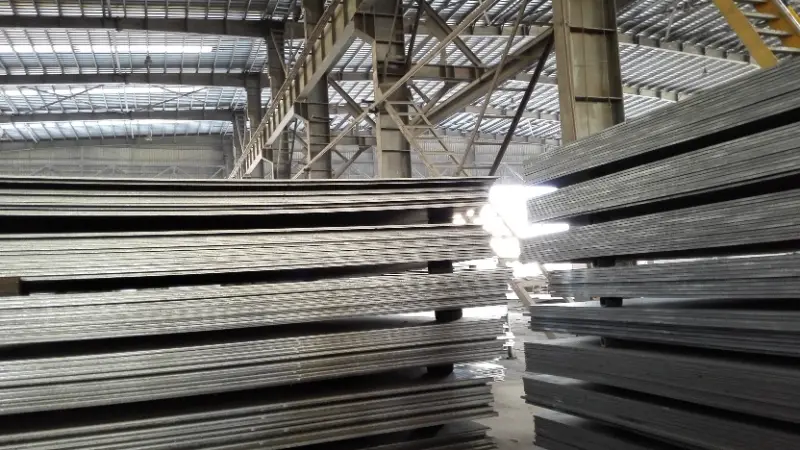
X5CrNiMoCuNh14-5 Stainless Steel Plate/Coil
X5CrNiMoCuNh14-5 Stainless Steel Plate/Coil - High Strength Precipitation Hardening Material
Comprehensive data for X5CrNiMoCuNh14-5 stainless steel, a precipitation hardening martensitic grade offering excellent corrosion resistance and high mechanical strength, applicable for springs, aerospace and marine hardware.
Hot rolling, cold rolling, solution annealing, precipitation hardening (aging), machining, limited welding, forming
- Phone : +8618037372205
- Email : [email protected]
- WhatsApp: Contact via Whtsapp
- WeChat: +8618037372205
X5CrNiMoCuNh14-5 Stainless Steel Plate/Coil Introduction
X5CrNiMoCuNh14-5 is a precipitation hardening (PH) martensitic stainless steel defined in the European standard EN 10088, primarily supplied as plate, coil and strip. The grade symbol contains 'Nh' which historically designates niobium (Nb), the key precipitation former together with copper. The alloy combines a chromium-nickel-molybdenum matrix with additions of copper and niobium, enabling a significant increase in hardness and strength through a simple aging heat treatment.
- High strength after aging – minimum yield strength 1000 MPa in the precipitation hardened condition.
- Good corrosion resistance comparable to AISI 304 in many environments, with enhanced pitting resistance from molybdenum.
- Excellent formability in solution annealed state – permits complex part production before hardening.
- Magnetic in all conditions – typical of martensitic stainless steels.
The material finds use where a superior combination of strength, toughness and corrosion resistance is required, particularly for thin flat products employed in the aerospace, chemical and general engineering sectors.
X5CrNiMoCuNh14-5 Stainless Steel Plate/Coil Chemical Composition
The chemical composition listed is according to the heat analysis specification for grade 1.4594 (X5CrNiMoCuNb14-5) in EN 10088-1. The designation Nh in the grade name refers to niobium (Nb). Elements are controlled to ensure adequate precipitation hardening and corrosion resistance. Trace elements are kept at low levels.
| Chemical Element | Standard Value (wt%) | Remarks |
|---|---|---|
| Carbon (C) | ≤ 0.07 | |
| Silicon (Si) | ≤ 0.70 | |
| Manganese (Mn) | ≤ 1.00 | |
| Phosphorus (P) | ≤ 0.040 | |
| Sulfur (S) | ≤ 0.015 | |
| Chromium (Cr) | 14.0 – 15.5 | Key element for corrosion resistance |
| Nickel (Ni) | 5.0 – 6.0 | Austenite former, improves toughness |
| Molybdenum (Mo) | 1.5 – 2.0 | Enhances pitting resistance and strength |
| Copper (Cu) | 1.2 – 2.0 | Precipitation hardening element |
| Niobium (Nb) | 0.15 – 0.45 | Designated as Nh in the grade symbol; precipitation former |
| Nitrogen (N) | ≤ 0.05 | May be present as a strengthening addition |
X5CrNiMoCuNh14-5 Stainless Steel Plate/Coil Thermal and Electrical Physical Properties
Physical properties are typical for the precipitation hardened condition at room temperature, unless otherwise noted. The data are derived from laboratory measurements on similar PH grades and are provided for design guidance. The expansion and conductivity values change slightly with aging temperature; the values below represent a standard aging treatment.
| Property | Standard Value | Unit | Test Condition |
|---|---|---|---|
| Density (ρ) | 7.8 | g/cm³ | 20 °C |
| Elastic modulus (E) | 200 | GPa | 20 °C |
| Shear modulus (G) | 78 | GPa | 20 °C |
| Poisson's ratio (ν) | 0.3 | – | 20 °C |
| Thermal expansion coefficient (α) | 10.8 | µm/m·K | 20 – 100 °C |
| Thermal expansion coefficient (α) | 11.2 | µm/m·K | 20 – 200 °C |
| Thermal expansion coefficient (α) | 11.6 | µm/m·K | 20 – 300 °C |
| Thermal conductivity (λ) | 15 | W/m·K | 20 °C |
| Thermal conductivity (λ) | 17 | W/m·K | 100 °C |
| Thermal conductivity (λ) | 20 | W/m·K | 300 °C |
| Specific heat capacity (cp) | 460 | J/(kg·K) | 20 °C |
| Electrical resistivity (ρe) | 0.80 | µΩ·m | 20 °C |
X5CrNiMoCuNh14-5 Stainless Steel Plate/Coil Mechanical Properties
Data refer to the precipitation hardened (PH) condition achieved after solution annealing, quenching and aging in the temperature range 480–550°C. Properties are guaranteed for flat products per EN 10088-2 and apply to thicknesses up to 6 mm. The values represent the minimum requirements; actual properties may be higher and depend on the exact aging parameters.
| Property | Required Value | Unit | Test Condition / Thickness |
|---|---|---|---|
| Yield strength (Rp0.2) | ≥ 1000 | MPa | PH condition, thickness ≤ 6 mm |
| Tensile strength (Rm) | 1100 – 1350 | MPa | PH condition, thickness ≤ 6 mm |
| Elongation after fracture (A80) | ≥ 6 | % | PH condition, thickness < 3 mm, gauge 80 mm |
| Elongation after fracture (A5) | ≥ 8 | % | PH condition, thickness 3 – 6 mm, gauge 5.65√S0 |
| Brinell hardness (HBW) | 360 – 440 | – | PH condition, typical range |
| Bend test (bending angle / mandrel diameter) | 180° / D=3t | – | PH condition, t = plate thickness |
X5CrNiMoCuNh14-5 Stainless Steel Plate/Coil Exact Equivalent Material Standards and Substitutable Grades
| Country/Region | Standard | Grade | Remarks |
|---|---|---|---|
| Europe | EN 10088-1 | X5CrNiMoCuNb14-5 (1.4594) | Identical composition; Nb is denoted as Nh in some historical denominations |
| International | ISO 15510 | X5CrNiMoCuNb14-5 | Chemical composition matches EN version |
X5CrNiMoCuNh14-5 Stainless Steel Plate/Coil Application Introduction
X5CrNiMoCuNh14-5 is ideally suited for applications that require a combination of high strength, moderate corrosion resistance and good fatigue properties. The alloy can be readily formed and machined in the solution-annealed condition, then hardened by a simple low-temperature aging treatment to achieve tensile strengths in the 1100–1350 MPa range. It is frequently selected for thin components that must withstand cyclic loads or where weight savings are critical.
Product Applications: High-performance leaf and coil springs, Corrosion-resistant fasteners (bolts, screws, washers), Valve stems and seats, Pump shafts and impellers, Aircraft structural brackets, Nuclear reactor fuel element components
Processed into products: Spring washers and Belleville springs, Rotor clips and retaining rings, Landing gear hinge pins, Marine propeller shafts for small vessels, Surgical forceps and needle holders, High-pressure filter elements
Application industries: Aerospace, Chemical processing, Marine engineering, Medical devices, Oil & gas, Power generation
X5CrNiMoCuNh14-5 Stainless Steel Plate/Coil Similar or Alternative Materials with Close Composition or Performance
| Country/Region | Standard | Grade | Remarks |
|---|---|---|---|
| USA | ASTM A564 | 15-5 PH (UNS S15500, EN 1.4545) | Precipitation hardening similar, but without molybdenum and with higher copper (3.0–5.0%). Strength level comparable. |
| USA / Europe | ASTM A564 / EN 10088-1 | 17-4 PH (S17400 / 1.4542) | Widely used PH stainless; contains Cu but no Mo, slightly different corrosion resistance. |
| Japan | JIS G4303 | SUS630 (17-4 PH) | Equivalent to 17-4 PH; lacks molybdenum, otherwise similar aging response. |
| Europe | EN 10088-1 | X4CrNiMo16-5-1 (1.4418) | Martensitic stainless with Mo, but not precipitation hardening; lower achievable strength. |
Notes:
Typical heat treatment: solution anneal at 1040–1060 °C, oil or water quench, followed by aging at 480–550 °C for 2–4 hours, air cool. Welding is possible with matching filler and post-weld heat treatment, but the heat-affected zone may require re-aging to restore mechanical properties. Cold forming operations should be performed on solution-annealed material to avoid cracking. For optimum corrosion resistance and toughness, a low aging temperature (below 500 °C) is recommended.
- Share



