
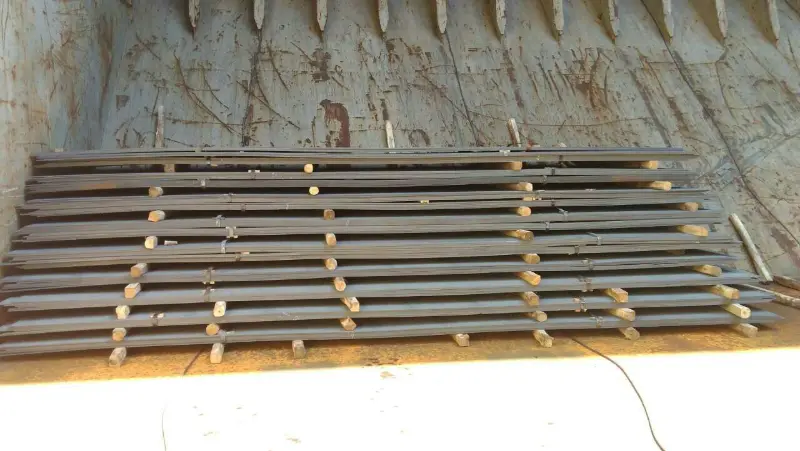
X5NiCrTiMoVB25-15-2 (1.4980) Precipitation Hardening Stainless Steel Plate & Coil
X5NiCrTiMoVB25-15-2 (1.4980) Precipitation Hardening Stainless Steel Plate & Coil - High Temp Strength
Explore the detailed material properties, chemical composition, mechanical and physical data for EN 10088-1 X5NiCrTiMoVB25-15-2 stainless steel plate/coil. Find equivalent grades and application guidance.
Cold forming, hot forming, machining (solution-treated condition), welding (with filler metal 1.4980 or similar), aging heat treatment
- Phone : +8618037372205
- Email : [email protected]
- WhatsApp: Contact via Whtsapp
- WeChat: +8618037372205
X5NiCrTiMoVB25-15-2 Precipitation Hardening Stainless Steel Plate & Coil Introduction
X5NiCrTiMoVB25-15-2 (EN 1.4980) is an austenitic precipitation hardening (PH) stainless steel, often referred to as an iron-base superalloy. It combines high tensile and creep-rupture strength at elevated temperatures (up to approx. 700°C) with good oxidation resistance and corrosion resistance in many environments. The alloy achieves its strength through a solution annealed condition followed by an aging heat treatment, which precipitates finely dispersed gamma-prime (Ni3(Al,Ti)) phases. Key alloying elements include nickel and chromium for corrosion resistance, titanium and aluminium for precipitation hardening, and minor additions of molybdenum, vanadium, and boron for improved elevated-temperature properties. In the solution-treated condition, the material exhibits good ductility and formability, making it suitable for fabrication into complex components. Typical applications are found in aerospace, gas turbine, and automotive turbocharger industries where a combination of high strength, thermal stability, and moderate corrosion resistance is required. The material is also known under the trade name A286 and UNS S66286.
X5NiCrTiMoVB25-15-2 Precipitation Hardening Stainless Steel Plate & Coil Chemical Composition
The specified chemical composition according to EN 10088-1 for grade X5NiCrTiMoVB25-15-2 (1.4980). These limits ensure the required precipitation hardening response and elevated-temperature strength. The alloy relies on a balance of nickel, chromium, titanium, and aluminium to form the strengthening gamma-prime precipitate. Boron and vanadium are present in small controlled amounts to improve grain boundary strengthening and high-temperature creep resistance. All values are maximum unless a range is given.
| Element | Standard Value (%) | Remarks |
|---|---|---|
| Carbon (C) | ≤ 0.08 | |
| Silicon (Si) | ≤ 1.00 | |
| Manganese (Mn) | ≤ 2.00 | |
| Phosphorus (P) | ≤ 0.025 | |
| Sulfur (S) | ≤ 0.015 | |
| Chromium (Cr) | 13.5 – 16.0 | |
| Nickel (Ni) | 24.0 – 27.0 | |
| Molybdenum (Mo) | 1.00 – 1.50 | |
| Titanium (Ti) | 1.90 – 2.30 | Key precipitation hardening element |
| Vanadium (V) | 0.10 – 0.50 | Grain refinement and strengthening |
| Boron (B) | 0.003 – 0.010 | Grain boundary strengthening |
| Aluminium (Al) | ≤ 0.35 | Forms Ni3(Al,Ti) precipitates |
| Cobalt (Co) | ≤ 0.50 | |
| Copper (Cu) | ≤ 0.50 | |
| Nitrogen (N) | ≤ 0.030 | Not always specified, typical residual |
X5NiCrTiMoVB25-15-2 Precipitation Hardening Stainless Steel Plate & Coil Thermal and Electrical Physical Properties
The physical properties listed are typical values for X5NiCrTiMoVB25-15-2 in the solution-annealed condition at room temperature, unless a temperature range is indicated. The alloy is non-magnetic and exhibits the high thermal expansion and low thermal conductivity characteristic of austenitic stainless steels. These properties are important for components exposed to thermal cycling and for heat transfer calculations. Data compiled from published manufacturer datasheets and open literature.
| Property | Typical Value | Unit | Test Condition |
|---|---|---|---|
| Density (ρ) | 7.9 – 8.0 | g/cm³ | 20 °C |
| Elastic modulus (E) | 200 – 205 | GPa | 20 °C |
| Shear modulus (G) | 77 – 79 | GPa | 20 °C |
| Poisson's ratio (ν) | 0.30 – 0.31 | — | 20 °C |
| Thermal expansion coefficient (α) | 16.5 – 17.0 | 10⁻⁶/K | 20 – 100 °C |
| Thermal expansion coefficient (α) | 17.5 – 18.0 | 10⁻⁶/K | 20 – 500 °C |
| Thermal expansion coefficient (α) | 18.0 – 18.5 | 10⁻⁶/K | 20 – 700 °C |
| Thermal conductivity (λ) | 14.5 – 15.5 | W/(m·K) | 20 °C |
| Thermal conductivity (λ) | 18.5 – 20.0 | W/(m·K) | 200 °C |
| Thermal conductivity (λ) | 22.0 – 23.5 | W/(m·K) | 500 °C |
| Specific heat capacity (cp) | 450 – 500 | J/(kg·K) | 20 – 100 °C |
| Electric resistivity (ρe) | 0.90 – 1.00 | µΩ·m | 20 °C |
X5NiCrTiMoVB25-15-2 Precipitation Hardening Stainless Steel Plate & Coil Mechanical Properties
The mechanical properties of X5NiCrTiMoVB25-15-2 depend strongly on the heat treatment condition. The values below correspond to the solution-annealed condition (1D) as delivered for plates and coils according to EN 10088-2. This soft and ductile state allows further forming and fabrication. The material can subsequently be precipitation hardened (aged) to achieve high strength. Aging at 700-730 °C for 16 hours typically raises the yield strength to above 550 MPa and tensile strength to about 900-1100 MPa. The data shown are guaranteed minimum or maximum values for the solution-annealed condition for thickness ≤6 mm (transverse direction).
| Property | Standard Requirement | Unit | Test Condition |
|---|---|---|---|
| Tensile strength (Rm) | ≤ 850 | MPa | Solution annealed (1D), thickness ≤6 mm |
| Yield strength (Rp0.2) | ≤ 600 | MPa | Solution annealed (1D), thickness ≤6 mm |
| Elongation (A80mm) | ≥ 15 | % | Solution annealed (1D), longitudinal, thickness ≤6 mm, gauge length 80 mm |
| Tensile strength (Rm) | ≤ 850 | MPa | Solution annealed (1D), thickness >6 mm |
| Yield strength (Rp0.2) | ≤ 600 | MPa | Solution annealed (1D), thickness >6 mm |
| Elongation (A5) | ≥ 15 | % | Solution annealed (1D), longitudinal, thickness >6 mm, gauge length 5.65√S₀ |
X5NiCrTiMoVB25-15-2 Precipitation Hardening Stainless Steel Plate & Coil Complete Equivalent Material Standards & Substitute Grade Recommendations
| Country/Region | Standard | Grade | Remarks |
|---|---|---|---|
| Europe | EN 10088-1 | X5NiCrTiMoVB25-15-2 (1.4980) | Original specification |
| USA | ASTM A453/A453M | Grade 660 (UNS S66286/A286) | Identical chemical composition and properties |
| USA | ASTM A638/A638M | Grade 660 (UNS S66286) | For high-temperature service |
| USA | AMS 5525 / AMS 5731/5732/5737 | A286 (UNS S66286) | Aerospace Material Specifications for sheet/bar/forgings |
| China | GB/T 14992 | GH2132 (06Cr15Ni25Ti2MoAlVB) | Chinese high-temperature alloy grade, equivalent to A286 |
| Japan | JIS G4902 | NCF660 (SUH660) | JIS grade for heat-resisting superalloy, equivalent |
| International | ISO 15510 | X5NiCrTiMoVB25-15-2 (4763-498-13-X) | ISO stainless steel designation |
X5NiCrTiMoVB25-15-2 Precipitation Hardening Stainless Steel Plate & Coil Application Introduction
X5NiCrTiMoVB25-15-2 is selected for applications requiring high strength and creep resistance at temperatures from about -196°C up to 700°C, coupled with good oxidation resistance and moderate corrosion resistance in environments such as atmospheric, fresh water, and many chemical media. It is not recommended for strong reducing acids or chloride-rich environments where stress corrosion cracking can occur. The alloy is readily fabricated in the solution-treated condition and then hardened by a simple aging treatment. The material's non-magnetic nature and high electrical resistivity are additional benefits in some instrument applications.
Product Applications: Turbine wheels and blades, Aircraft engine casings and rings, Turbocharger wheels and shafts, High-temperature bolting and studs, Springs for elevated temperature service, Extrusion dies for aluminium, Superconducting magnet structural parts, Automotive exhaust valves
Processed into products: Jet engine compressor blades and disks, Gas turbine combustion chamber parts, Turbocharger turbine wheels and shafts, High-strength fasteners (screws, nuts, bolts) for temperatures up to 700°C, Belleville springs and disc springs, Heat exchanger tube plates and baffles, Nuclear reactor internal structural components, Forged rings and flanges for pressure vessels
Application industries: Aerospace (jet engine and airframe parts), Power generation (gas turbines, nuclear fasteners), Automotive (turbocharger components, high-performance exhaust valves), Oil & gas (downhole tools, valve bodies for sour service with caution), Chemical process (heat exchangers, reaction vessels for moderate environments), Marine (shafts, fasteners where non-magnetic property is important)
X5NiCrTiMoVB25-15-2 Precipitation Hardening Stainless Steel Plate & Coil Similar/Alternative Material Recommendations
| Country/Region | Standard | Grade | Remarks |
|---|---|---|---|
| Europe | EN 10088-1 | X4NiCrTiMoVB25-15-2 (1.4979) | Lower carbon variant (C 0.03-0.08), slightly different precipitation behaviour, used for welded structures |
| Europe | EN 10088-1 | X6NiCrTiMoVB25-15-2 (1.4944) | Higher carbon variant (C 0.04-0.08), often used for similar high-temperature fasteners and disks |
| USA | AMS 5735 | A286 with modified heat treatment (UNS S66286) | Same base composition, different heat treatment for specific strength levels |
| USA | UNS N07718 (Inconel 718) | N07718 | Nickel-based superalloy with higher strength and temperature capability but more expensive, for substitution when higher strength needed |
| China | GB/T 14992 | GH2136 (0Cr13Ni8Mo2Al) | A precipitation hardening stainless steel with lower Ni content, lower hot strength but higher corrosion resistance in some media |
Notes:
All data is based on EN 10088-1 and EN 10088-2 standards and typical published values. For critical applications, specific material certifications should be obtained. The aging treatment commonly used is 720 °C ± 10 °C for 16 hours followed by air cooling. Higher strength can be achieved with modified aging cycles. Welding of this grade requires careful control to avoid hot cracking; recommended filler metal is matching composition 1.4980 or nickel-base fillers (e.g., ERNiCrCoMo-1). Post-weld heat treatment is generally required to restore properties. Magnetic permeability is typically < 1.01 in the solution-treated and aged conditions.
- Share



