
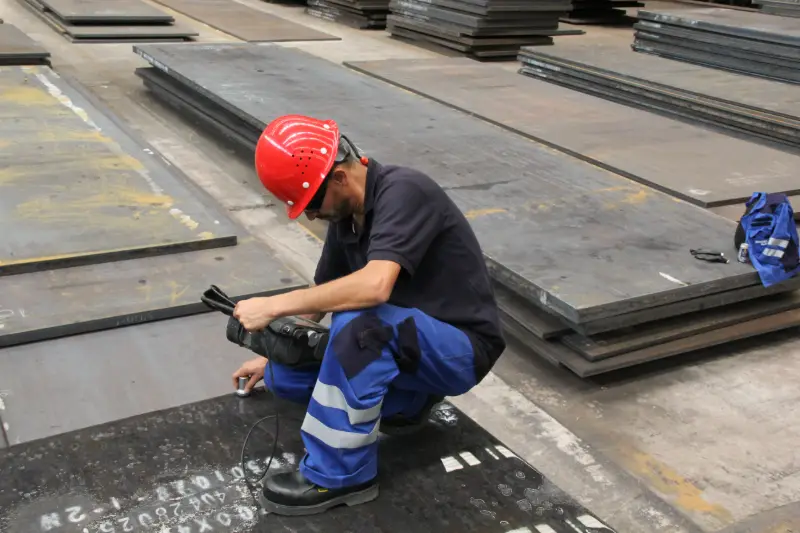
X30Cr13 Stainless Steel (EN 10088-1)
X30Cr13 Stainless Steel (EN 10088-1) - Martensitic Corrosion-Resistant Plate & Coil Grade
Comprehensive material data for X30Cr13 martensitic stainless steel plate and coil according to EN 10088-1, including chemical composition, mechanical and thermal properties, international equivalents, and application guidance.
Hot rolling, cold rolling, annealing, quenching and tempering, machining
- Phone : +8618037372205
- Email : [email protected]
- WhatsApp: Contact via Whtsapp
- WeChat: +8618037372205
X30Cr13 Stainless Steel Introduction
X30Cr13 is a martensitic corrosion-resistant stainless steel standardized in EN 10088-1 and supplied as plate or coil. It offers a combination of high hardness, moderate corrosion resistance, and good wear performance after heat treatment. The grade is widely used for applications requiring strength and mild chemical resistance.
- Typical condition: annealed (+A) for forming, or quenched and tempered (+QT) for final mechanical properties
- Corrosion resistance comparable to AISI 420, but lower than austenitic grades
- Magnetic in all conditions
- Good polishability and machinability in annealed state
X30Cr13 Stainless Steel Chemical Composition
The chemical composition of X30Cr13 conforms to EN 10088-1:2014. The alloy is characterized by its carbon and chromium content, which enable hardenability and corrosion resistance. Low sulfur ensures minimal hot working difficulties.
- Iron forms the balance
- No intentional additions of molybdenum, titanium, or other elements
| Element | Standard Value | Remarks |
|---|---|---|
| Carbon (C) | 0.26 – 0.35 | Key hardenability element |
| Silicon (Si) | ≤ 1.00 | Deoxidizer |
| Manganese (Mn) | ≤ 1.50 | Improves hot workability |
| Phosphorus (P) | ≤ 0.040 | Maximum limit to avoid embrittlement |
| Sulfur (S) | ≤ 0.015 | Controlled for cleanliness |
| Chromium (Cr) | 12.50 – 14.50 | Provides corrosion resistance and hardenability |
| Nickel (Ni) | ≤ 1.00 | Residual element |
| Iron (Fe) | Balance | Base metal |
X30Cr13 Stainless Steel Thermal and Electrical Physical Properties
Physical properties are typical for martensitic stainless steel X30Cr13 at room temperature unless otherwise noted. These values assist in engineering design and process planning.
- Magnetic permeability is typical for ferritic/martensitic grades
- Values may vary slightly with heat treatment condition
| Property | Typical Value | Unit | Test Condition / Remarks |
|---|---|---|---|
| Density (ρ) | 7.70 | g/cm³ | At 20°C |
| Modulus of Elasticity (E) | 215 | GPa | At 20°C |
| Shear Modulus (G) | 85 | GPa | At 20°C |
| Poisson's Ratio (ν) | 0.24 | - | At 20°C |
| Thermal Expansion Coefficient (α) | 10.5 | 10⁻⁶/K | 20–100°C |
| Thermal Expansion Coefficient (α) | 11.0 | 10⁻⁶/K | 20–200°C |
| Thermal Expansion Coefficient (α) | 11.5 | 10⁻⁶/K | 20–300°C |
| Thermal Conductivity (λ) | 25.0 | W/(m·K) | At 20°C |
| Specific Heat Capacity (c) | 460 | J/(kg·K) | At 20°C |
| Electrical Resistivity (ρ_e) | 0.55 x 10⁻⁶ | Ω·m | At 20°C |
X30Cr13 Stainless Steel Mechanical Properties
Mechanical properties are given for the two main delivery conditions according to EN 10088-2:2014. The annealed (+A) condition provides maximum limits for soft forming; the quenched and tempered (+QT) condition shows the strength achievable after heat treatment.
- Hardness tests performed on annealed material
- QT condition requires quenching from 950–1000°C, tempering at 650–750°C
- Values apply to plate/coil thickness ≤ 10 mm unless stated otherwise
| Property | Required Value | Unit | Test Condition / Remarks |
|---|---|---|---|
| Hardness (Brinell) | ≤ 220 | HB | Annealed (+A); all thicknesses |
| Tensile Strength (Rm) | ≤ 750 | MPa | Annealed (+A); all thicknesses |
| Yield Strength (Rp0.2) | ≤ 600 | MPa | Annealed (+A); all thicknesses |
| Tensile Strength (Rm) | 800 – 1000 | MPa | Quenched and tempered (+QT); thickness ≤ 10 mm |
| Yield Strength (Rp0.2) | ≥ 600 | MPa | Quenched and tempered (+QT); thickness ≤ 10 mm |
| Elongation (A) | ≥ 11 | % | Quenched and tempered (+QT); thickness ≤ 10 mm; gauge length 80 mm |
X30Cr13 Stainless Steel Completely Equivalent Material Standards & Substitutable Grades
| Country/Region | Standard | Grade | Remarks |
|---|---|---|---|
| European Union | EN 10088-1 | X30Cr13 (1.4028) | Original designation; identical composition |
| Germany | DIN EN 10088-1 | X30Cr13 (1.4028) | Directly equivalent; same material number |
| USA | ASTM A276 / A276M | Type 420 | Closest match; minor compositional tolerance differences |
| Japan | JIS G4303 | SUS420J2 | Equivalent grade in JIS system |
| China | GB/T 1220 | 30Cr13 (New GB/T 20878: 30Cr13) | Equivalent Chinese standard martensitic stainless steel |
X30Cr13 Stainless Steel Application Introduction
X30Cr13 is suitable for parts that require a combination of high strength, moderate corrosion resistance, and wear resistance after heat treatment. Typical processing includes machining in annealed condition, followed by quenching and tempering to achieve final mechanical properties.
- Not recommended for highly oxidizing or reducing environments where austenitic grades are preferred
- Excellent polishability for aesthetic and surgical applications
Product Applications: Surgical scalpels, clamps, forceps, Kitchen knives, scissors, food processor blades, Valve stems, seats, and balls, Pump shafts and sleeves, Wear-resistant bushes and plungers, Plastic injection mould components
Processed into products: Blade edges, Guide pins, Nozzle tips, Bearings for low-load corrosive environments, Steam turbine blades (low temperature)
Application industries: Medical & Dental Instruments, Cutlery & Kitchenware, General Engineering Components, Pump & Valve Manufacturing, Mould & Die Making, Automotive Parts
X30Cr13 Stainless Steel Similar / Comparable Substitute Materials
| Country/Region | Standard | Grade | Remarks |
|---|---|---|---|
| European Union | EN 10088-1 | X20Cr13 (1.4021) | Lower carbon (0.16–0.25%), better toughness and corrosion resistance, slightly lower hardness |
| European Union | EN 10088-1 | X46Cr13 (1.4034) | Higher carbon (0.43–0.50%), higher achievable hardness, used for cutting tools |
| USA | ASTM A276 | Type 420F | Free-machining variant with selenium or sulfur, improved machinability |
| China | GB/T 1220 | 20Cr13 | Similar to X20Cr13; better corrosion resistance, lower carbon |
Notes:
Heat treatment: Austenitize at 950–1000°C, oil or air quench; temper at 650–750°C (air cool). Avoid tempering between 400–600°C to prevent embrittlement. Welding: Preheating (200–300°C) and post-weld heat treatment required to avoid cracking. Use matching filler metal (e.g., AWS E410 filler). Corrosion: Best resistance obtained in hardened and tempered condition with smooth surface finish. Susceptible to intergranular corrosion if sensitized; not suitable for strong acidic environments.
- Share



