
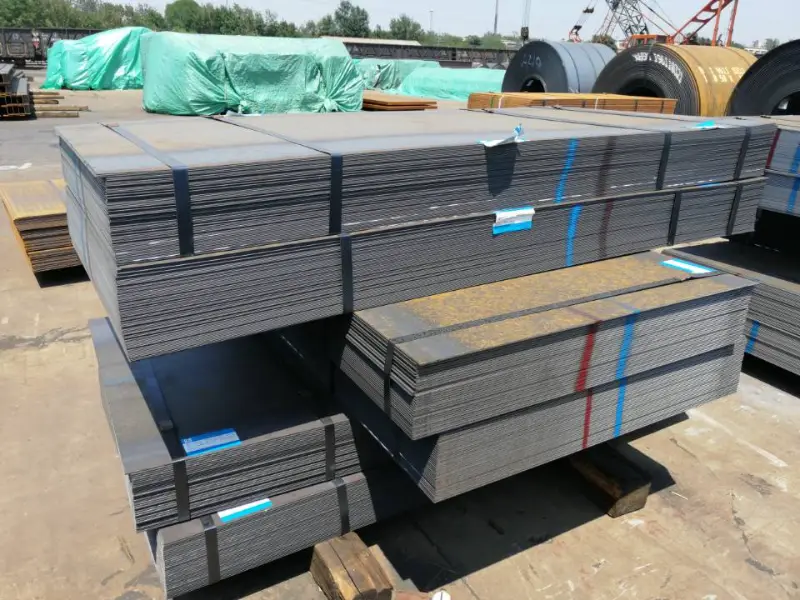
X29CrS13 (1.4029) Martensitic Stainless Steel Plate/Coil
X29CrS13 (1.4029) Martensitic Stainless Steel Plate/Coil - Sulfur-Enhanced Free-Machining Grade to EN 10088-1
Complete material data sheet for X29CrS13 (1.4029) martensitic stainless steel plate/coil according to EN 10088-1 and EN 10088-2. Includes chemical composition, mechanical and thermal properties, international equivalents, and application guidance.
Available processing: cutting, forming (limited), machining (excellent), heat treatment (hardening and tempering). Suitable for precision turning, grinding, and polishing.
- Phone : +8618037372205
- Email : [email protected]
- WhatsApp: Contact via Whtsapp
- WeChat: +8618037372205
X29CrS13 Martensitic Stainless Steel Plate/Coil Introduction
X29CrS13 (W.-Nr. 1.4029) is a martensitic chromium stainless steel defined in EN 10088-1. The grade features a higher carbon content (nominal 0.29 %) for hardenability and a deliberate sulfur addition (0.15–0.25 %) to improve machinability. In the quenched and tempered condition it offers high hardness and wear resistance combined with moderate corrosion resistance. It is typically supplied as plate or coil in the soft annealed (+A) or quenched and tempered (+QT) condition. Key characteristics:
- Good machinability due to elevated sulfur
- High hardness achievable by heat treatment (approx. 55 HRC)
- Moderate resistance to atmospheric corrosion, water, and some mild chemical environments
- Limited weldability – preheating and post-weld heat treatment required
X29CrS13 Martensitic Stainless Steel Plate/Coil Chemical Composition
Chemical composition according to EN 10088-1:2014 heat analysis. The high sulfur addition creates manganese sulfide inclusions that break chips and enhance machinability. All other elements are at residual levels.
| Element | Content (%) | Remarks |
|---|---|---|
| C | 0.25 – 0.32 | Required; provides hardenability |
| Si | ≤ 1.00 | Maximum |
| Mn | ≤ 1.50 | Maximum |
| P | ≤ 0.040 | Maximum |
| S | 0.15 – 0.25 | Required for machinability |
| Cr | 12.0 – 13.5 | Required for corrosion resistance |
| Fe | Balance |
X29CrS13 Martensitic Stainless Steel Plate/Coil Physical & Thermal Properties
Physical properties representative of X29CrS13 martensitic stainless steel at room temperature unless otherwise indicated. Data based on general knowledge for 12–14% Cr martensitic steels.
| Property | Value | Unit | Test Condition / Temperature |
|---|---|---|---|
| Density (ρ) | 7.7 | g/cm³ | 20 °C |
| Modulus of elasticity (E) | 215 | GPa | 20 °C |
| Shear modulus (G) | 83 | GPa | 20 °C |
| Poisson's ratio (ν) | 0.28 – 0.30 | - | 20 °C |
| Thermal expansion coefficient (α) | 10.5 × 10⁻⁶ | K⁻¹ | 20–100 °C |
| Thermal expansion coefficient (α) | 11.0 × 10⁻⁶ | K⁻¹ | 20–200 °C |
| Thermal conductivity (λ) | 25 | W/(m·K) | 20 °C |
| Specific heat capacity (cp) | 460 | J/(kg·K) | 20 °C |
| Electrical resistivity (ρ_e) | 0.60 | µΩ·m | 20 °C |
X29CrS13 Martensitic Stainless Steel Plate/Coil Mechanical Properties
Minimum mechanical properties for plate/strip in the quenched and tempered (+QT) condition according to EN 10088-2. Values apply to thickness ≤6 mm (transverse test pieces for plate width ≥300 mm).
| Property | Value | Unit | Test Condition |
|---|---|---|---|
| Yield strength (Rp0.2) | ≥ 500 | MPa | +QT, thickness ≤6 mm |
| Tensile strength (Rm) | 750 – 950 | MPa | +QT, thickness ≤6 mm |
| Elongation after fracture (A80) | ≥ 12 | % | +QT, thickness 0.5–3 mm, gauge length 80 mm |
| Elongation after fracture (A) | ≥ 10 | % | +QT, thickness 3–6 mm, short proportional gauge |
| Hardness (reference) | 52 – 56 | HRC | +QT (quenched and tempered), typical |
X29CrS13 Martensitic Stainless Steel Plate/Coil Fully Equivalent International Standards & Replaceable Grades
| Country / Region | Standard | Grade | Remarks |
|---|---|---|---|
| European Union | EN 10088-1 | X29CrS13 (1.4029) | Original designation, plate/coil |
| USA | ASTM A240 / A959 | 420F (UNS S42020) | Free-machining variant of 420; sulfur ≥0.15 % |
| Japan | JIS G4303 | SUS 420F | Free-machining martensitic stainless steel |
| China | GB/T 1220 | Y30Cr13 | Sulfur-added martensitic steel |
| International | ISO 15510 | X29CrS13 (4029-420-00-I) | ISO designation matches EN grade |
X29CrS13 Martensitic Stainless Steel Plate/Coil Application Introduction
X29CrS13 combines high hardness, wear resistance, and excellent machinability, making it suitable for precision components in corrosive environments where edge retention is critical. The sulfur addition allows high-speed automatic machining without sacrificing the ability to be hardened to 55 HRC and above. Typical application areas:
Product Applications: Scalpels, scissors, forceps, Knife blades and cutter bars, Valve seats and balls, Nozzles for injection systems, Piston pins and shafts
Processed into products: Precision turned parts, Bushings and bearing sleeves, Surgical clamps and retractors, Nozzle inserts, Wear strips and guides
Application industries: Medical technology and surgical instruments, Food processing equipment, Mechanical engineering, Pump and valve manufacturing, General industrial hardware
X29CrS13 Martensitic Stainless Steel Plate/Coil Closely Related Grades
| Country / Region | Standard | Grade | Remarks |
|---|---|---|---|
| European Union | EN 10088-1 | X30Cr13 (1.4028) | Nominally 0.30 % C, no added sulfur; lower machinability, better toughness and corrosion resistance. |
| European Union | EN 10088-1 | X39Cr13 (1.4031) | Higher carbon (≈0.39 %) for increased hardness; often used for cutlery. |
| European Union | EN 10088-1 | X46Cr13 (1.4034) | Even higher carbon (≈0.46 %) for maximum wear resistance; typical for high-end knives. |
| USA | ASTM A240 | 420 (UNS S42000) | Standard martensitic stainless without sulfur; weldable with caution. |
Notes:
Heat treatment: Typical hardening temperature 980–1030 °C, oil or air quenching, followed by tempering at 150–300 °C depending on desired hardness. Weldability: Poor due to high carbon and sulfur content; preheating at 200–300 °C and post-weld heat treatment are mandatory to avoid cracking. Corrosion resistance: Best in hardened and tempered condition; susceptible to pitting in chloride-containing environments. Not suitable for welding without filler or high-temperature applications above 400 °C due to temper embrittlement.
- Share



