
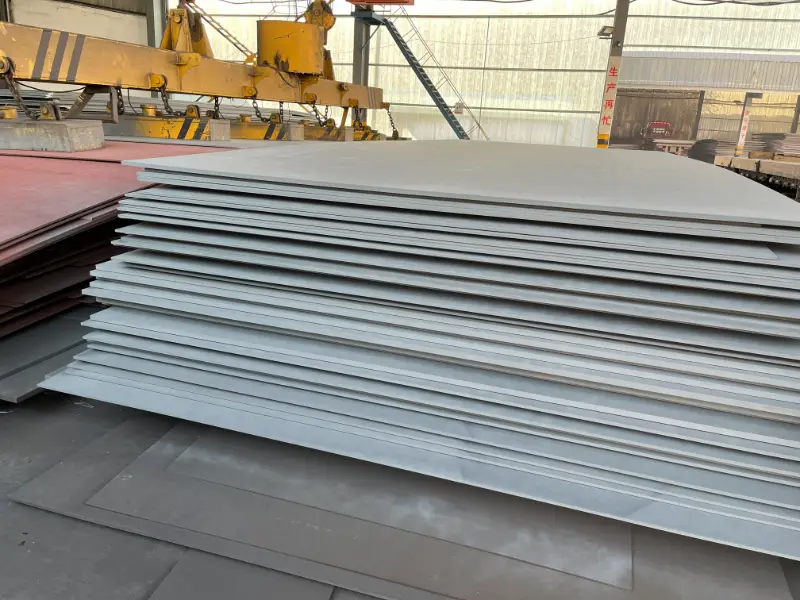
X39Cr13 (1.4031) Stainless Steel
X39Cr13 (1.4031) Stainless Steel: Martensitic Grade for High-Hardness Components
Comprehensive technical data for X39Cr13 (1.4031) martensitic stainless steel under EN 10088, covering chemical composition, mechanical and thermal properties, international equivalents, and application guidance for plate/coil forms.
Hot/cold forming, machining (annealed state), hardening and tempering, welding (requires preheating and post-weld heat treatment)
- Phone : +8618037372205
- Email : [email protected]
- WhatsApp: Contact via Whtsapp
- WeChat: +8618037372205
X39Cr13 Stainless Steel Introduction
X39Cr13 (material number 1.4031) is a martensitic stainless steel standardized under EN 10088-1, commonly supplied as plate or coil. It belongs to the family of corrosion-resisting steels capable of achieving high hardness through heat treatment. The alloy contains approximately 0.36–0.42% carbon and 12.5–14.5% chromium, providing a balance of good wear resistance and moderate corrosion resistance.
- Hardenable to over 50 HRC via quenching and tempering.
- Suitable for applications requiring cutting edges, high strength, and moderate resistance to mild environments.
- Typically delivered in annealed condition (softened) for further processing or in quenched and tempered state according to agreed properties.
The steel is widely used for cutlery, surgical instruments, valves, pump shafts, and wear-resistant parts.
X39Cr13 Stainless Steel Chemical Composition
The ladle analysis limits for X39Cr13 according to EN 10088-2:2014 and EN 10088-3:2014. All values are in weight percent.
- The carbon content is strictly controlled between 0.36% and 0.42% to ensure adequate hardenability while maintaining acceptable corrosion resistance.
- Sulfur is limited to a maximum of 0.015% to minimize hot shortness and improve surface quality in flat products.
- Phosphorus is restricted to 0.040% max to avoid embrittlement.
Product analysis tolerances may apply per the relevant product standard.
| Element | Standard Value (%) | Remarks |
|---|---|---|
| Carbon (C) | 0.36 – 0.42 | Key element for martensitic hardening |
| Silicon (Si) | ≤ 1.00 | |
| Manganese (Mn) | ≤ 1.00 | |
| Phosphorus (P) | ≤ 0.040 | |
| Sulfur (S) | ≤ 0.015 | Low sulfur enhances formability and surface finish |
| Chromium (Cr) | 12.50 – 14.50 | Primary element for corrosion resistance |
| Nickel (Ni) | - | Not specified; may be present as impurity ≤ 1.0% (typical restricted) |
| Molybdenum (Mo) | - | Not added |
| Nitrogen (N) | - | Not intentionally added |
| Iron (Fe) | Balance |
X39Cr13 Stainless Steel Physical Properties
Physical data represent typical engineering values for hardened and tempered X39Cr13. Thermal conductivity is moderate for stainless steels and decreases with increasing temperature. Coefficient of thermal expansion is lower than that of austenitic grades, reducing dimensional changes during heating.
- Elastic modulus is roughly constant for martensitic grades.
- Electrical resistivity is relatively high, typical of chromium-containing steels.
Values are compiled from published stainless steel handbooks and material property databases consistent with EN 10088-1 typical requirements.
| Property | Standard / Typical Value | Unit | Test Condition / Remarks |
|---|---|---|---|
| Density (ρ) | 7.70 – 7.75 | g/cm³ | 20°C |
| Modulus of elasticity (E) | 215 | GPa | 20°C |
| Shear modulus (G) | 82 – 85 | GPa | Calculated from E and Poisson's ratio |
| Poisson's ratio (ν) | 0.30 | - | Elastic range |
| Thermal expansion coefficient (α) | 10.5 – 11.0 | 10⁻⁶·K⁻¹ | 20–100°C; 11.0–11.5 for 20–200°C; 11.5–12.0 for 20–300°C |
| Thermal conductivity (λ) | 30 | W/(m·K) | 20°C |
| Specific heat capacity (cp) | 460 | J/(kg·K) | 20–100°C |
| Electrical resistivity (ρₑ) | 0.55 | µΩ·m | 20°C |
X39Cr13 Stainless Steel Mechanical Properties
Mechanical properties depend on the heat treatment condition. Annealed condition (1C, 1D) represents the softened state for forming/machining. Quenched & tempered (+QT) values are achievable after hardening and tempering at specified conditions; exact values are subject to agreement between supplier and purchaser.
- In the +QT state, the steel exhibits high strength with adequate ductility.
- Hardness can be adjusted over a wide range by tempering temperature.
- Impact values are typical for martensitic grades and decrease at lower tempering temperatures.
Data compiled from EN 10088-2:2014 Table 17 and EN 10088-3:2014 Table A.7.
| Property | Requirement / Typical Value | Unit | Condition / Remarks |
|---|---|---|---|
| Hardness (HB) | ≤ 230 | HB | Annealed condition (1C, 1D) – EN 10088-2 |
| Tensile strength (Rm) | 850 – 1000 | MPa | Quenched & tempered (+QT), thickness ≥ 3 mm, typical for flat products |
| Yield strength (Rp0.2) | ≥ 650 | MPa | +QT condition, thickness ≥ 3 mm |
| Elongation (A) | ≥ 12 (longitudinal) | % | +QT, gauge length 5.65√S₀ |
| Bend test (mandrel diameter) | No cracks; bend angle 180° | - | Annealed condition, mandrel diameter = 2× thickness (transverse) |
| Impact energy (KV₂, ISO‑V) | ≥ 20 | J | +QT, longitudinal, at room temperature (reference for bars ≤ 60 mm, may apply to plates by agreement) |
X39Cr13 Stainless Steel Fully Equivalent Material Standards and Substitute Grades
| Country/Region | Standard | Designation | Remarks |
|---|---|---|---|
| European Union | EN 10088-2/-3 | X39Cr13 (1.4031) | Reference grade |
| Germany (legacy) | DIN EN 10088 | X39Cr13 (1.4031) | Same number, superseded DIN 17440 |
| China | GB/T 20878; GB/T 1220 | 40Cr13 (4Cr13) | Carbon 0.36–0.45, Cr 12.0–14.0; full equivalence to X39Cr13 |
| Japan | JIS G 4303; JIS G 4304 | SUS 420J2 | Carbon 0.26–0.40; within range but slightly lower maximum carbon; considered an equivalent in many applications |
| USA | ASTM A276 / A240 | 420 (UNS S42000) | Carbon 0.15–0.40; grade with carbon content near upper end can match X39Cr13; verify heat analysis |
| Russia | GOST 5632 | 40Ch13 (40Х13) | Technical equivalent with similar carbon and chromium ranges |
X39Cr13 Stainless Steel Application Introduction
X39Cr13 is ideal for parts requiring high hardness (typically 50–54 HRC after proper hardening and tempering) with moderate corrosion resistance in mildly aggressive media such as fresh water, steam, organic acids at low concentrations, and food contact.
- Avoid in chloride-rich environments as pitting resistance is limited.
- Excellent edge retention and polishability make it a standard choice for cutlery and surgical instruments.
- Used in plastics technology for corrosion-resistant mould cavities that require high hardness against abrasive melts.
Product Applications: Kitchen knives and scissors, Surgical scalpels, forceps, and dental burs, Ball bearing rings and elements, Valve stems, seats, and trim (non-chloride service), Pump shafts and wear rings, Plastic injection mould inserts
Processed into products: Blade edges that require re-sharpenability, Hardened liners and guides in textile machinery, High-strength fasteners subjected to mild corrosion, Measuring and precision instrument parts, Wear-resistant linings and cutting tools for soft materials
Application industries: Cutlery and household goods, Medical and dental instruments, Pumps and valves for mild fluids, Plastic processing (injection moulds), Automotive (fuel system components, wear sleeves), Mechanical engineering (bushes, shafts, bearings)
X39Cr13 Stainless Steel Closely Related Alternative Stainless Steels
| Country/Region | Standard | Designation | Remarks |
|---|---|---|---|
| European Union | EN 10088 | X30Cr13 (1.4028) | Slightly lower carbon (0.26–0.35%) offers better toughness and slightly reduced maximum hardness. Often interchangeable for less demanding wear applications. |
| European Union | EN 10088 | X46Cr13 (1.4034) | Higher carbon (0.42–0.50%) provides increased dry wear resistance and hardness but lower ductility and corrosion resistance. Suitable for knife blades requiring extreme edge retention. |
| European Union | EN 10088 | X20Cr13 (1.4021) | Lower carbon (0.16–0.25%) results in significantly better toughness and corrosion resistance but lower as-quenched hardness. Used for structural components where wear is less critical. |
| USA | ASTM | 420F (UNS S42020) | Similar carbon range with added sulfur for improved machinability; lower corrosion resistance and toughness. Not recommeded for welding or critical dynamic loads. |
| Japan | JIS | SUS 440A (SUS 440C) | Higher carbon variants (440A 0.60–0.75% C, 440C 0.95–1.20% C) offer extreme hardness but are more brittle and less corrosion resistant. Suitable for specialized bearing and cutting applications. |
Notes:
X39Cr13 (1.4031) must be preheated to 200–300°C before welding, followed by immediate annealing or tempering to avoid cracking. Caution: Avoid sharp corners and abrupt section changes during hardening to reduce quench-crack risk. For maximum corrosion resistance, a polished surface finish is recommended. This grade is magnetic in all conditions.
- Share



