
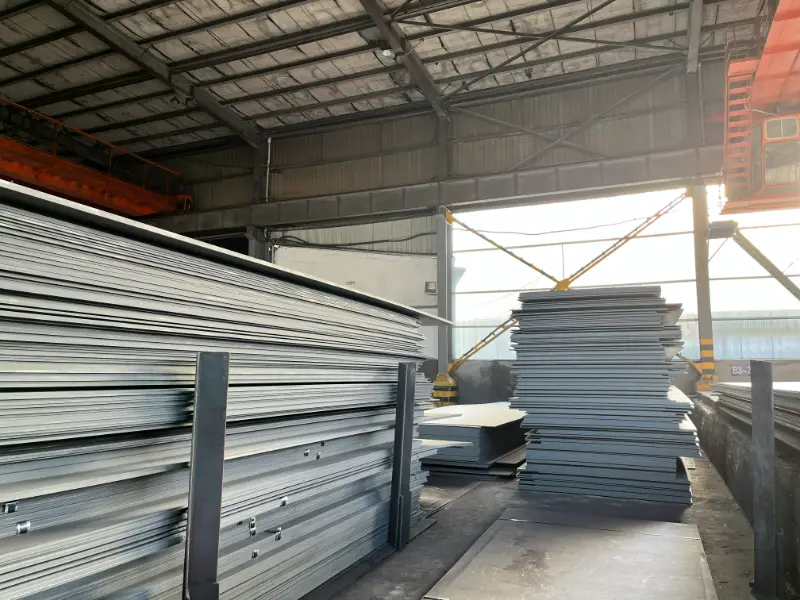
X46Cr13 (1.4034) Martensitic Stainless Steel
X46Cr13 (1.4034) Martensitic Stainless Steel - High Carbon, High Hardness for Cutting and Wear Parts
Complete technical data for X46Cr13 (EN 10088-1) including chemical composition, mechanical and thermal properties, equivalent grades, and application examples for plate and coil products.
Hot rolling, cold rolling, forging, machining in annealed condition, hardening (austenitizing 980–1030°C, oil/polymer quench) and tempering.
- Phone : +8618037372205
- Email : [email protected]
- WhatsApp: Contact via Whtsapp
- WeChat: +8618037372205
X46Cr13 Martensitic Stainless Steel Introduction
X46Cr13 (1.4034) is a high‑carbon martensitic stainless steel according to EN 10088‑1, designed for applications that require high hardness, moderate corrosion resistance, and good wear properties after heat treatment. With a carbon content between 0.43% and 0.50% and chromium around 12.5–14.5%, it can be hardened by quenching and tempering to achieve hardness levels up to approx. 55 HRC. In the annealed condition it offers good machinability and formability; after hardening it is used for cutting tools, surgical instruments, valve components, and industrial knives. The grade is typically supplied as hot rolled plate/coil or cold rolled strip in the annealed (+A) or quenched and tempered (+QT) condition.
X46Cr13 Martensitic Stainless Steel Chemical Composition
The chemical composition is defined in EN 10088‑1. High carbon and chromium are responsible for the hardenability and basic corrosion resistance. Maximum limits for silicon and manganese ensure hot workability, while low sulfur and phosphorus levels are controlled for cleanliness and good mechanical properties.
| Element | Standard Value (wt%) | Remarks |
|---|---|---|
| Carbon (C) | 0.43 – 0.50 | Primary hardenability element |
| Silicon (Si) | ≤ 1.00 | Deoxidizer, improves strength |
| Manganese (Mn) | ≤ 1.00 | Improves hot workability |
| Phosphorus (P) | ≤ 0.040 | Max. to avoid embrittlement |
| Sulfur (S) | ≤ 0.030 | Max. for machinability control |
| Chromium (Cr) | 12.50 – 14.50 | Corrosion resistance and hardenability |
| Iron (Fe) | Balance | Approximately 85 – 88% |
X46Cr13 Martensitic Stainless Steel Thermal and Electrical Physical Properties
Physical properties at room temperature and elevated temperatures are representative for X46Cr13 in the hardened and tempered condition. Thermal conductivity increases with temperature, while the elastic modulus decreases. These values are useful for design calculations involving heat transfer and dimensional changes.
| Property | Typical Value | Unit | Condition / Temperature |
|---|---|---|---|
| Density (ρ) | 7.70 | g/cm³ | 20°C |
| Modulus of elasticity (E) | 215 | GPa | 20°C |
| Shear modulus (G) | 84 | GPa | 20°C |
| Poisson's ratio (ν) | 0.28 | - | 20°C |
| Thermal expansion coefficient (α) | 10.5 | 10⁻⁶/K | 20 – 100°C |
| Thermal expansion coefficient (α) | 11.0 | 10⁻⁶/K | 20 – 200°C |
| Thermal expansion coefficient (α) | 11.5 | 10⁻⁶/K | 20 – 300°C |
| Thermal expansion coefficient (α) | 11.5 | 10⁻⁶/K | 20 – 400°C |
| Thermal expansion coefficient (α) | 12.0 | 10⁻⁶/K | 20 – 500°C |
| Thermal conductivity (λ) | 25.0 | W/(m·K) | 100°C |
| Thermal conductivity (λ) | 25.5 | W/(m·K) | 500°C |
| Specific heat capacity (cₚ) | 460 | J/(kg·K) | 20°C |
| Electrical resistivity (ρₑ) | 0.55 | 10⁻⁶ Ω·m | 20°C |
X46Cr13 Martensitic Stainless Steel Mechanical Properties
Mechanical properties depend on the heat treatment condition. In the annealed (+A) condition, the steel is soft and can be formed or machined. After hardening and tempering (+QT) the steel achieves high strength, hardness, and wear resistance. The values given below are from EN 10088‑2 for hot rolled plate/coil with thickness ≤ 75 mm, unless otherwise noted.
| Property | Standard Value | Unit | Condition |
|---|---|---|---|
| Brinell hardness | ≤ 225 | HB | Annealed (+A) |
| Tensile strength (Rm) | ≤ 730 | MPa | Annealed (+A) |
| Yield strength (Rp0.2) | ≥ 350 | MPa | Annealed (+A) |
| Elongation (A) | ≥ 15 | % | Annealed (+A) |
| Tensile strength (Rm) | 650 – 850 | MPa | Quenched & tempered (+QT) |
| Yield strength (Rp0.2) | ≥ 450 | MPa | Quenched & tempered (+QT) |
| Elongation (A) | ≥ 12 | % | Quenched & tempered (+QT) |
| Impact energy (KV, 20°C) | ≥ 25 (longitudinal) | J | Quenched & tempered (+QT) |
| Brinell hardness (typical) | 200 – 250 | HB | Quenched & tempered (+QT, tempered at 200–370°C) |
X46Cr13 Martensitic Stainless Steel Completely Equivalent Material Standards & Replaceable Grades
| Country/Region | Standard | Grade | Remarks |
|---|---|---|---|
| Europe | EN 10088-1 | X46Cr13 (1.4034) | Reference standard for this datasheet |
X46Cr13 Martensitic Stainless Steel Application Introduction
X46Cr13 is widely used where a combination of high hardness, moderate corrosion resistance, and good wear resistance is required. After hardening and tempering it can hold a sharp edge, making it a classical cutlery steel. Typical fields include:
Product Applications: Surgical scalpels, scissors, forceps, tweezers, Chef's knives, steak knives, scissors, Industrial shear blades, circular knives, granulator blades, Valve seats, pump shafts, wear sleeves, Razor blades, shaving heads
Processed into products: Blade edges, cutting discs, doctor blades, Wear rings, thrust washers, valve trims, Nozzles, injector components, High‑strength corrosion‑resistant springs and fasteners (after tempering)
Application industries: Medical and surgical instruments, Cutlery and kitchen tools, Industrial blades and cutting tools, Pumps, valves and fluid handling, Food processing machinery
X46Cr13 Martensitic Stainless Steel Similar / Alternative Materials
| Country/Region | Standard | Grade | Remarks |
|---|---|---|---|
| Europe | EN 10088-1 | X39Cr13 (1.4031) | Lower carbon (0.36–0.42%), slightly lower hardness |
| USA | ASTM A276 / ASTM A240 | 420 (UNS S42000) | Carbon ≤ 0.40%, lower achievable hardness |
| Japan | JIS G4303 / G4304 | SUS420J2 | Carbon 0.26–0.40%, similar but lower carbon range |
| Germany (historic) | DIN 17440 | X46Cr13 (1.4034) | Identical composition, predecessor standard |
Notes:
Welding is not recommended for this grade due to the high carbon content; if unavoidable, preheating to 200–300°C and post‑weld heat treatment (quench & temper) are required to restore hardness and avoid cracking. Corrosion resistance is moderate – suitable for mild environments, fresh water, steam, and some organic acids, but not for chloride‑rich or strongly acidic conditions. Machining is best performed in the annealed condition; after hardening, only grinding is practical.
- Share



