
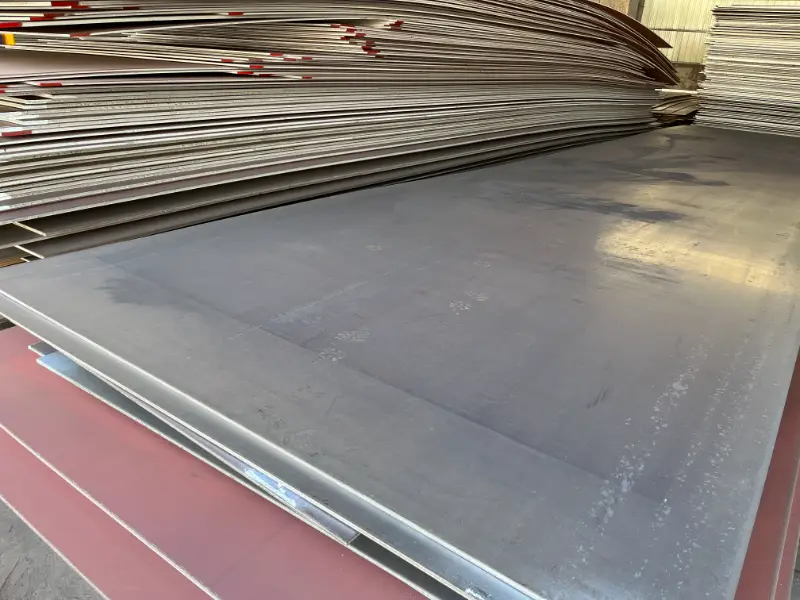
X38CrMo14 (1.4419) Martensitic Stainless Steel
X38CrMo14 (1.4419) Martensitic Stainless Steel - EN 10088 Grade for High-Hardness Cutlery and Surgical Tools
Detailed material data for X38CrMo14 (1.4419) per EN 10088, including chemical composition, mechanical and physical properties, international equivalents, and application guidance.
Hot rolling, cold rolling, forging; machining in annealed condition; hardening by quenching from 950–1050 °C followed by tempering between 150–300 °C
- Phone : +8618037372205
- Email : [email protected]
- WhatsApp: Contact via Whtsapp
- WeChat: +8618037372205
X38CrMo14 Martensitic Stainless Steel Introduction
X38CrMo14, material number 1.4419, is a martensitic stainless steel specified in EN 10088-1. It contains higher carbon and molybdenum compared to standard 13% chromium martensitic grades, achieving high hardness after heat treatment while maintaining good corrosion resistance. Typical characteristics:
- High hardness (up to 56 HRC) after quenching and tempering
- Improved wear resistance and edge retention
- Suitable for hardening by martensitic transformation
- Limited weldability and requires preheating and post-weld heat treatment
The material is primarily produced as plate and coil for subsequent fabrication into cutting tools, surgical instruments, and wear-resistant components. Its combination of hardness and corrosion resistance makes it particularly suitable for applications where both sharp edges and moderate chemical exposure are expected.
X38CrMo14 Martensitic Stainless Steel Chemical composition
The chemical composition of X38CrMo14 (1.4419) as specified in EN 10088-1 is given below. Carbon and chromium are the primary elements determining hardenability and corrosion resistance. Molybdenum further enhances resistance to pitting and improves tempering response. Strict control of phosphorus and sulfur ensures adequate toughness after heat treatment.
| Element | Standard value (%) | Remarks |
|---|---|---|
| Carbon, C | 0.33 – 0.43 | Key for hardness and martensite formation |
| Silicon, Si | ≤ 1.00 | Deoxidizer; limited to maintain toughness |
| Manganese, Mn | ≤ 1.00 | May be present as a deoxidizer |
| Phosphorus, P | ≤ 0.040 | Kept low to avoid embrittlement |
| Sulfur, S | ≤ 0.015 | For improved cleanliness (low sulfur content) |
| Chromium, Cr | 13.0 – 14.0 | Primary element for corrosion resistance |
| Molybdenum, Mo | 0.30 – 0.60 | Improves corrosion resistance and hardenability |
| Iron, Fe | Balance |
X38CrMo14 Martensitic Stainless Steel Thermal and electrical physical properties
Physical properties of X38CrMo14 (1.4419) are typical for a high‑carbon martensitic stainless steel. Data provided are for the annealed condition and serve for design calculations. Properties may vary slightly with heat treatment condition.
| Property | Typical value | Unit | Test conditions/Remarks |
|---|---|---|---|
| Density, ρ | 7.70 | g/cm³ | Room temperature |
| Modulus of elasticity, E | 215 | GPa | 20 °C, tension |
| Shear modulus, G | ≈ 83 | GPa | Calculated from E and Poisson's ratio |
| Poisson's ratio, ν | 0.30 | — | Room temperature |
| Thermal expansion coefficient, α | 10.5 × 10⁻⁶ | K⁻¹ | 20–100 °C |
| Thermal expansion coefficient, α | 11.0 × 10⁻⁶ | K⁻¹ | 20–200 °C |
| Thermal expansion coefficient, α | 11.5 × 10⁻⁶ | K⁻¹ | 20–400 °C |
| Thermal conductivity, λ | 24 | W/(m·K) | At 20 °C |
| Thermal conductivity, λ | 25 | W/(m·K) | At 200 °C |
| Thermal conductivity, λ | 27 | W/(m·K) | At 400 °C |
| Specific heat capacity, cp | 460 | J/(kg·K) | Room temperature |
| Electrical resistivity, ρe | 0.65 | μΩ·m | Room temperature |
X38CrMo14 Martensitic Stainless Steel Mechanical properties
The mechanical properties listed below apply to flat products of thickness up to 75 mm in the quenched and tempered (+QT) condition according to EN 10088-2. Values are for longitudinal direction at room temperature unless otherwise stated. The material exhibits a combination of high strength and moderate ductility. Impact toughness is typically limited due to the high carbon content.
| Property | Standard value | Unit | Test conditions |
|---|---|---|---|
| Yield strength, Rp0.2 | ≥ 550 | MPa | +QT, thickness 1.5–75 mm, room temperature |
| Tensile strength, Rm | 750 – 950 | MPa | +QT, thickness 1.5–75 mm, room temperature |
| Elongation, A | ≥ 14 (longitudinal) | % | Gauge length L0 = 5.65√S0, +QT |
| Impact energy, KV | ≥ 20 (ISO-V) | J | +QT, room temperature, transverse |
| Hardness | approx. 50–56 HRC | HRC | After hardening and tempering at 150–200 °C; dependent on tempering temperature |
X38CrMo14 Martensitic Stainless Steel Completely equivalent material standards and substitute grades
| Country / Region | Standard | Designation | Remarks |
|---|---|---|---|
| EU | EN 10088-1 | X38CrMo14 (1.4419) | General standard, base grade |
| EU | EN 10088-2 | X38CrMo14 (1.4419) | Flat products (plate, coil, strip) |
| EU | EN 10088-3 | X38CrMo14 (1.4419) | Semi-finished products, bars, wires, profiles |
| EU | EN 10272 | X38CrMo14 (1.4419) | Stainless steel bars for pressure purposes |
| International | ISO 15510 | X38CrMo14 (1.4419) | Identical chemical composition |
| France | NF EN 10088-2 | X38CrMo14 (1.4419) | Adoption of EN standard |
| UK | BS EN 10088-2 | X38CrMo14 (1.4419) | Adoption of EN standard |
| Germany | DIN EN 10088-2 | X38CrMo14 (1.4419) | Adoption of EN standard |
X38CrMo14 Martensitic Stainless Steel Application Introduction
X38CrMo14 (1.4419) is selected where high hardness and moderate corrosion resistance are required. Typical fields of use and fabricated products are listed below.
Product Applications: Knife blades, scissors, shears, Surgical scalpels, forceps, clamps, Valve seats and stems, Pump shafts and spindles, Wear plates and guides
Processed into products: Hardened cutting edges, Precision dental tools, High-hardness washers and spacers, Mould inserts for plastics, Industrial shear blades
Application industries: Cutlery & kitchenware, Medical and surgical instruments, Food processing equipment, Valves and pumps, Mechanical engineering (wear parts)
X38CrMo14 Martensitic Stainless Steel Similar / alternative grades with comparable properties
| Country / Region | Standard | Designation | Remarks |
|---|---|---|---|
| EU | EN 10088-1 | X40Cr14 (1.4034) | Slightly higher carbon, no intentional Mo; lower corrosion resistance |
| EU | EN 10088-1 | X20Cr13 (1.4021) | Lower carbon; lower hardness but better toughness |
| EU | EN 10088-1 | X50CrMoV15 (1.4116) | Contains vanadium; widely used for cutlery, similar hardness range |
| USA | ASTM A276 | 420 (UNS S42000) | Lower carbon; not directly equivalent but often compared for cutlery applications |
| USA | ASTM A276 | 440A (UNS S44002) | Higher Cr, lower C; somewhat similar corrosion resistance |
| Japan | JIS G4303 | SUS420J1 (SUS 420 J1) | Similar composition; slight differences in C and Mo |
Notes:
Heat treatment recommendations: Austenitize at 950–1050 °C, oil/air quench, temper immediately at 150–300 °C to achieve desired hardness and relieve stresses. Avoid tempering in the 400–600 °C range to prevent embrittlement. For improved corrosion resistance, a low-temperature temper (150–200 °C) is recommended. The material is magnetic in all conditions. For welding, preheat to 200–300 °C and use matching filler metals (e.g., 1.4419 wires); post-weld heat treatment is essential to restore properties. Not recommended for applications involving high-temperature strength above 400 °C due to loss of hardness.
- Share



