
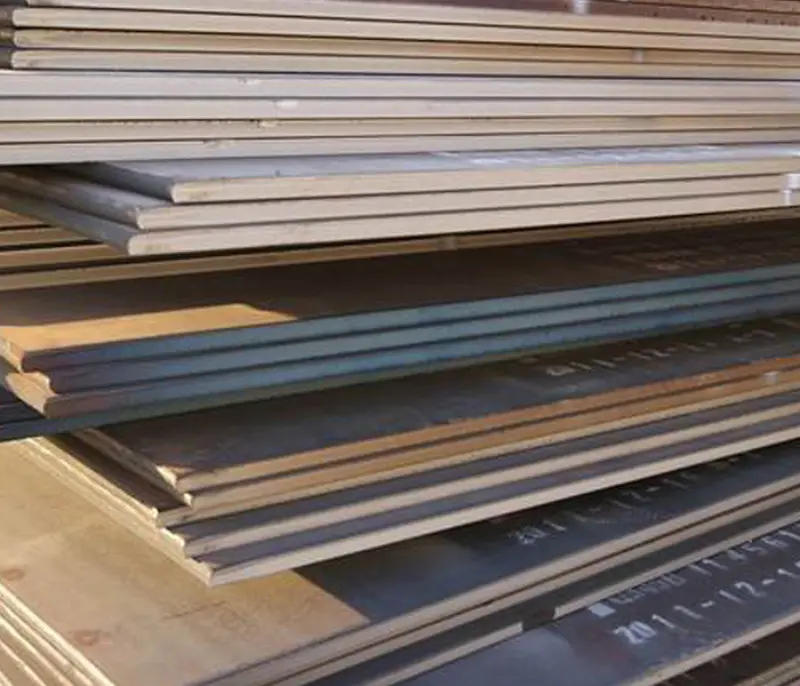
X6CrAl13 Ferritic Stainless Steel Plate/Coil
X6CrAl13 Ferritic Stainless Steel Plate/Coil | EN 10088-1 Grade | Oxidation Resistant
Explore the technical properties of X6CrAl13 (1.4002) ferritic stainless steel plate and coil. Chemical composition, mechanical strength, and thermal data per EN 10088-1. Ideal for exhaust systems and high-temperature oxidation resistance.
Cold rolling, hot rolling, annealing, pickling, cutting, forming, welding
- Phone : +8618037372205
- Email : [email protected]
- WhatsApp: Contact via Whtsapp
- WeChat: +8618037372205
X6CrAl13 Ferritic Stainless Steel Plate/Coil Introduction
X6CrAl13, designated as 1.4002 under EN 10088-1, is a ferritic stainless steel with an aluminum addition that enhances high-temperature oxidation resistance. This grade provides good corrosion resistance in mildly aggressive environments and is particularly suited for applications requiring scaling resistance up to 800 °C.
Key features include:
- Low carbon content (<0.08%) ensures ductility and weldability without post-weld annealing.
- Aluminum (0.10–0.30%) promotes a tightly adherent oxide layer at elevated temperatures.
- Ferritic microstructure eliminates stress corrosion cracking susceptibility.
- Good cold formability and satisfactory weldability with proper filler metals.
X6CrAl13 is typically supplied in the annealed condition, offering a combination of moderate strength and excellent thermal stability.
X6CrAl13 Ferritic Stainless Steel Plate/Coil Chemical Composition
The following table lists the chemical requirements for X6CrAl13 (1.4002) as specified in EN 10088-2:2014 for flat products. The aluminum addition is critical for high-temperature scaling resistance. All values are in percent by weight.
| Element | Specified Value | Remarks |
|---|---|---|
| Carbon (C) | ≤0.08 | Maximum |
| Silicon (Si) | ≤1.00 | Maximum |
| Manganese (Mn) | ≤1.00 | Maximum |
| Phosphorus (P) | ≤0.040 | Maximum |
| Sulfur (S) | ≤0.015 | Maximum |
| Chromium (Cr) | 12.00–14.00 | Content range |
| Aluminium (Al) | 0.10–0.30 | Content range |
X6CrAl13 Ferritic Stainless Steel Plate/Coil Thermal and Electrical Physical Properties
Typical physical properties at room temperature and elevated temperatures as given in the informative annex of EN 10088-1:2014. These values are representative for the grade and can be used for design calculations. The specific heat and thermal conductivity increase with temperature, while elastic modulus decreases.
| Property | Typical Value | Unit | Test Condition / Temperature Range |
|---|---|---|---|
| Density (ρ) | 7.7 | kg/dm³ | 20 °C |
| Modulus of elasticity (E) | 220 | GPa | 20 °C |
| Shear modulus (G) | 85 | GPa | 20 °C |
| Poisson's ratio (ν) | 0.28 | — | 20 °C |
| Thermal expansion coefficient (α) | 10.5 | 10⁻⁶/K | 20–100 °C |
| Thermal expansion coefficient (α) | 11.0 | 10⁻⁶/K | 20–200 °C |
| Thermal expansion coefficient (α) | 11.5 | 10⁻⁶/K | 20–300 °C |
| Thermal expansion coefficient (α) | 12.0 | 10⁻⁶/K | 20–400 °C |
| Thermal conductivity (λ) | 25 | W/(m·K) | 20 °C |
| Specific heat capacity (cp) | 460 | J/(kg·K) | 20 °C |
| Electrical resistivity (ρ_e) | 0.60 | µΩ·m | 20 °C |
X6CrAl13 Ferritic Stainless Steel Plate/Coil Mechanical Properties
Mechanical properties for flat products in the annealed condition according to EN 10088-2:2014. The values vary with product thickness. The elongation values are given for gauge length A80 (thickness <3 mm) and A (thickness ≥3 mm, proportional gauge length 5.65√S0). No impact test requirements are specified for this grade in the standard.
| Property | Standard Requirement | Unit | Test Condition |
|---|---|---|---|
| Yield strength (Rp0.2) | ≥250 | MPa | Thickness ≤8 mm, transverse |
| Yield strength (Rp0.2) | ≥240 | MPa | Thickness 8-13.5 mm, transverse |
| Tensile strength (Rm) | 400–600 | MPa | All thicknesses, transverse |
| Elongation after fracture (A80) | ≥18 | % | Thickness <3 mm, gauge length 80 mm |
| Elongation after fracture (A) | ≥18 | % | Thickness ≥3 mm, gauge length 5.65√S0 |
X6CrAl13 Ferritic Stainless Steel Plate/Coil Completely Equivalent Material Standards & Substitute Grades
| Country/Region | Standard | Grade | Remarks |
|---|---|---|---|
| Europe | EN 10088-2 | X6CrAl13 (1.4002) | Original designation |
| USA | ASTM A240/A240M | 405 (S40500) | UNS S40500 |
| Japan | JIS G4304/G4305 | SUS405 | Hot/cold rolled plate |
| China | GB/T 20878 | 06Cr13Al (S11348) | Old designation 0Cr13Al |
| International | ISO 15510 | X6CrAl13 | Identical chemical composition |
X6CrAl13 Ferritic Stainless Steel Plate/Coil Application Introduction
X6CrAl13 is specifically designed for elevated temperature service where resistance to scaling and oxidation is essential. Its ferritic structure avoids embrittlement from sigma phase, and the aluminum addition ensures a protective oxide layer. Key application areas and products include:
Product Applications: Exhaust manifolds and pipes, Catalytic converter shells, Heat exchanger plates and tubes, Furnace dampers and radiant tubes, Oil burner components, Firebox linings
Processed into products: Flanges, Bolted connections, Welded assemblies, Stamped brackets, Deep-drawn cups and housings, Structural supports in hot zones
Application industries: Automotive (exhaust systems, catalytic converters), Petrochemical (heat exchangers, furnace parts), Power generation (preheaters, recuperators), Domestic appliances (oven liners, burner parts), General engineering (oxidizing atmosphere components)
X6CrAl13 Ferritic Stainless Steel Plate/Coil Similar / Alternative Materials Recommendations
| Country/Region | Standard | Grade | Remarks |
|---|---|---|---|
| Europe | EN 10088-2 | X6Cr13 (1.4000) | Ferritic, no Al, slightly lower oxidation resistance |
| USA | ASTM A240/A240M | 410S (S41008) | Low carbon martensitic, higher hardenability, less oxidation resistance |
| China | GB/T 20878 | 10Cr17 (S11710) | Higher Cr, no Al, better corrosion resistance but lower thermal stability for scaling |
| Japan | JIS G4304 | SUS410L | Low carbon 12Cr ferritic, no Al, used in similar applications with less temperature stability |
Notes:
- Welding should preferably use an austenitic filler metal (e.g., ER308L) to improve toughness and avoid grain growth; post-weld heat treatment is not mandatory but stress relief at 750–800 °C can be applied.
- Maximum service temperature for continuous exposure in air is approximately 800 °C; intermittent use up to 900 °C may be possible depending on atmosphere.
- Cold forming requires attention to limited ductility compared to austenitic grades; preheating to 200–300 °C improves formability for severe operations.
- Surface finish (e.g., 2B, 2D) is standardized according to EN 10088-2.
- The material is magnetic and has a coefficient of thermal expansion lower than austenitic stainless steels, which reduces thermal fatigue in cyclic heating applications.
- Share



