
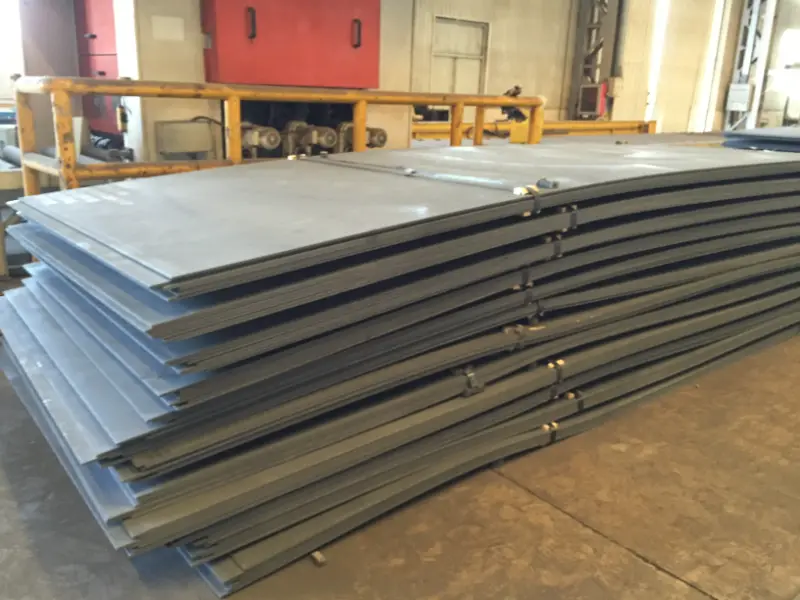
X2CrTi17 (1.4510) Ferritic Stainless Steel Plate & Coil
X2CrTi17 (1.4510) Ferritic Stainless Steel Plate & Coil | EN 10088-1 Data
Complete material data for X2CrTi17 (1.4510) ferritic stainless steel as per EN 10088-1 and EN 10088-2. Chemical composition, mechanical and physical properties, international equivalents and application guide.
cold rolling, hot rolling, forming, welding, blanking, bending
- Phone : +8618037372205
- Email : [email protected]
- WhatsApp: Contact via Whtsapp
- WeChat: +8618037372205
X2CrTi17 Ferritic Stainless Steel Plate & Coil Introduction
X2CrTi17 (1.4510) is a titanium-stabilized ferritic stainless steel with very low carbon content, providing excellent resistance to intergranular corrosion after welding. It combines good mechanical strength with moderate ductility and is supplied in the annealed condition for plate, coil and strip products. The titanium addition prevents sensitization during welding, making it suitable for fabrications that cannot be heat treated after welding. It is magnetic and offers good oxidation resistance up to about 800°C in intermittent service. Typical applications include household appliances, automotive exhaust systems, architectural trim and chemical equipment.
X2CrTi17 Ferritic Stainless Steel Plate & Coil Chemical Composition
Chemical composition according to EN 10088-1:2014 cast analysis for grade 1.4510. Titanium content is controlled by the formula Ti ≥ 4×(C+N) + 0.15, up to a maximum of 0.80%. Residual elements not listed are kept as low as practically possible.
| Element | Standard Value | Remarks |
|---|---|---|
| C | ≤ 0.025 | |
| Si | ≤ 1.00 | |
| Mn | ≤ 1.00 | |
| P | ≤ 0.040 | |
| S | ≤ 0.015 | |
| Cr | 16.0 – 18.0 | |
| Ti | ≤ 0.80 | Ti ≥ 4×(C+N) + 0.15 |
X2CrTi17 Ferritic Stainless Steel Plate & Coil Thermal, Electrical and Physical Properties
Physical properties as given in EN 10088-1:2014 Annex A for grade 1.4510 in the annealed condition. Values are typical for wrought products and may vary slightly with processing. The alloy is ferromagnetic at all service temperatures.
| Property | Typical Value | Unit | Test Condition / Remarks |
|---|---|---|---|
| Density (ρ) | 7.7 | g/cm³ | 20 °C |
| Elastic modulus (E) | 220 | GPa | 20 °C |
| Shear modulus (G) | 84 | GPa | Calculated from E and Poisson ratio |
| Poisson ratio (ν) | 0.3 | Typical for ferritic stainless steels | |
| Thermal expansion coefficient (α) | 10.0 | 10⁻⁶/K | 20–100 °C |
| Thermal expansion coefficient (α) | 10.5 | 10⁻⁶/K | 20–200 °C |
| Thermal expansion coefficient (α) | 11.0 | 10⁻⁶/K | 20–400 °C |
| Thermal expansion coefficient (α) | 11.5 | 10⁻⁶/K | 20–600 °C |
| Thermal conductivity (λ) | 25 | W/(m·K) | 20 °C |
| Thermal conductivity (λ) | 26 | W/(m·K) | 200 °C |
| Thermal conductivity (λ) | 27 | W/(m·K) | 400 °C |
| Specific heat capacity (Cp) | 460 | J/(kg·K) | 20 °C |
| Electrical resistivity (ρe) | 0.60 | μΩ·m | 20 °C |
X2CrTi17 Ferritic Stainless Steel Plate & Coil Mechanical Properties
Room temperature mechanical properties in the annealed condition according to EN 10088-2:2014. Values for cold rolled strip (thickness ≤6 mm) and hot rolled plate (thickness ≤12 mm) are given for the longitudinal direction. Bend test requirements apply to both cold rolled and hot rolled products.
| Property | Standard Requirement | Unit | Test Condition |
|---|---|---|---|
| Yield strength Rp0.2 | ≥ 200 | MPa | Longitudinal, cold rolled strip, thickness ≤6 mm, annealed |
| Tensile strength Rm | 420 – 600 | MPa | Longitudinal, cold rolled strip, thickness ≤6 mm, annealed |
| Elongation A80 | ≥ 20 | % | Longitudinal, cold rolled strip, thickness ≤6 mm, annealed |
| Yield strength Rp0.2 | ≥ 200 | MPa | Longitudinal, hot rolled plate, thickness ≤12 mm, annealed |
| Tensile strength Rm | 420 – 600 | MPa | Longitudinal, hot rolled plate, thickness ≤12 mm, annealed |
| Elongation A (5.65√S0) | ≥ 20 | % | Longitudinal, hot rolled plate, thickness ≤12 mm, annealed |
| Bend test (180°) | Bend mandrel diameter = 2t | Cold rolled strip 0.5–10 mm, hot rolled plate 3–25 mm; t = thickness |
X2CrTi17 Ferritic Stainless Steel Plate & Coil Direct Equivalent Standards and Substitutable Grades
| Country/Region | Standard | Grade | Remarks |
|---|---|---|---|
| Europe | EN 10088-1 | X2CrTi17 (1.4510) | Reference grade |
| International | ISO 15510 | X2CrTi17 (1.4510) | Identical to EN |
| China | GB/T 3280 | 022CrTi17 (S11863) | Chemically identical, stabilized with Ti |
X2CrTi17 Ferritic Stainless Steel Plate & Coil Application Introduction
X2CrTi17 is selected where a combination of moderate corrosion resistance, weldability without post-weld heat treatment, and low cost is required. The titanium stabilization makes it immune to intergranular corrosion after welding. Typical applications fall into the following areas:
Product Applications: Dishwasher inner cabinets and spray arms, Cooker control panels and oven linings, Automotive exhaust mufflers and pipes, Architectural sandwich panels and flashings, Storage tanks for water, acetic acid, or food products, Decorative indoor and outdoor trim
Processed into products: Deep-drawn and formed parts such as tubs and bowls, Welded tubular components and exhaust pipe sections, Perforated strips and expanded metal, Brackets and supports in lightly corrosive environments, Heat exchanger plates (brazed or welded type)
Application industries: Domestic appliances (dishwashers, washing machines, ovens), Automotive (exhaust systems, catalytic converter shells, mufflers), Architecture and construction (cladding, roofing, decorative profiles), Chemical industry (tanks, piping for mildly corrosive fluids), Food and beverage processing (mild environment, non-severe corrosion exposure), Heat exchange (low-pressure water heaters, solar panels)
X2CrTi17 Ferritic Stainless Steel Plate & Coil Similar or Closely Related Substitute Materials
| Country/Region | Standard | Grade | Remarks |
|---|---|---|---|
| USA | ASTM A240/A240M | UNS S43940 (AISI 439) | Higher carbon (≤0.07%) but similar Cr and Ti stabilization; good alternative for many applications |
| Japan | JIS G4304/G4305 | SUS 436J1L | Nb-stabilized 17% Cr ferritic with slightly different composition; similar corrosion resistance |
| Europe | EN 10088-1 | X2CrMoTi17-1 (1.4513) | Mo-bearing variant with improved pitting resistance |
Notes:
Special considerations: Although titanium stabilized, X2CrTi17 can be susceptible to 475°C embrittlement if exposed for long periods in the temperature range 400–550°C. Ductile-to-brittle transition temperature is relatively high; therefore it is not recommended for cryogenic service or heavy impact loading at low temperatures. The material is magnetic and cannot be hardened by heat treatment. Surface pickling and passivation are recommended after welding to restore full corrosion resistance. Cold working increases strength but reduces ductility; post-cold-work annealing restores soft, formable condition.
- Share



