
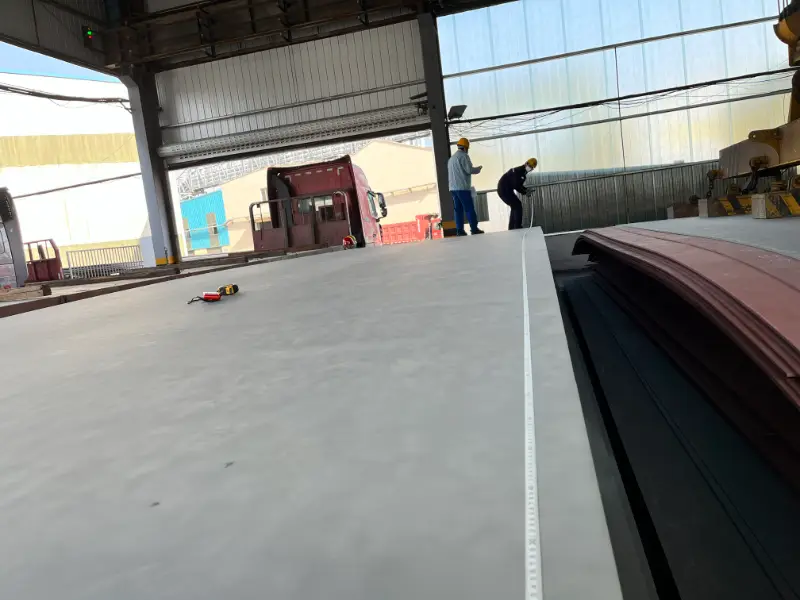
X4CrNiMo16-5-1 (1.4418) High-Strength Martensitic Stainless Steel Plate & Coil
X4CrNiMo16-5-1 (1.4418) High-Strength Martensitic Stainless Steel Plate & Coil
Detailed technical data for X4CrNiMo16-5-1 stainless steel including chemical composition, mechanical and thermal properties, equivalent grades, and application examples for plates and coils.
Hot rolling, cold rolling, heat treatment (quenching & tempering), machining, welding, forging, cold forming
- Phone : +8618037372205
- Email : [email protected]
- WhatsApp: Contact via Whtsapp
- WeChat: +8618037372205
X4CrNiMo16-5-1 High-Strength Martensitic Stainless Steel Plate & Coil Introduction
X4CrNiMo16-5-1 (material number 1.4418) is a low-carbon martensitic stainless steel with additions of chromium, nickel, and molybdenum. It delivers a unique combination of high strength, good toughness, and improved corrosion resistance compared to conventional 13% Cr steels.
The grade is designed for applications that demand mechanical durability in mildly aggressive environments. Its balanced composition ensures excellent weldability and good resistance to general corrosion, pitting, and stress corrosion cracking.
- High yield and tensile strength after quenching and tempering
- Good impact toughness down to low temperatures
- Better corrosion resistance than martensitic grades such as 1.4021
- Available as plate, coil, sheet, and strip
Typical delivery condition is quenched and tempered (QT) according to EN 10088-2.
X4CrNiMo16-5-1 High-Strength Martensitic Stainless Steel Plate & Coil Chemical Composition
The chemical composition is controlled to guarantee a martensitic microstructure with balanced corrosion resistance. Low carbon content enhances weldability. Sulfur is limited to 0.015% for flat products (plate/coil) according to EN 10088-2.
- Chromium, nickel and molybdenum provide improved pitting and general corrosion resistance
- Phosphorus and sulfur are kept low to maintain toughness and cleanness
| Chemical Element | Standard Value (wt%) | Remarks |
|---|---|---|
| Carbon (C) | ≤ 0.06 | Maximum |
| Silicon (Si) | ≤ 0.70 | Maximum |
| Manganese (Mn) | ≤ 1.50 | Maximum |
| Phosphorus (P) | ≤ 0.040 | Maximum |
| Sulfur (S) | ≤ 0.015 | Maximum for flat products |
| Chromium (Cr) | 15.00 - 17.00 | Range |
| Nickel (Ni) | 4.00 - 6.00 | Range |
| Molybdenum (Mo) | 0.80 - 1.50 | Range |
X4CrNiMo16-5-1 High-Strength Martensitic Stainless Steel Plate & Coil Thermal and Electrical Physical Properties
Typical physical property data for X4CrNiMo16-5-1 are presented below. Values may vary slightly depending on the exact heat treatment and production route. Thermal expansion, heat capacity, and conductivity are given for different temperature ranges to assist in design calculations.
| Property | Typical Value | Unit | Test Condition / Temperature |
|---|---|---|---|
| Density (ρ) | 7700 | kg/m³ | 20°C |
| Elastic Modulus (E) | 215 | GPa | 20°C |
| Shear Modulus (G) | 84 | GPa | 20°C |
| Poisson's Ratio (ν) | 0.30 | – | 20°C |
| Thermal Expansion Coefficient (α) | 10.5 | 10⁻⁶/K | 20 – 100°C |
| Thermal Expansion Coefficient (α) | 11.0 | 10⁻⁶/K | 20 – 200°C |
| Thermal Expansion Coefficient (α) | 11.5 | 10⁻⁶/K | 20 – 300°C |
| Thermal Expansion Coefficient (α) | 12.0 | 10⁻⁶/K | 20 – 400°C |
| Thermal Conductivity (λ) | 15 | W/(m·K) | 20°C |
| Thermal Conductivity (λ) | 18 | W/(m·K) | 200°C |
| Thermal Conductivity (λ) | 21 | W/(m·K) | 400°C |
| Specific Heat Capacity (c) | 430 | J/(kg·K) | 20°C |
| Specific Heat Capacity (c) | 500 | J/(kg·K) | 200°C |
| Specific Heat Capacity (c) | 580 | J/(kg·K) | 400°C |
| Electrical Resistivity (ρ_e) | 0.60 | µΩ·m | 20°C |
X4CrNiMo16-5-1 High-Strength Martensitic Stainless Steel Plate & Coil Mechanical Properties
The mechanical properties below apply to plate and coil products in quenched and tempered (QT) condition, for thicknesses up to 160 mm. Tests are performed at room temperature in the longitudinal direction (tensile) and at 20°C for Charpy V-notch specimens.
Higher strength and adequate ductility make this grade ideal for heavy-duty components.
| Property | Required Value | Unit | Test Conditions |
|---|---|---|---|
| Yield Strength (Rp0.2) | ≥ 700 | MPa | Room temperature, QT, thickness ≤ 160 mm |
| Tensile Strength (Rm) | 900 - 1100 | MPa | Room temperature, QT, thickness ≤ 160 mm |
| Elongation (A) | ≥ 15 | % | Room temperature, QT, thickness ≤ 160 mm, L0=5.65√S0 |
| Impact Energy (KV) | ≥ 50 | J | 20°C, QT, thickness ≤ 160 mm, Charpy V-notch |
X4CrNiMo16-5-1 High-Strength Martensitic Stainless Steel Plate & Coil Fully Equivalent Grades and Standards
| Region/Country | Standard | Grade | Remarks |
|---|---|---|---|
| European Union | EN 10088-1 | X4CrNiMo16-5-1 (1.4418) | Identical |
| International (ISO) | ISO 15510 | X4CrNiMo16-5-1 | Identical chemical composition |
| Germany | DIN EN 10088-1 | X4CrNiMo16-5-1 | Same as EN |
| France | NF EN 10088-1 | X4CrNiMo16-5-1 | Same as EN |
| United Kingdom | BS EN 10088-1 | X4CrNiMo16-5-1 | Same as EN |
| Sweden | SS-EN 10088-1 | X4CrNiMo16-5-1 | Same as EN |
X4CrNiMo16-5-1 High-Strength Martensitic Stainless Steel Plate & Coil Application Introduction
X4CrNiMo16-5-1 is widely used where high strength, good fatigue resistance, and moderate corrosion resistance are required.
- Excellent machinability in the hardened and tempered condition
- Suitable for welding with proper preheating and post-weld heat treatment
- Can be surface hardened (nitriding or induction) to improve wear resistance
Typical industries and products include:
Product Applications: Pump shafts and impellers, Valve bodies, seats, and stems, Propeller shafts and rudder stocks, Hydraulic cylinder rods, High-strength corrosion-resistant fasteners, Forged pressure-containing components
Processed into products: Turbine blades and guide vanes, Compressor rotors and casings, Bolting for pressure vessels and piping, Shaft sleeves and bearing housings, Corrosion-resistant structural weldments
Application industries: Hydropower and thermal power generation, Oil & gas (pumps, valves, compressors), Chemical and petrochemical processing, Marine and shipbuilding, Food processing equipment, General mechanical engineering
X4CrNiMo16-5-1 High-Strength Martensitic Stainless Steel Plate & Coil Similar/Alternative Materials
| Region/Country | Standard | Grade | Remarks |
|---|---|---|---|
| USA | ASTM A182 / A240 | F6NM (UNS S41500) | Similar martensitic stainless, lower Mo (0.5-1.0%), C ≤ 0.05 |
| EU | EN 10088-2 | X4CrNi13-4 (1.4313) | Lower Mo, slightly different mechanical properties |
| China | GB/T 20878 | 022Cr12Ni (S11203) or analogous | Approximate replacement, exact equivalency not guaranteed |
Notes:
Welding: Preheat to 100–200°C recommended; post-weld heat treatment (QT) restores properties. Low hydrogen welding processes are preferred.
Heat treatment: Solution anneal at 950–1050°C, oil or air quench, then temper at 600–700°C to achieve desired mechanical properties.
Surface treatment: Can be pickled, passivated, or electropolished for enhanced corrosion resistance. Nitriding or PVD coatings can improve surface hardness.
Availability: Typically stocked in plate, coil, and round bar forms. Other shapes available upon request.
- Share



