
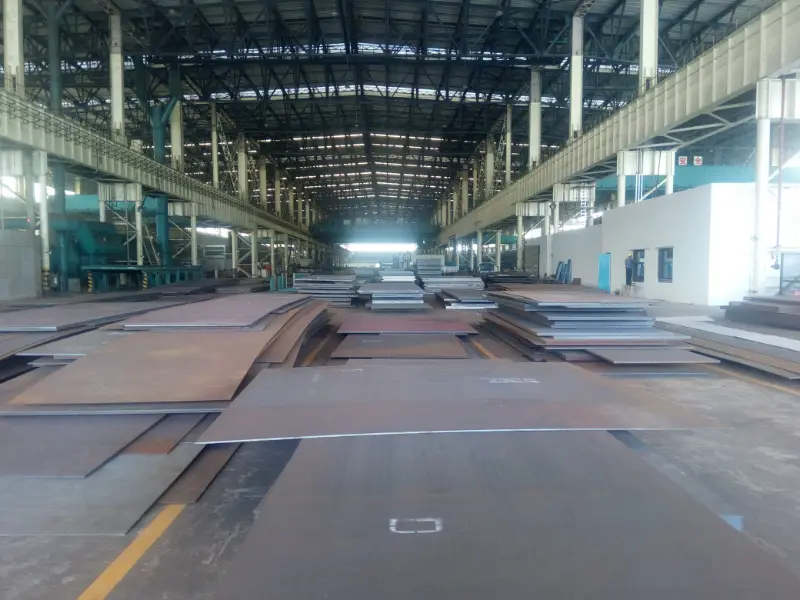
X1CrNiMoAlTi12-9-2 (1.4594) Stainless Steel
X1CrNiMoAlTi12-9-2 (1.4594) Stainless Steel: High-Strength Martensitic & Corrosion-Resistant Alloy Data
Technical data and properties of X1CrNiMoAlTi12-9-2, an ultra-high-strength martensitic stainless steel per EN 10088-1, ideal for aerospace, medical, and marine applications due to its corrosion resistance and toughness.
Machining (in solution-annealed condition), cold forming, welding, aging heat treatment, hot working
- Phone : +8618037372205
- Email : [email protected]
- WhatsApp: Contact via Whtsapp
- WeChat: +8618037372205
X1CrNiMoAlTi12-9-2 Stainless Steel Introduction
X1CrNiMoAlTi12-9-2 (material number 1.4594) is a low-carbon martensitic precipitation hardening stainless steel standardised in EN 10088-1. It combines ultra-high tensile strength (exceeding 1400 MPa after aging) with good ductility and excellent corrosion resistance. The alloy derives its strength from the precipitation of nanometer-sized intermetallic phases NiAl and Ni₃Ti during a simple aging heat treatment, applied after a solution anneal and martensitic transformation. Its composition—around 12% Cr, 9% Ni, and 2% Mo—provides resistance to pitting and crevice corrosion, while the extremely low carbon content (<0.015%) ensures good weldability and intergranular corrosion resistance. This steel is delivered in the solution-annealed condition, allowing cold forming and machining before final aging. Typical applications include high-stress aerospace components, surgical instruments, high-performance fasteners, and marine shafts where both mechanical load and aggressive environments are encountered.
X1CrNiMoAlTi12-9-2 Stainless Steel Chemical Composition
The chemistry of X1CrNiMoAlTi12-9-2 is tightly controlled to achieve the desired precipitation hardening response and corrosion performance. The key alloying elements are chromium for passivity, nickel for toughness and martensite start temperature adjustment, molybdenum for pitting resistance, and aluminum plus titanium as precipitation hardeners. The extremely low levels of carbon, silicon, manganese, phosphorus, and sulfur minimize detrimental non-metallic inclusions and ensure high cleanliness.
| Element | Standard Value (wt%) | Remarks |
|---|---|---|
| Carbon (C) | ≤ 0.015 | Ultra-low carbon for corrosion resistance and weldability |
| Silicon (Si) | ≤ 0.10 | Minimizes segregation and inclusions |
| Manganese (Mn) | ≤ 0.10 | Kept low to avoid adverse effects on toughness |
| Phosphorus (P) | ≤ 0.015 | Maintains hot workability and ductility |
| Sulfur (S) | ≤ 0.010 | Low to improve cleanliness and toughness |
| Chromium (Cr) | 11.5 - 12.5 | Essential for corrosion resistance |
| Nickel (Ni) | 8.5 - 9.5 | Promotes martensite formation and toughness |
| Molybdenum (Mo) | 2.0 - 3.0 | Enhances pitting corrosion resistance and strength |
| Aluminum (Al) | 0.20 - 0.50 | Precipitation hardening element (NiAl) |
| Titanium (Ti) | 0.15 - 0.50 | Precipitation hardening element (Ni₃Ti) |
| Nitrogen (N) | ≤ 0.015 | Low to prevent nitride formation |
X1CrNiMoAlTi12-9-2 Stainless Steel Thermal and Electrical Physical Properties
These physical properties are representative for X1CrNiMoAlTi12-9-2 in the solution-annealed or aged condition. They aid in design calculations for thermal expansion, heat transfer, and electrical applications. Values may vary slightly with heat treatment and temperature.
| Property | Typical Value | Unit | Condition / Temperature |
|---|---|---|---|
| Density (ρ) | 7.85 | g/cm³ | At 20°C |
| Modulus of elasticity (E) | 200 | GPa | At 20°C, aged |
| Shear modulus (G) | 78 | GPa | At 20°C (calculated from E and ν) |
| Poisson's ratio (ν) | 0.30 | - | Elastic range |
| Thermal expansion coefficient (α) | 10.5 | 10⁻⁶/K | 20-100°C |
| Thermal expansion coefficient (α) | 11.0 | 10⁻⁶/K | 20-200°C |
| Thermal expansion coefficient (α) | 11.5 | 10⁻⁶/K | 20-300°C |
| Thermal expansion coefficient (α) | 12.0 | 10⁻⁶/K | 20-400°C |
| Thermal conductivity (λ) | 14 | W/m·K | At 20°C |
| Thermal conductivity (λ) | 18 | W/m·K | At 300°C |
| Thermal conductivity (λ) | 22 | W/m·K | At 500°C |
| Specific heat capacity (c) | 460 | J/kg·K | At 20°C |
| Electrical resistivity (ρ_e) | 0.80 | µΩ·m | At 20°C |
X1CrNiMoAlTi12-9-2 Stainless Steel Mechanical Properties
These properties are representative for flat products (plate/coil) in two heat treatment conditions: solution annealed (AT) for maximum formability, and precipitation hardened (aged, PHT) for service. The aged condition unlocks the full strength potential through controlled precipitation of NiAl and Ni₃Ti. Values depend on product thickness and direction; values for longitudinal and transverse specimens are given where differentiated.
| Property | Required Value | Unit | Condition / Remarks |
|---|---|---|---|
| Yield strength Rp0.2 (AT) | ≤ 750 | MPa | Solution annealed, thickness ≤ 25 mm, transverse |
| Tensile strength Rm (AT) | ≤ 1050 | MPa | Solution annealed, thickness ≤ 25 mm, transverse |
| Elongation A50mm (AT) | ≥ 12 | % | Solution annealed, thickness ≤ 25 mm, transverse |
| Yield strength Rp0.2 (PHT) | ≥ 1000 | MPa | Aged at 480-510°C, thickness ≤ 6 mm |
| Tensile strength Rm (PHT) | 1100 - 1400 | MPa | Aged, thickness ≤ 6 mm |
| Elongation A50mm (PHT) | ≥ 10 | % | Aged, thickness ≤ 6 mm |
| Yield strength Rp0.2 (PHT) | ≥ 950 | MPa | Aged, thickness 6-25 mm |
| Tensile strength Rm (PHT) | 1050 - 1350 | MPa | Aged, thickness 6-25 mm |
| Elongation A50mm (PHT) | ≥ 10 | % | Aged, thickness 6-25 mm |
| Impact energy KV (20°C) (PHT) | ≥ 27 | J | Longitudinal, aged condition, thickness ≥ 10 mm |
| Hardness (PHT) | 36 - 43 | HRC | Typical after aging, for information only |
X1CrNiMoAlTi12-9-2 Stainless Steel Completely Equivalent Standards and Grades
| Country/Region | Standard | Grade/Designation | Remarks |
|---|---|---|---|
| Europe | EN 10088-1 | X1CrNiMoAlTi12-9-2 (1.4594) | Original standard grade |
| International (ISO) | ISO 15510 | X1CrNiMoAlTi12-9-2 | Identical designation, fully equivalent |
X1CrNiMoAlTi12-9-2 Stainless Steel Application Introduction
X1CrNiMoAlTi12-9-2 is primarily selected for applications demanding a combination of very high strength and exceptional corrosion resistance, often in critical components where failure cannot be tolerated. Its ability to be hardened through a simple aging treatment while maintaining good toughness and dimensional stability makes it suitable for complex shapes. Typical industries and uses include:
Product Applications: Landing gear components (actuators, shafts), Structural brackets and fittings, Surgical instruments and implants, Marine propeller and pump shafts, High-strength bolts and fasteners (Class 12.9 and above), Valve stems and seats, High-pressure connectors
Processed into products: Shims, washers, and spring elements, Rivets, Actuator housings, Specialty fasteners for subsea equipment, Torsion bars, Rotors for small turbines
Application industries: Aerospace, Medical Devices, Marine Engineering, Oil & Gas, High-Performance Automotive, Chemical Processing, Power Generation
X1CrNiMoAlTi12-9-2 Stainless Steel Similar or Substitute Materials
| Country/Region | Standard | Grade/Designation | Remarks |
|---|---|---|---|
| USA | ASTM A564/A564M | UNS S17400 (17-4PH / 1.4542) | Widely used precipitation hardening stainless; lower strength (~1100 MPa) but good corrosion resistance |
| USA | ASTM A564 | UNS S15500 (15-5PH / 1.4545) | Similar to 17-4PH with better transverse toughness; strength range overlaps |
| USA | AMS 5936 | Custom 465 (UNS S46500) | Ultra-high strength martensitic PH stainless; comparable tensile strength but different Cr-Ni-Ti balance |
| Europe | EN 10088-1 | X5CrNiCuNb16-4 (1.4542) | European equivalent of 17-4PH; commonly available but lower strength |
| Europe | EN 10088-1 | X1CrNiMoAlTi12-10-2 (1.4593) | Another advanced PH stainless with slightly different Ni/Mo ratio; similar mechanical properties |
Notes:
This steel is typically supplied in the solution-annealed condition for best formability. Maximum hardness after aging is around 43 HRC. Although it has good weldability, special filler metals and post-weld heat treatment may be required to restore properties. For detailed fabrication guidelines, refer to EN 10088-2 and EN 10088-3. The data provided are typical and may vary depending on the exact heat treatment and product form. Always consult the material manufacturer for specific recommendations.
- Share



