
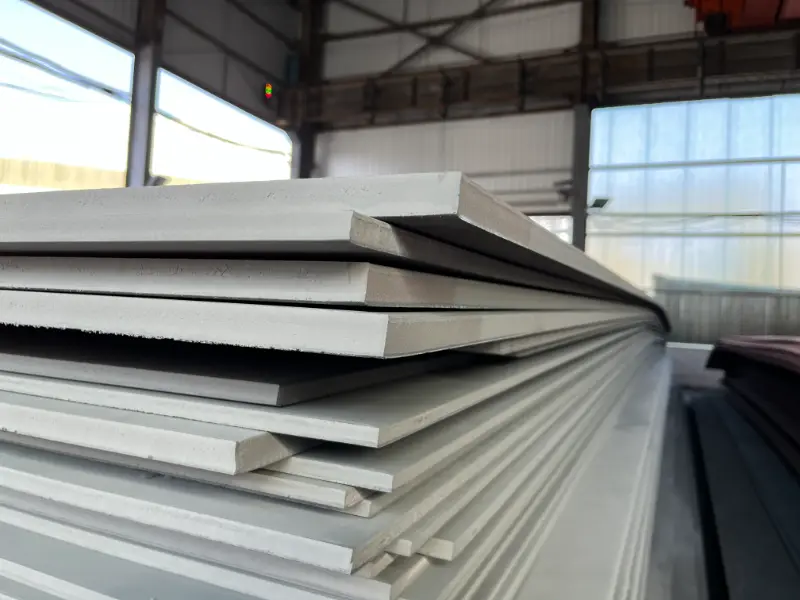
X3CrNiMo13-4 (1.4313) Martensitic Stainless Steel
X3CrNiMo13-4 (1.4313) Martensitic Stainless Steel - Corrosion Resistant, High Strength for Engineering
Complete datasheet for X3CrNiMo13-4 (1.4313) martensitic stainless steel according to EN 10088. Includes chemical composition, mechanical properties, physical data, international equivalents, and application guide.
Hot rolling, cold rolling, forging, machining, welding (with pre-heating and post-weld heat treatment)
- Phone : +8618037372205
- Email : [email protected]
- WhatsApp: Contact via Whtsapp
- WeChat: +8618037372205
X3CrNiMo13-4 Martensitic Stainless Steel Introduction
X3CrNiMo13-4, designated 1.4313 in the EN 10088 system, is a low-carbon martensitic stainless steel with additions of nickel and molybdenum. It combines high strength and hardness after heat treatment with good corrosion resistance in mild environments, particularly in water, steam, and weak acidic media. The alloy exhibits excellent weldability for a martensitic grade and offers improved toughness compared to standard 13% Cr steels. It is typically supplied in the quenched and tempered condition (QT650, QT780, or QT900), enabling a wide range of mechanical properties for demanding applications such as hydraulic machinery, pump shafts, valves, and offshore components. Its magnetic properties and good fatigue resistance further extend its use.
X3CrNiMo13-4 Martensitic Stainless Steel Chemical Composition
Chemical composition conforms to EN 10088-1:2014 for grade X3CrNiMo13-4. The low carbon content ensures good weldability, while nickel and molybdenum enhance corrosion resistance and toughness. Trace elements are restricted to maintain cleanliness.
| Chemical element | Standard value | Remarks |
|---|---|---|
| Carbon (C) | ≤0.05 | |
| Silicon (Si) | ≤0.70 | |
| Manganese (Mn) | ≤1.50 | |
| Phosphorus (P) | ≤0.040 | |
| Sulfur (S) | ≤0.015 | |
| Chromium (Cr) | 12.0–14.0 | Key element for corrosion resistance |
| Nickel (Ni) | 3.5–4.5 | Improves toughness and hardenability |
| Molybdenum (Mo) | 0.30–0.70 | Increases pitting resistance and strength |
| Nitrogen (N) | ≤0.020 | Controlled to avoid detrimental effects on toughness |
X3CrNiMo13-4 Martensitic Stainless Steel Thermal and electrical physical properties
Physical property data for X3CrNiMo13-4 are derived from EN 10088-1:2014 and standard martensitic stainless steel references. Values are typical for the grade at room temperature unless otherwise noted. They serve as a guide for design calculations.
| Property | Typical value | Unit | Test conditions / Remarks |
|---|---|---|---|
| Density (ρ) | 7.7 | kg/dm³ | 20°C |
| Modulus of elasticity (E) | 200 | GPa | 20°C |
| Shear modulus (G) | 77 | GPa | Calculated from E and ν (20°C) |
| Poisson's ratio (ν) | 0.3 | – | 20°C (typical for martensitic grades) |
| Thermal expansion coefficient (α) | 10.5×10⁻⁶ | K⁻¹ | 20–100°C, mean linear expansion |
| Thermal conductivity (λ) | 30 | W/(m·K) | 20°C |
| Specific heat capacity (cₚ) | 460 | J/(kg·K) | 20°C |
| Electrical resistivity (ρₑ) | 0.6 | Ω·mm²/m | 20°C |
X3CrNiMo13-4 Martensitic Stainless Steel Mechanical Properties
The following mechanical property requirements are according to EN 10088-2:2014 for hot rolled plate/coil in quenched and tempered condition QT780, applicable for thicknesses ≤160 mm. Values are the minimum required unless a range is given. Impact energy is based on Charpy V-notch test.
| Property | Required value | Unit | Test conditions |
|---|---|---|---|
| Yield strength (Rp0.2) | ≥620 | MPa | Room temperature, longitudinal |
| Tensile strength (Rm) | 780–980 | MPa | Room temperature, longitudinal |
| Elongation (A) | ≥12 | % | Gauge length 5.65√S₀, longitudinal |
| Impact energy (KV) | ≥50 | J | 20°C, Charpy V-notch, longitudinal |
| Hardness (HB) | approx. 250–320 | HB | Typical range for QT780 condition |
X3CrNiMo13-4 Martensitic Stainless Steel Fully equivalent material standards and replaceable grades
| Country/Region | Standard | Designation | Remarks |
|---|---|---|---|
| USA | ASTM A182 / A276 / A479 | F6NM (UNS S41500) | Identical chemistry; mechanical property requirements may differ slightly. |
| China | GB/T 1220 / GB/T 4237 | 04Cr13Ni4Mo (0Cr13Ni4Mo) | New designation 04Cr13Ni4Mo replaces 0Cr13Ni4Mo; fully equivalent. |
| Japan | JIS G 3214 / JIS G 4303 | SUS F6NM | Equivalent forged or rolled stainless steel. |
| France (legacy) | NF A35-574 | Z4CND13.4M | Historical designation, now unified under EN 10088. |
| International | ISO 15510 | X3CrNiMo13-4 | Direct inclusion in ISO standard, identical to EN. |
X3CrNiMo13-4 Martensitic Stainless Steel Application Introduction
X3CrNiMo13-4 is selected for components that require a balance of mechanical strength, corrosion resistance in fresh water and mild chemical environments, and good fabricability. It is widely adopted in hydropower, marine engineering, and general mechanical engineering. Its magnetic properties also enable certain electromagnetic applications.
Product Applications: Pelton turbines, Francis runners, Kaplan blades, High-pressure pump shafts and casings, Gate and globe valve stems, balls, seats, Offshore platform structural parts (bolting, hubs), Ship propulsion shafts and rudder stocks
Processed into products: Machined parts: shafts, axles, pins, bolts, studs, nuts, bushes, sleeves, Forged pieces: flanges, rings, discs, valve bodies, impellers, Welded fabrications: structures subject to dynamic loading (after PWHT), Wear rings, thrust bearing pads, seal rings, Hydraulic cylinder rods subjected to corrosion and wear
Application industries: Hydroelectric power generation (turbine runners, shafts, thrust rings), Oil and gas ( valve bodies, pump components, blowout preventers), Marine (propeller shafts, rudder posts, fasteners), Chemical and petrochemical process equipment (pump impellers, mixers), Food and beverage processing (homogenizer pistons, hygienic fittings), Compressor and turbine construction
X3CrNiMo13-4 Martensitic Stainless Steel Similar / alternative material recommendations
| Country/Region | Standard | Designation | Remarks |
|---|---|---|---|
| European Union | EN 10088-1 | X4CrNiMo16-5-1 (1.4418) | Higher strength supermartensitic stainless steel; superior corrosion resistance due to higher Cr, Mo, and Ni; used for similar applications when enhanced performance is needed. |
| USA | ASTM A182 / A276 | F6NM (UNS S41500) – same as above, already equivalent | Note: ASTM specifications align with EN requirements, but when higher toughness is desired, modified chemistries within the grade may be specified. |
| USA | ASTM A743 | CA6NM (UNS J91540) | Cast version of F6NM, used for cast components such as turbine runners and valve bodies. |
| European Union | EN 10088-1 | X5CrNiCuNb16-4 (1.4542) | Precipitation hardening stainless steel with better corrosion resistance and higher strength but different heat treatment regime; not a direct drop-in but considered for upgraded designs. |
Notes:
Material may be supplied with different heat treatment designations (QT650, QT780, QT900) to meet specific strength-ductility combinations. Welding should follow approved procedures, including preheating to 150–250°C and post-weld heat treatment to avoid cracking. Magnetic permeability is in the range of 1.3–1.5 μ (relative), confirming ferromagnetic behavior. For sour service (H₂S environments), compliance with NACE MR0175/ISO 15156 is possible with careful control of hardness and heat treatment. Surface finish can be improved by pickling, passivation, or mechanical polishing to enhance corrosion resistance.
- Share



