
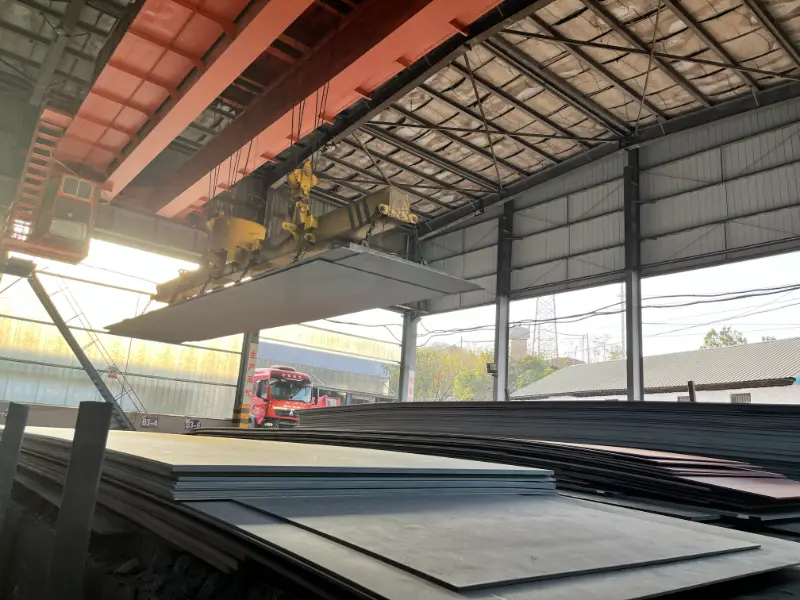
X2CrNi12 (1.4003) Ferritic Stainless Steel Plate/Coil EN 10088
X2CrNi12 (1.4003) Ferritic Stainless Steel Plate/Coil EN 10088-1 Properties & Data
Explore detailed data for X2CrNi12 ferritic stainless steel plate and coil according to EN 10088-1: chemical composition, mechanical and thermal properties, equivalent grades, and application guidance.
Hot rolling, cold rolling, annealing, pickling, cutting, forming, welding, machining
- Phone : +8618037372205
- Email : [email protected]
- WhatsApp: Contact via Whtsapp
- WeChat: +8618037372205
X2CrNi12 Ferritic Stainless Steel Plate/Coil EN 10088 Introduction
X2CrNi12 (material number 1.4003) is a low-carbon, chromium-nickel ferritic stainless steel standardized in EN 10088-1. It is characterized by:
- Good resistance to atmospheric corrosion, water, and mildly aggressive environments
- Excellent weldability without preheating, similar to carbon steel fabrication practices
- Higher strength than most austenitic stainless steels
- Magnetic behavior due to its ferritic microstructure
- Cost-effectiveness owing to low nickel content
Typical delivery condition is annealed and pickled, suitable for cold forming and structural applications. Commonly supplied as plate and coil for subsequent manufacturing.
X2CrNi12 Ferritic Stainless Steel Plate/Coil EN 10088 Chemical Composition
Chemical composition according to EN 10088-1 for the heat analysis of grade X2CrNi12. The values represent the maximum limits unless a range is indicated. The steel is low in carbon to ensure good weldability and contains chromium and nickel to provide adequate corrosion resistance.
| Element | Standard Value (%) | Remarks |
|---|---|---|
| Carbon (C) | ≤ 0.030 | Max limit |
| Silicon (Si) | ≤ 1.00 | Max limit |
| Manganese (Mn) | ≤ 1.50 | Max limit |
| Phosphorus (P) | ≤ 0.040 | Max limit |
| Sulfur (S) | ≤ 0.015 | Max limit |
| Chromium (Cr) | 10.5 – 12.5 | Range |
| Nickel (Ni) | 0.30 – 1.00 | Range |
| Nitrogen (N) | ≤ 0.030 | Max limit |
X2CrNi12 Ferritic Stainless Steel Plate/Coil EN 10088 Thermal and Electrical Physical Properties
Typical room-temperature physical properties of X2CrNi12. These values are representative for the annealed condition and may vary slightly depending on processing history. Data compiled from EN 10088-1 and supplementary literature.
| Property | Standard/Typical Value | Unit | Test Conditions |
|---|---|---|---|
| Density (ρ) | 7.70 | g/cm³ | At 20 °C |
| Modulus of elasticity (E) | 220 | GPa | At 20 °C, longitudinal |
| Shear modulus (G) | 84 | GPa | At 20 °C, calculated |
| Poisson's ratio (ν) | 0.3 | — | At 20 °C, approximate |
| Thermal expansion coefficient (α) | 10.4 × 10⁻⁶ | K⁻¹ | Between 20 °C and 100 °C |
| Thermal expansion coefficient (α) | 11.2 × 10⁻⁶ | K⁻¹ | Between 20 °C and 200 °C |
| Thermal conductivity (λ) | 25 | W/(m·K) | At 20 °C |
| Specific heat capacity (Cp) | 460 | J/(kg·K) | At 20 °C |
| Electrical resistivity (ρe) | 0.60 | µΩ·m | At 20 °C |
X2CrNi12 Ferritic Stainless Steel Plate/Coil EN 10088 Mechanical Properties
Mechanical properties for X2CrNi12 in the annealed (+A) delivery condition, as specified in EN 10088-2 for flat products. Properties vary with thickness. Values are for longitudinal test pieces unless noted. The yield strength is the 0.2% proof strength (Rp0.2).
| Property | Standard Required Value | Unit | Test Conditions |
|---|---|---|---|
| Tensile strength (Rm) | 450 – 650 | MPa | Thickness ≤ 75 mm, longitudinal |
| Yield strength, 0.2% offset (Rp0.2) | ≥ 260 | MPa | Thickness ≤ 12 mm, longitudinal |
| Yield strength, 0.2% offset (Rp0.2) | ≥ 240 | MPa | Thickness 12–75 mm, longitudinal |
| Elongation after fracture (A) | ≥ 20 | % | Thickness ≤ 12 mm, longitudinal, L0 = 5.65 √S0 |
| Elongation after fracture (A) | ≥ 18 | % | Thickness 12–75 mm, longitudinal, L0 = 5.65 √S0 |
| Bend test (mandrel diameter) | No cracks, bending angle 180° | — | Mandrel diameter = thickness 'a', for thickness ≤ 12 mm |
| Impact energy (KV), longitudinal | ≥ 40 | J | At 20 °C, Charpy V-notch, typical minimum |
X2CrNi12 Ferritic Stainless Steel Plate/Coil EN 10088 Complete Equivalent Material Standards and Substitutable Grades
| Country/Region | Standard | Grade | Remarks |
|---|---|---|---|
| Europe | EN 10088-1 | X2CrNi12 (1.4003) | Identical reference grade |
| International | ISO 15510 | X2CrNi12 | Equivalent in ISO stainless steel designation |
| USA | ASTM A240 / A240M | UNS S41003 | Chemically very close; typically covered under Grade 410S or 41003 |
| Japan | JIS G 4304 / G 4305 | SUS 410L | Low-carbon 13%Cr steel; slight differences in Ni specification; can be substituted after verification |
X2CrNi12 Ferritic Stainless Steel Plate/Coil EN 10088 Application Introduction
X2CrNi12 is widely used where a combination of moderate corrosion resistance, good mechanical strength, and economic fabrication is required. It fills the gap between carbon steels and more expensive austenitic stainless steels. The material is suitable for both indoor and outdoor mildly corrosive environments.
Product Applications: Cold-rolled and hot-rolled plates and coils for further processing, Welded structural hollow sections and tubes, Pressed and formed parts for vehicle bodies, Corrosion-resistant linings and cladding panels, Fabricated assemblies requiring high stiffness and lower weight than carbon steel
Processed into products: Railway vehicle side walls, roof panels, underframes, Exhaust flanges, muffler shells, catalytic converter housings, Industrial gratings, stair treads, ladder rungs, Agricultural sprayer booms, hopper linings, Modular building frames, balcony brackets, Cargo container corner castings and rails (combined with carbon steel structures)
Application industries: Railway and transportation (structural frames, wagon bodies, hopper cars), Automotive (exhaust systems, chassis components, structural reinforcements), Industrial equipment and machinery (conveyor parts, walkways, platforms, tanks), Agricultural engineering (fertilizer spreaders, trailers, storage), Architecture and construction (facades, roofing, structural sections), Energy and power generation (coal handling, ash handling systems)
X2CrNi12 Ferritic Stainless Steel Plate/Coil EN 10088 Similar/Near-Equivalent Material Recommendations
| Country/Region | Standard | Grade | Remarks |
|---|---|---|---|
| Europe | EN 10088-1 | X6Cr13 (1.4000) | Ferritic stainless steel with higher carbon (≤0.08%) and no intentional Ni; lower weldability but similar corrosion resistance in mild environments |
| Europe | EN 10088-1 | X12Cr13 (1.4006) | Martensitic grade with higher carbon (0.08-0.15%) and 12-14% Cr; higher strength after heat treatment, but more difficult to weld |
| Europe | EN 10088-1 | X6Cr17 (1.4016) | Ferritic 17%Cr steel without Ni; better corrosion resistance than X2CrNi12 but more sensitive to grain growth and reduced toughness in welds |
| USA | ASTM A240 | Type 410S | Low-carbon ferritic stainless steel (UNS S41008); similar Cr level, no Ni required; often used in similar structural applications |
Notes:
Additional information:
- Magnetic: X2CrNi12 is ferritic and therefore strongly magnetic.
- Weldability: Excellent; all common welding methods can be used (MIG, TIG, laser, resistance). Preheating is not required; interpass temperature should be kept below 150 °C to avoid grain growth. Filler metals: 309L or matching ferritic consumables may be used.
- Corrosion: Suitable for rural and urban atmospheric exposure, fresh water, and mildly acidic condensates. Not recommended for chloride-rich marine environments or strong acids.
- Formability: Good cold formability; minimum bending radius similar to structural carbon steels. Springback should be considered.
- Surface finish: Usually supplied as pickled and optionally skin-passed (2B, 2D, 2R).
- Heat treatment: Annealing at 700–780 °C followed by air cooling restores optimum properties after heavy cold working or welding.
All data based on EN 10088-1 and EN 10088-2; certain physical property values are typical and not part of the standard.
- Share



