
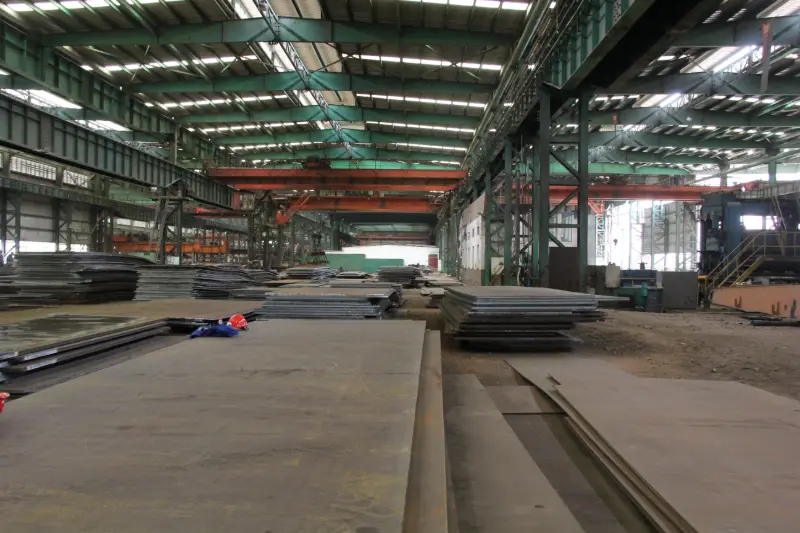
GB/T 4237 06Cr17Ni7AlTi Precipitation Hardening Stainless Steel Plate/Coil
06Cr17Ni7AlTi Precipitation Hardening Stainless Steel Plate/Coil per GB/T 4237
Comprehensive data sheet for 06Cr17Ni7AlTi stainless steel according to GB/T 4237, covering chemical composition, mechanical and physical properties, international equivalents, applications, and processing guidance.
Cold forming, stamping, deep drawing (in solution-treated condition), welding (with post-weld heat treatment), machining (in solution-treated or overaged condition)
- Phone : +8618037372205
- Email : [email protected]
- WhatsApp: Contact via Whtsapp
- WeChat: +8618037372205
GB/T 4237 06Cr17Ni7AlTi Precipitation Hardening Stainless Steel Plate/Coil Introduction
06Cr17Ni7AlTi is a precipitation hardening (PH) austenitic-martensitic stainless steel supplied as hot-rolled plates and coils under GB/T 4237. It is based on the classic 17-7PH alloy but is enhanced with a deliberate titanium addition (0.40–1.00%) alongside the standard aluminium content. This modification refines grain size, improves elevated temperature strength, and enhances aging response. The alloy exhibits a unique combination of high strength, good corrosion resistance, and excellent fatigue properties after a simple low-temperature aging treatment. In the solution-annealed (Condition A) state it is ductile and formable, allowing complex part fabrication before hardening. Typical applications include aerospace structural components, springs, fasteners, and high-pressure vessels where weight saving and reliability are critical. The material can be heat treated to various strength levels (e.g., TH1050, RH950) to meet specific design requirements. Its corrosion resistance is comparable to AISI 304 in many environments, making it suitable for chemical and food processing equipment.
GB/T 4237 06Cr17Ni7AlTi Precipitation Hardening Stainless Steel Plate/Coil Chemical composition
The chemical composition is in accordance with GB/T 4237 for grade 06Cr17Ni7AlTi. The titanium addition together with aluminium provides precipitation hardening capability by forming fine intermetallic phases (e.g., Ni3Al, Ni3Ti) during aging treatment. Iron (Fe) forms the balance.
| Chemical element | Standard value (wt%) | Remarks |
|---|---|---|
| Carbon (C) | ≤ 0.08 | Maintains hardenability and strength; kept low for corrosion resistance |
| Silicon (Si) | ≤ 1.00 | Deoxidizer; influences fluidity |
| Manganese (Mn) | ≤ 1.00 | Desulfurization and deoxidation |
| Phosphorus (P) | ≤ 0.040 | Impurity; limited for toughness |
| Sulfur (S) | ≤ 0.030 | Impurity; limited for toughness and corrosion resistance |
| Chromium (Cr) | 16.00 – 18.00 | Primary corrosion resistance element; stabilizes ferrite |
| Nickel (Ni) | 6.50 – 7.75 | Promotes austenite, toughness, and precipitation hardening |
| Aluminium (Al) | 0.75 – 1.50 | Forms hardening precipitates (Ni3Al) |
| Titanium (Ti) | 0.40 – 1.00 | Refines grain, enhances aging response, forms Ni3Ti |
| Iron (Fe) | Balance | Matrix element |
GB/T 4237 06Cr17Ni7AlTi Precipitation Hardening Stainless Steel Plate/Coil Thermal, electrical and physical properties
Typical physical properties for 06Cr17Ni7AlTi at room temperature and relevant temperatures. Data are representative of precipitation hardening stainless steels of the 17-7PH family and may vary slightly with heat treatment condition. Values are provided for engineering calculations.
| Property | Typical value | Unit | Test condition |
|---|---|---|---|
| Density (ρ) | 7.65 | g/cm³ | Room temperature, solution treated |
| Modulus of elasticity (E) | 203 | GPa | Room temperature, solution treated |
| Shear modulus (G) | 78 | GPa | Room temperature, calculated |
| Poisson ratio (ν) | 0.30 | - | Room temperature |
| Thermal expansion coefficient (α) | 15.3 | 10⁻⁶ /K | 20–100°C |
| Thermal expansion coefficient (α) | 16.2 | 10⁻⁶ /K | 20–200°C |
| Thermal expansion coefficient (α) | 17.0 | 10⁻⁶ /K | 20–400°C |
| Thermal conductivity (λ) | 16.0 | W/(m·K) | 20°C |
| Thermal conductivity (λ) | 17.5 | W/(m·K) | 100°C |
| Thermal conductivity (λ) | 20.5 | W/(m·K) | 300°C |
| Specific heat capacity (c) | 0.46 | J/(g·K) | 20°C |
| Electrical resistivity (ρe) | 0.80 | µΩ·m | 20°C |
GB/T 4237 06Cr17Ni7AlTi Precipitation Hardening Stainless Steel Plate/Coil Mechanical properties
Mechanical properties for hot-rolled plate/coil of 06Cr17Ni7AlTi in solution-treated condition (Condition A) comply with GB/T 4237. Aging heat treatment can significantly increase strength and hardness. Values below represent minimum requirements for the solution-treated state unless otherwise noted. Different aging conditions (e.g., TH1050, RH950) lead to tailored combinations of strength and ductility; consult mill certificates for specific heat treatment.
| Property | Standard requirement value | Unit | Test condition |
|---|---|---|---|
| Yield strength, Rp0.2 | ≥ 380 | MPa | Solution treated (Condition A: 1000–1100°C, quenched) |
| Tensile strength, Rm | ≥ 1030 | MPa | Solution treated |
| Elongation after fracture, A | ≥ 20 | % | Solution treated, gauge length 50 mm (or proportional) |
| Hardness | ≤ 229 | HBW | Solution treated |
| Yield strength, Rp0.2 (typical for TH1050 condition) | ≈ 960 – 1170 | MPa | Solution treated + aged at 760°C/2h, air cool + 565°C/90min, air cool |
| Tensile strength, Rm (typical for TH1050 condition) | ≈ 1130 – 1310 | MPa | TH1050 condition |
| Elongation, A (typical for TH1050 condition) | ≈ 3 – 7 | % | TH1050 condition |
GB/T 4237 06Cr17Ni7AlTi Precipitation Hardening Stainless Steel Plate/Coil Direct equivalent material standards and recommended substitute grades
No international standard provides an exact equivalent to 06Cr17Ni7AlTi with its specific titanium addition. The closest compositional match is the standard 17-7PH (aluminium-only precipitation hardening), which can be considered a substitute in many applications. The table lists the most relevant similar grades from major standards.
| Country/Region | Standard | Grade | Remarks |
|---|---|---|---|
| China | GB/T 4237 | 06Cr17Ni7AlTi | Base grade under consideration |
| United States | ASTM A693 / AMS 5528 | 631 (17-7PH) / UNS S17700 | No intentional Ti; aluminium-only precipitation hardening |
| European Union | EN 10088-2 / EN 10088-3 | 1.4568 (X7CrNiAl17-7) | Equivalent to 17-7PH; no Ti |
| Japan | JIS G4304 / G4305 | SUS 631 | Same as 17-7PH; no Ti |
GB/T 4237 06Cr17Ni7AlTi Precipitation Hardening Stainless Steel Plate/Coil Application Introduction
06Cr17Ni7AlTi is designed for parts that require a combination of high strength, good fatigue resistance, and moderate corrosion protection. It is particularly advantageous when components can be fabricated in the soft, ductile solution-treated condition and then hardened by a low-temperature aging treatment, minimizing distortion. The Ti addition improves the alloy's performance in slightly elevated temperature service and provides a finer grain structure compared to standard 17-7PH.
Product Applications: Springs (flat, coil, wave), Diaphragms and bellows, Aircraft structural components (frames, stiffeners), High-strength bolts and fasteners, Washers and retaining rings, Flexible metallic hoses, Pressure vessel linings, Knife blades and surgical instruments, Industrial screens and filters
Processed into products: Aircraft landing gear parts (brackets, clips), Engine ring components, Heat exchanger plates, Valve parts and stem guides, Hydrogen embrittlement-resistant fasteners, Custom precision stamped parts, Welded fabrications requiring post-weld aging
Application industries: Aerospace & Defense, Chemical processing, Food processing equipment, Medical devices, Energy (pressure vessels, springs), General engineering (high-strength fasteners, wear parts)
GB/T 4237 06Cr17Ni7AlTi Precipitation Hardening Stainless Steel Plate/Coil Similar or near-equivalent material recommendations
| Country/Region | Standard | Grade | Remarks |
|---|---|---|---|
| Global | ASTM A693 / AMS 5528 | 17-7PH (UNS S17700) | Comparable strength and corrosion resistance; easier availability but lower elevated temperature stability without Ti. Suitable alternative for many room-temperature applications. |
| United States | ASTM A693 / AMS 5813 | 15-7PH (UNS S15700) | Mo addition (2.0-3.0%) provides better corrosion resistance; slightly lower Ni but no Ti. Similar hardening mechanism. |
| Europe | EN 10088-2 EN 1.4532 | X5CrNiCuNb16-4 (17-4PH) | Precipitation hardening steel with different hardening element (Cu/Nb). Higher corrosion resistance but may require different aging parameters. |
Notes:
Heat treatment: Typical heat treatments include solution annealing at 1000–1100°C followed by rapid quenching (Condition A). Aging treatments such as TH1050 (760°C/2h air cool + 565°C/90min air cool) or RH950 (cold treatment + 510°C aging) are used to achieve desired strength levels. Welding: Can be welded by common fusion and resistance methods; post-weld solution treatment and aging are recommended to restore corrosion resistance and mechanical properties. Forming: Excellent formability in the solution-treated condition; bending and deep drawing should be performed on annealed material. Spring-back is moderate and can be compensated by overbending. Corrosion: Resistance is generally between AISI 304 and 316 in many environments; best performance is obtained in the hardened condition. Avoid prolonged exposure to temperatures above 315°C to prevent overaging.
- Share



