
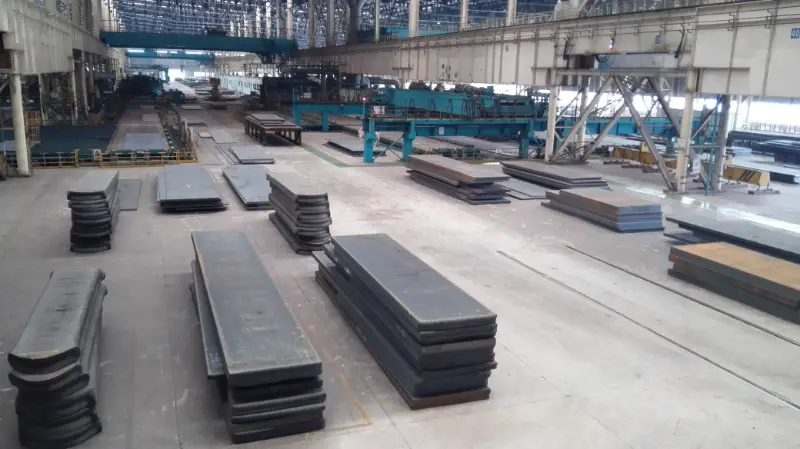
X2CrTi12 (1.4512) Ferritic Stainless Steel
X2CrTi12 (1.4512) Ferritic Stainless Steel: Properties, Equivalents & Applications
Comprehensive material data for X2CrTi12 (1.4512) ferritic corrosion-resistant stainless steel according to EN 10088-1, including chemical composition, mechanical and physical properties, international equivalents, and application guidance for plate and coil products.
Hot rolling, cold rolling, annealing, pickling, skin passing, welding, bending, deep drawing, stamping, cutting
- Phone : +8618037372205
- Email : [email protected]
- WhatsApp: Contact via Whtsapp
- WeChat: +8618037372205
X2CrTi12 Ferritic Stainless Steel Introduction
X2CrTi12, designation 1.4512 in EN 10088-1, is a titanium-stabilized ferritic stainless steel with low interstitial elements. It offers good resistance to corrosion, oxidation, and stress corrosion cracking, particularly in mildly corrosive environments and at elevated temperatures up to ~800 °C. The titanium addition (Ti ≥ 6×(C+N)) effectively prevents intergranular corrosion after welding or heating, eliminating the need for post-weld heat treatment. The steel is characterized by its ferromagnetic behavior, dual-phase microstructure free of austenite, and ability to be cold formed. Its moderate strength, high ductility, and cost-effectiveness make it ideal for applications demanding a combination of weldability, oxidation resistance, and thermal fatigue resistance, such as automotive exhaust components, catalytic converter shells, mufflers, and domestic appliances. It is typically delivered in the annealed condition as hot-rolled or cold-rolled strip, sheet, and plate with surface finishes like 1D, 2D, 2B, 2R, or BA.
X2CrTi12 Ferritic Stainless Steel Chemical Composition
The chemical composition as per EN 10088-1 for grade X2CrTi12 (1.4512). The titanium content must satisfy the stabilization requirement Ti ≥ 6×(C+N) to ensure full binding of carbon and nitrogen and prevent sensitization during welding or high-temperature exposure. Residual elements are controlled to maintain ferritic structure and desired properties.
| Element | Standard Value | Remarks |
|---|---|---|
| Carbon (C) | ≤ 0.030 | |
| Silicon (Si) | ≤ 1.00 | Typically 0.30–0.60 |
| Manganese (Mn) | ≤ 1.00 | Typically 0.30–0.60 |
| Phosphorus (P) | ≤ 0.040 | |
| Sulfur (S) | ≤ 0.015 | For improved formability; ≤ 0.030 also possible |
| Chromium (Cr) | 10.50 – 12.50 | Key element for ferritic structure and corrosion resistance |
| Titanium (Ti) | ≤ 0.65 | Requirement: Ti ≥ 6×(C+N); stabilizes against intergranular corrosion |
| Nitrogen (N) | ≤ 0.030 | Low interstitial content enhances ductility and weldability |
| Nickel (Ni) | ≤ 0.50 | Residual; not intentionally added |
| Molybdenum (Mo) | – | Not specified, typically ≤ 0.50 as impurity |
| Iron (Fe) | Balance |
X2CrTi12 Ferritic Stainless Steel Thermal and Electrical Physical Properties
Physical properties are generic for the 1.4512 ferritic stainless steel in the annealed condition. These values are useful for design calculations and processing simulations. Thermal conductivity and expansion are isotropic. Slight variations may occur depending on actual heat treatment and cold work.
| Property | Typical Value | Unit | Test Condition / Remarks |
|---|---|---|---|
| Density (ρ) | 7.70 | g/cm³ | At 20 °C |
| Elastic modulus (E) | 220 | GPa | At 20 °C |
| Shear modulus (G) | 84 | GPa | Calculated using ν=0.30 |
| Poisson's ratio (ν) | 0.30 | – | At 20 °C |
| Thermal expansion coefficient (α) | 10.5 / 11.0 / 11.5 / 12.0 | 10⁻⁶/K | Temperature ranges: 20–100 °C / 20–200 °C / 20–400 °C / 20–600 °C |
| Thermal conductivity (λ) | 25 | W/(m·K) | At 20 °C |
| Specific heat capacity (cp) | 460 | J/(kg·K) | At 20 °C |
| Electrical resistivity (ρ_e) | 0.60 | µΩ·m | At 20 °C |
| Melting range | 1430 – 1510 | °C | Approximate |
| Magnetic property | Ferromagnetic | Stable ferritic structure |
X2CrTi12 Ferritic Stainless Steel Mechanical Properties
Mechanical properties according to EN 10088-2 for cold- and hot-rolled flat products in the annealed (+A) condition. Values are minimum required for longitudinal test pieces unless otherwise stated. The properties are valid for thicknesses ≤ 8 mm; for larger thicknesses slightly reduced values may apply. Bending test is guaranteed for the delivery condition.
| Property | Standard Requirement | Unit | Test Condition / Remarks |
|---|---|---|---|
| Yield strength (Rp0.2) | ≥ 210 | MPa | Room temperature; transverse values may be slightly higher |
| Tensile strength (Rm) | 380 – 560 | MPa | Typical range for thickness ≤ 8 mm |
| Elongation (A80) | ≥ 25 | % | Gauge length 80 mm; thickness < 3 mm; longitudinal |
| Elongation (A) | ≥ 25 | % | Proportional test piece; thickness 3 ≤ t ≤ 8 mm |
| Bending test (bend angle 180°) | Mandrel diameter = 1×t (t = thickness) | – | No cracks acceptable; applicable up to 8 mm thickness |
| Hardness (HBW) | ≤ 180 | HBW | Typical value after annealing; not a mandatory requirement but typical |
| Impact energy (KV) | – | J | Not normally specified; ferritic grades may show low toughness at sub-zero temperatures |
X2CrTi12 Ferritic Stainless Steel Complete Equivalent Material Standards & Alternative Grades
Direct equivalents to X2CrTi12 (1.4512) in major international standards. These grades share the same titanium-stabilized ferritic concept with very similar chemistry and mechanical properties, making them direct substitutes in most applications.
| Country / Region | Standard | Grade / Designation | Remarks |
|---|---|---|---|
| Europe (EN) | EN 10088-1 | X2CrTi12 / 1.4512 | Original designation |
| International (ISO) | ISO 15510 | X2CrTi12 | Identical composition |
| Germany (DIN) | DIN EN 10088-1 | X2CrTi12 / 1.4512 | Former DIN 1.4512 |
| France (NF) | NF EN 10088-1 | X2CrTi12 / Z3CT12 | Alternate national symbol |
| UK (BS) | BS EN 10088-1 | X2CrTi12 / 1.4512 | Identical |
| Italy (UNI) | UNI EN 10088-1 | X2CrTi12 / 1.4512 | Identical |
| Spain (UNE) | UNE EN 10088-1 | X2CrTi12 / 1.4512 | Identical |
| USA (ASTM) | ASTM A240/A240M | UNS S40920 | C ≤ 0.030, Cr 11.0–12.5, Ti 0.10–0.60; nearly identical |
| Japan (JIS) | JIS G 4304 / G 4305 | SUS 409L | C ≤ 0.030, Cr 10.50–11.75, Ti 6×C~0.75; typically interchangeable |
| China (GB) | GB/T 20878 / GB/T 4237 | 022Cr11Ti (approximate) | C ≤ 0.030, Cr 10.5–11.7, Ti ≥6×C; covers similar properties |
X2CrTi12 Ferritic Stainless Steel Application Introduction
X2CrTi12 (1.4512) is extensively employed where a cost-effective, weldable ferritic stainless steel with moderate corrosion and oxidation resistance is required. Its titanium stabilization ensures immunity to intergranular corrosion, making it suitable for components that experience thermal cycling and welding during fabrication. Typical service temperatures range from cryogenic to about 800 °C. The material exhibits good formability for deep drawing and bending, and its low thermal expansion and high thermal conductivity (for a stainless steel) are beneficial in thermal applications.
Product Applications: Automotive exhaust systems (mufflers, pipes, flanges, catalytic converter housings), Domestic oven liners and burner parts, Heat exchanger tubes for condensing boilers, Architectural cladding and flashings, Welded tubes for structural and mechanical applications, Storage tanks for mildly corrosive chemicals, Furnace parts, annealing boxes, and heat treatment baskets (up to 800 °C)
Processed into products: Muffler shells and internals (perforated tubes, baffles), Exhaust manifold and downpipes, Catalytic converter substrates and outer cans, EGR (Exhaust Gas Recirculation) tubes, Oven cavities and heating element supports, Flue gas pipes and chimney liners, Formed sheet metal brackets, clips, and fasteners in corrosive atmospheres, Welded and drawn tubular components for furniture or structural use
Application industries: Automotive and transportation, Heat treatment and furnace construction, Household appliances (white goods), Building and construction (roofing, flashing), Energy and exhaust systems, Industrial machinery and storage tanks
X2CrTi12 Ferritic Stainless Steel Similar / Alternative Materials for Substitution
These grades are not exact equivalents but have comparable chemical and mechanical profiles and can be used in similar environments with proper engineering assessment. Differences in stabilization element (Nb instead of Ti) or chromium content may influence weldability, cost, or high-temperature performance.
| Country / Region | Standard | Grade | Remarks |
|---|---|---|---|
| Europe | EN 10088-1 | 1.4509 (X2CrTiNb18) | Higher Cr (17.5–18.5), dual stabilized Ti+Nb; better oxidation resistance up to 950 °C |
| Europe | EN 10088-1 | 1.4510 (X3CrTi17) | Cr 16.0–18.0, Ti stabilized; improved aqueous corrosion resistance |
| Europe | EN 10088-1 | 1.4016 (X6Cr17) | Non-stabilized ferritic; Cr 16.0–18.0; lower cost but susceptible to intergranular attack after welding |
| USA | ASTM A240 | Type 409 (S40900) | Higher C ≤0.08, Cr 10.5–11.75; still widely used for automotive exhaust but less weldable |
| USA | ASTM A240 | Type 439 (S43035) | Cr 17.0–19.0, Ti stabilized; enhanced corrosion resistance for more aggressive environments |
| Japan | JIS G 4304 | SUS430LX (SUS430J1L) | Cr 16.0–20.0, Nb stabilized; alternative for exhaust applications requiring higher strength |
Notes:
- Welding: X2CrTi12 can be welded by all common processes (TIG, MIG, resistance, laser) without preheating. Post-weld heat treatment is generally not required because Ti prevents chromium carbide precipitation. Filler metal of matching composition (e.g., 1.4502) or slightly over-alloyed (1.4509) is recommended.
- Forming: Excellent cold formability is achieved in the annealed condition. Minimum bending radius for 180° is 1×thickness. Deep drawing is possible with appropriate lubrication.
- Pickling/Passivation: Standard stainless steel pickling solutions (HNO₃/HF) can be used to remove heat tint after welding and restore corrosion resistance.
- Surface finishes: Available in 1D (hot-rolled, heat treated, pickled), 2D (cold-rolled, heat treated, pickled), 2B (cold-rolled, heat treated, pickled, skin passed), 2R (bright annealed), and BA (bright annealed under protective atmosphere).
- Magnetic properties: The steel is ferromagnetic and can be used for components where magnetic attraction is required.
- High-temperature scaling resistance: The alloy resists oxidation in air up to 800 °C under intermittent conditions and up to 850 °C in continuous service. Above these temperatures, excessive scaling may occur.
- Share



