
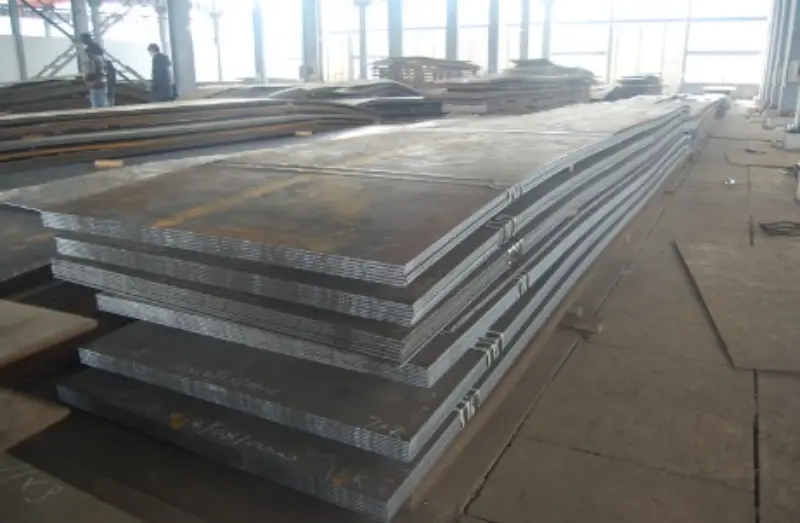
X1CrNiMoCu12-5-2 Martensitic Precipitation Hardening Stainless Steel
X1CrNiMoCu12-5-2 Martensitic Precipitation Hardening Stainless Steel Grade Data
Comprehensive material data for X1CrNiMoCu12-5-2 martensitic corrosion-resisting stainless steel per EN10088-1, including chemical composition, mechanical properties, physical properties, and equivalent grades.
Hot working, cold working, machining, welding (with precautions), solution annealing, aging heat treatment
- Phone : +8618037372205
- Email : [email protected]
- WhatsApp: Contact via Whtsapp
- WeChat: +8618037372205
X1CrNiMoCu12-5-2 Martensitic Precipitation Hardening Stainless Steel Introduction
X1CrNiMoCu12-5-2, also designated as 1.4594, is a low-carbon martensitic precipitation hardening stainless steel standardized under EN 10088-1. It combines high strength and excellent corrosion resistance through a precipitation hardening heat treatment. The alloy features additions of chromium, nickel, molybdenum, and copper, which provide superior resistance to general corrosion, pitting, and stress corrosion cracking in chloride-containing environments. After solution annealing and aging, it achieves very high tensile and yield strengths (typically Rm > 1300 MPa, Rp0.2 > 1100 MPa), making it suitable for demanding applications in aerospace, marine, and chemical processing industries. The material is supplied as plates, sheets, and coils in the solution-annealed or aged condition, and can be further hardened by a simple low-temperature aging treatment, minimizing distortion. Its outstanding mechanical properties coupled with good ductility and toughness distinguish it from conventional martensitic stainless steels.
X1CrNiMoCu12-5-2 Martensitic Precipitation Hardening Stainless Steel Chemical Composition
The chemical composition of X1CrNiMoCu12-5-2 is governed by EN 10088-1. The alloy is characterized by very low carbon content to ensure good weldability and toughness, combined with controlled additions of nickel, molybdenum, and copper to promote precipitation hardening while maintaining corrosion resistance. Sulphur and phosphorus are strictly limited to enhance cleanliness.
| Element | Standard Value (wt.%) | Remarks |
|---|---|---|
| Carbon (C) | ≤ 0.02 | Low carbon for improved toughness and weldability |
| Silicon (Si) | ≤ 0.50 | Deoxidizing element |
| Manganese (Mn) | ≤ 0.50 | Austenite former, improves hot workability |
| Phosphorus (P) | ≤ 0.030 | Residual element, kept low |
| Sulphur (S) | ≤ 0.015 | Residual element, strictly controlled |
| Chromium (Cr) | 11.50 - 13.00 | Provides corrosion resistance and hardenability |
| Nickel (Ni) | 4.50 - 6.00 | Improves toughness and corrosion resistance |
| Molybdenum (Mo) | 1.80 - 2.50 | Enhances pitting and crevice corrosion resistance |
| Copper (Cu) | 1.50 - 2.50 | Precipitation hardening element |
| Nitrogen (N) | ≤ 0.020 | Residual element, limited to avoid sensitization |
X1CrNiMoCu12-5-2 Martensitic Precipitation Hardening Stainless Steel Thermal and Electrical Physical Properties
Physical properties are measured at room temperature unless otherwise indicated. These values are typical for X1CrNiMoCu12-5-2 in the solution-annealed and aged condition, and they can vary slightly with heat treatment. The material exhibits a martensitic microstructure with fine precipitates, influencing its thermal and electrical behavior.
| Property | Typical Value | Unit | Test Condition |
|---|---|---|---|
| Density (ρ) | 7.7 | g/cm³ | Room temperature |
| Elastic Modulus (E) | 200 | GPa | Room temperature, tension |
| Shear Modulus (G) | 77 | GPa | Calculated from E and ν |
| Poisson's Ratio (ν) | 0.30 | - | Room temperature |
| Thermal Expansion Coefficient (α) | 10.6 | 10⁻⁶/K | 20 - 100 °C |
| Thermal Expansion Coefficient | 11.0 | 10⁻⁶/K | 20 - 200 °C |
| Thermal Expansion Coefficient | 11.4 | 10⁻⁶/K | 20 - 300 °C |
| Thermal Conductivity (λ) | 15 | W/(m·K) | 20 °C |
| Specific Heat Capacity (c) | 460 | J/(kg·K) | 20 °C |
| Electrical Resistivity (ρe) | 0.80 | µΩ·m | 20 °C |
X1CrNiMoCu12-5-2 Martensitic Precipitation Hardening Stainless Steel Mechanical Properties
The mechanical properties are determined according to EN 10088-2 for flat products in the precipitation hardened condition (AT = solution annealed + aged). Aging is typically performed at temperatures between 450 °C and 510 °C. The values below represent minimum requirements for material thickness ≤ 12 mm in the longitudinal direction. Hardness values are typical for the aged condition. Actual properties depend on the specific aging treatment and product form.
| Property | Standard Requirement | Unit | Test Condition / Remarks |
|---|---|---|---|
| Yield Strength Rp0.2 | ≥ 1150 | MPa | AT condition (450-510°C aging), thickness ≤ 12 mm, longitudinal |
| Tensile Strength Rm | 1300 - 1600 | MPa | AT condition, thickness ≤ 12 mm, longitudinal |
| Elongation A80/A50 | ≥ 8 (A50) / ≥ 6 (A80) | % | A50 for thickness >3mm, A80 for ≤3mm; longitudinal |
| Hardness | 44 - 50 (typical) | HRC | Aged condition, indicative range |
X1CrNiMoCu12-5-2 Martensitic Precipitation Hardening Stainless Steel Fully Equivalent Material Standards and Substitute Grades
| Country/Region | Standard | Grade | Remarks |
|---|---|---|---|
| Europe | EN 10088-1:2014 | X1CrNiMoCu12-5-2 (1.4594) | Original specification; fully equivalent |
| International | ISO 15510:2014 | X1CrNiMoCu12-5-2 (4594-100-00) | Identical chemical composition and designations |
X1CrNiMoCu12-5-2 Martensitic Precipitation Hardening Stainless Steel Application Introduction
X1CrNiMoCu12-5-2 is designed for high-strength, corrosion-resistant applications where conventional martensitic stainless steels fail due to insufficient corrosion protection or toughness. The precipitation hardening heat treatment allows achieving very high mechanical properties with low distortion, making it ideal for precision parts. Typical uses involve exposure to marine atmospheres, mild acids, and chloride-containing media. Its combination of strength and resistance to pitting and stress corrosion cracking is exploited in aerospace fasteners, naval hardware, and chemical process equipment.
Product Applications: High-strength fasteners (bolts, screws, studs), Valve stems and seats, Pump shafts and impellers, Precision springs and wire forms, Aerospace structural brackets, Medical needles and cutting tools, Molds for corrosive plastics processing
Processed into products: Aircraft brake parts, Hydraulic system components, Marine propeller shaft sleeves, Chemical reactor internals, Compressor blades, Surgical staples and bone screws, Precision gears and cams
Application industries: Aerospace and defense (structural frames, landing gear components, fittings), Marine engineering (propeller shafts, pump components, valves), Chemical and petrochemical processing (valve bodies, seals, springs), Medical technology (surgical instruments, implants requiring high strength), Nuclear engineering (fuel assembly components, control rod drive mechanisms), General mechanical engineering (high-strength bolts, dowel pins, tooling)
X1CrNiMoCu12-5-2 Martensitic Precipitation Hardening Stainless Steel Similar or Alternative Material Recommendations
| Country/Region | Standard | Grade | Remarks |
|---|---|---|---|
| USA | ASTM A564/A564M | UNS S45500 / Custom 455 (1.4559) | Similar precipitation hardening grade with higher Ni (7.5-9.5) and Ti; provides higher yield strength but lower ductility |
| Europe/USA | EN 10088-1 / ASTM A564 | X5CrNiCuNb16-4 (1.4542) / 17-4PH | Most widely used precipitation hardening stainless; higher Cr (15-17), no Mo; lower pitting resistance but good overall strength and toughness |
| Europe/USA | EN 10088-1 / ASTM A693 | X5CrNiCu15-5 (1.4545) / 15-5PH | Cleaner version of 17-4PH with improved transverse toughness; still lacks Mo, so inferior chloride resistance compared to X1CrNiMoCu12-5-2 |
Notes:
Heat Treatment: Solution annealing at 950-1050 °C, followed by rapid cooling (oil/air). Aging at 450-510 °C for 2-4 hours, air cool. Welding: Can be welded by TIG, MIG, or plasma processes using filler metal of similar composition (e.g., AWS ER 630 or similar). Preheating not generally required, but post-weld aging is recommended to restore properties. Machining: Machinability is fair in the solution-annealed condition; tools with carbide tips recommended. Corrosion Resistance: Excellent resistance to a wide range of corrosive environments; superior to 17-4PH in chloride pitting due to molybdenum content. Passivation treatments may be applied for optimal performance.
- Share



