
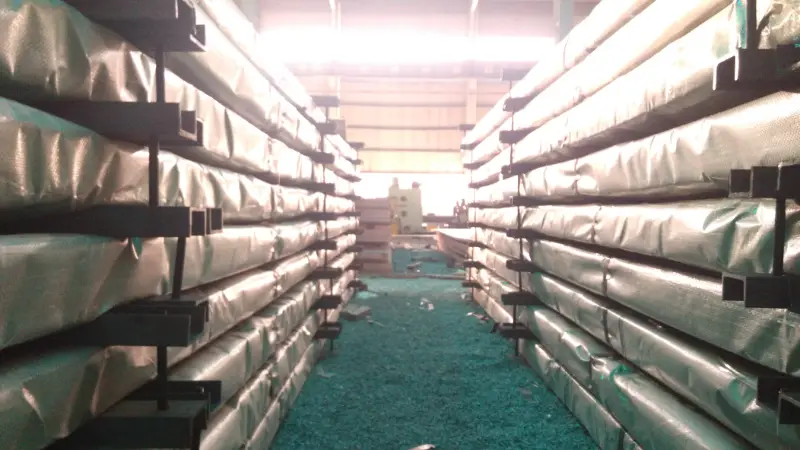
X14CrMoS17 (1.4104) Martensitic Stainless Steel
X14CrMoS17 (1.4104) Martensitic Stainless Steel: Plate Coil Properties and Global Equivalents
Detailed material data for EN X14CrMoS17 martensitic stainless steel including chemistry, mechanical and physical properties, equivalent grades, and application guidance.
Hot rolling, Cold rolling, Forging, Machining, Heat treatment (Quenching and Tempering, Annealing)
- Phone : +8618037372205
- Email : [email protected]
- WhatsApp: Contact via Whtsapp
- WeChat: +8618037372205
X14CrMoS17 Martensitic Stainless Steel Introduction
X14CrMoS17, designated as material number 1.4104 according to EN 10088-1, is a martensitic stainless steel with added sulfur to enhance machinability. It combines moderate corrosion resistance with high hardenability and strength after heat treatment. Typical applications include pump shafts, valve components, and fasteners where good machining characteristics are required alongside oxidation resistance in mild environments. The alloy is normally supplied in annealed or quenched and tempered condition, depending on the required mechanical properties. Its chromium content of 16–18% provides basic stainless properties, while molybdenum improves resistance to certain media. The intentional sulfur addition promotes chip breaking, making it suitable for automatic screw machines.
X14CrMoS17 Martensitic Stainless Steel Chemical Composition
The chemical composition of X14CrMoS17 is specified in EN 10088-1 and EN 10088-3. The sulfur content is intentionally increased to improve machinability, while chromium and molybdenum provide corrosion resistance and hardenability.
| Element | Standard Value (min-max) | Remarks |
|---|---|---|
| Carbon (C) | 0.10 - 0.17 | Austenite stabilizer, controls hardness |
| Silicon (Si) | ≤ 1.00 | Deoxidizer |
| Manganese (Mn) | ≤ 1.50 | Improves hot workability |
| Phosphorus (P) | ≤ 0.040 | Residual element |
| Sulfur (S) | 0.15 - 0.35 | Added for improved machinability |
| Chromium (Cr) | 15.50 - 17.50 | Primary corrosion resistance element |
| Molybdenum (Mo) | 0.20 - 0.60 | Enhances corrosion resistance and hardenability |
X14CrMoS17 Martensitic Stainless Steel Thermal and Electrical Physical Properties
The physical properties listed below are typical for X14CrMoS17 martensitic stainless steel at room temperature unless otherwise noted. These values are not mandatory in the standard but serve as engineering references.
| Property | Typical Value | Unit | Test Condition / Remarks |
|---|---|---|---|
| Density (ρ) | 7.7 | g/cm³ | At 20°C |
| Modulus of Elasticity (E) | 215 | GPa | At 20°C, longitudinal |
| Shear Modulus (G) | 84 | GPa | Calculated from E and ν |
| Poisson's Ratio (ν) | 0.30 | - | Typical for stainless steels |
| Thermal Expansion Coefficient (α) | 10.0 | 10⁻⁶/K | 20 - 100°C |
| Thermal Expansion Coefficient (α) | 11.0 | 10⁻⁶/K | 20 - 300°C |
| Thermal Conductivity (λ) | 25 | W/(m·K) | At 20°C |
| Specific Heat Capacity (c) | 460 | J/(kg·K) | At 20°C |
| Electrical Resistivity (ρₑ) | 0.70 | μΩ·m | At 20°C |
X14CrMoS17 Martensitic Stainless Steel Mechanical Properties
Mechanical properties for X14CrMoS17 depend on heat treatment condition. In the annealed state, the material is soft and suitable for machining. After quenching and tempering (QT), high strength and hardness can be achieved. The values below represent the quenched and tempered condition for rod or bar according to EN 10088-3.
| Property | Standard Requirement (min-max) | Unit | Test Condition |
|---|---|---|---|
| Tensile Strength (Rm) | 800 - 1000 | MPa | Quenched and tempered, diameter ≤ 160 mm |
| Yield Strength (Rp0.2) | ≥ 600 | MPa | Quenched and tempered, diameter ≤ 160 mm |
| Elongation (A) | ≥ 12 | % | Quenched and tempered, L0 = 5.65√S0 |
| Impact Energy (KV, longitudinal) | ≥ 25 | J | Quenched and tempered, ISO-V, room temperature |
| Hardness (HB) | ≤ 220 | - | Annealed (+A) condition |
X14CrMoS17 Martensitic Stainless Steel Identical / Directly Equivalent Material Standards and Grade Designations
| Country/Region | Standard | Grade | Remarks |
|---|---|---|---|
| European Union | EN 10088-1 | X14CrMoS17 (1.4104) | Identical; base designation |
| Germany | DIN EN 10088-1 | X14CrMoS17 | Identical; supersedes DIN 17440 |
| France | NF EN 10088-1 | X14CrMoS17 | Identical |
| United Kingdom | BS EN 10088-1 | X14CrMoS17 | Identical |
| International | ISO 15510 | X14CrMoS17 | Identical |
X14CrMoS17 Martensitic Stainless Steel Application Introduction
X14CrMoS17 is designed for automatic machining of parts requiring moderate corrosion resistance and high mechanical strength. It is not recommended for heavy welded structures or highly aggressive chloride environments. After heat treatment, it offers a good combination of toughness and wear resistance.
Product Applications: Pump shafts, Valve stems and spindles, Screws and bolts (machined from bar), Automatic screw machine parts, Hydraulic cylinder rods
Processed into products: Precision-turned bushings, Threaded nuts and connectors, Shaft sleeves, Coupling parts, Drive shafts for small pumps
Application industries: Pump and valve manufacturing, Automotive components, Food processing equipment (mild environments), General mechanical engineering, Hydraulic and pneumatic systems
X14CrMoS17 Martensitic Stainless Steel Similar / Near-Equivalent Materials
| Country/Region | Standard | Grade | Remarks |
|---|---|---|---|
| USA | ASTM A582 | Type 416 | Martensitic free-machining stainless; higher S, no Mo |
| USA | ASTM A276 | Type 430F | Ferritic free-machining stainless; lower C, no Mo, magnetic, softer |
| Japan | JIS G4304 | SUS430F | Ferritic equivalent to 430F, not martensitic |
| China | GB/T 1220 | Y1Cr17 | Chinese martensitic free-machining steel; similar composition but check specified limits |
| Germany | DIN 17440 | X12CrMoS17 | Former German designation; similar idea with slightly lower carbon |
Notes:
The intentional addition of sulfur (0.15-0.35%) significantly improves chip-breaking and surface finish during machining, but it reduces weldability, ductility, and corrosion resistance slightly compared to non-sulphurized martensitic grades. Welding is generally not advised; if necessary, low heat input and preheating are required. The grade is magnetic in all conditions. For improved corrosion resistance in oxidizing acids or marine atmospheres, consider martensitic grades with nickel or higher chromium, such as X30Cr13 or X46Cr13. Real stock availability of X14CrMoS17 in plate/coil form may be limited; bar and rod are more common.
- Share



