
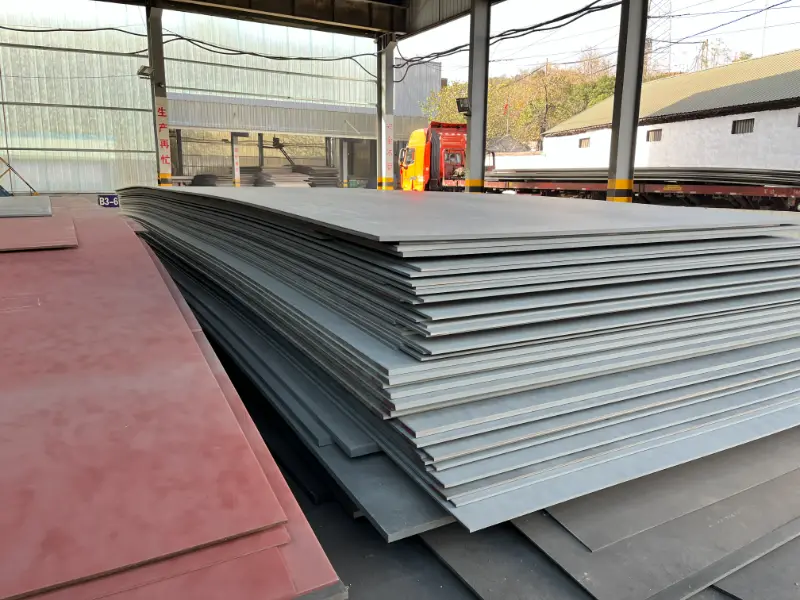
UNS S30941 Austenitic Stainless Steel Plate
UNS S30941 Austenitic Stainless Steel Plate - Niobium-Stabilized High-Temperature Grade with Superior Creep Resistance
Complete technical data for UNS S30941 (309Cb) stainless steel plate: chemical composition, mechanical properties, thermal and electrical physical properties, international equivalents, and application guide according to ASTM A240.
Hot rolling, Cold rolling, Forming, Welding, Machining, Solution annealing
- Phone : +8618037372205
- Email : [email protected]
- WhatsApp: Contact via Whtsapp
- WeChat: +8618037372205
UNS S30941 Austenitic Stainless Steel Plate Introduction
UNS S30941 (commonly designated as 309Cb) is a niobium-stabilized austenitic stainless steel plate primarily intended for elevated-temperature service. This grade offers enhanced resistance to intergranular corrosion after exposure to temperatures in the chromium carbide precipitation range (800–1600°F / 425–870°C) due to the addition of niobium, which ties up carbon as stable carbides.
Key characteristics:
- Excellent oxidation resistance up to 2000°F (1093°C)
- Good high-temperature strength and creep-rupture properties
- Improved resistance to sensitization compared to standard 309 (S30900)
- Suitable for cyclic heating conditions
- Welds retain intergranular corrosion resistance in the as-welded condition
Typical applications involve furnace parts, heat exchangers, kiln linings, and components exposed to high temperatures and mildly corrosive environments. It is normally supplied in the solution-annealed condition to ensure maximum ductility and corrosion resistance.
UNS S30941 Austenitic Stainless Steel Plate Chemical Composition
Chemical composition per ASTM A240/A240M for UNS S30941 plate. The analysis represents the heat analysis limits for the product. Niobium addition is specified as a minimum of 10 times the carbon content up to a maximum of 1.10%, ensuring stabilization of carbon and prevention of chromium carbide precipitation.
| Element | Standard Requirement (wt%) | Remarks |
|---|---|---|
| Carbon (C) | 0.08 max | Key element controlled for weldability and stabilization |
| Manganese (Mn) | 2.00 max | Deoxidizer and austenite stabilizer |
| Phosphorus (P) | 0.045 max | Residual element, limits ensure ductility |
| Sulfur (S) | 0.030 max | Improves machinability but kept low for corrosion resistance |
| Silicon (Si) | 1.00 max | Enhances oxidation resistance |
| Chromium (Cr) | 22.0 – 24.0 | Primary element for oxidation and corrosion resistance |
| Nickel (Ni) | 12.0 – 15.0 | Austenite stabilizer, improves high-temperature strength |
| Niobium (Nb) | 10×C min to 1.10 max | Stabilizing element, prevents intergranular corrosion |
| Iron (Fe) | Balance | Remainder |
UNS S30941 Austenitic Stainless Steel Plate Thermal and Electrical Physical Properties
Representative physical properties for UNS S30941 stainless steel in the annealed condition. Values are typical for the grade and may vary slightly with specific processing conditions. Thermal expansion and conductivity data are critical for high-temperature applications to evaluate thermal stresses and heat transfer.
| Property | Typical Value | Unit | Test Condition / Reference |
|---|---|---|---|
| Density (ρ) | 8.0 | g/cm³ | Room temperature |
| Elastic Modulus (E) | 193 | GPa | Tension, room temperature |
| Shear Modulus (G) | 77 | GPa | Calculated from E and Poisson's ratio |
| Poisson's Ratio (ν) | 0.30 | – | Room temperature |
| Thermal Expansion Coefficient (α) | 14.9 | 10⁻⁶/K | 20–100°C |
| Thermal Expansion Coefficient (α) | 16.7 | 10⁻⁶/K | 20–500°C |
| Thermal Expansion Coefficient (α) | 18.5 | 10⁻⁶/K | 20–1000°C |
| Thermal Conductivity (λ) | 15.0 | W/m·K | At 100°C |
| Thermal Conductivity (λ) | 21.0 | W/m·K | At 500°C |
| Specific Heat Capacity | 500 | J/kg·K | 0–100°C |
| Electrical Resistivity (ρₑ) | 0.78 | μΩ·m | At 20°C |
UNS S30941 Austenitic Stainless Steel Plate Mechanical Properties
Mechanical properties tested in the solution-annealed condition per ASTM A240/A240M requirements. Values represent minimum requirements unless noted as typical. Tensile properties apply to transverse specimens for plate, strip, and sheet. Hardness is not a mandatory requirement but is often reported for reference.
| Property | Standard Requirement | Unit | Test Condition |
|---|---|---|---|
| Tensile Strength (Rm) | 515 min | MPa | Ambient temperature, transverse specimen |
| Yield Strength (Rp0.2) | 205 min | MPa | 0.2% offset method |
| Elongation (A) | 40 min | % | Gauge length 50 mm (2 in.) |
| Hardness (HBW) | 217 max | HBW | Typical, not mandatory in ASTM A240 |
| Hardness (HRB) | 95 max | HRB | Typical, for reference |
UNS S30941 Austenitic Stainless Steel Plate Exact Equivalent Material Standards and Substitutable Grades
| Country/Region | Standard | Grade | Remarks |
|---|---|---|---|
| USA | ASTM A240 | UNS S30941 | Base standard – 309Cb |
| Europe | EN 10088-2 | 1.4833 (X9CrNiSiNCe21-11-2) | Chemically similar but includes N, Ce; Nb not explicitly required – close but not identical |
| Japan | JIS G4304 | SUS 309S | No Nb addition; lower carbon version of 309, not fully equivalent |
UNS S30941 Austenitic Stainless Steel Plate Application Introduction
UNS S30941 stainless steel plate is predominantly used in high-temperature environments where resistance to oxidation and carburization is required, and where welding or stress relieving may cause sensitization in standard grades. Its niobium stabilization allows prolonged service in the 425–870°C range without significant loss of intergranular corrosion resistance.
Typical applications span thermal processing, chemical processing, and power generation industries. The material is readily formable and weldable, making it suitable for fabrication of complex components.
Product Applications: Furnace muffles and radiant tubes, Heat exchanger plates and shell-and-tube bundles, Kiln linings and support structures, Burner nozzles and combustion chambers, Expansion joints and bellows, Petrochemical reformer tubes
Processed into products: Welded and seamless tubesheets, Flanges and gaskets for high-temperature piping, Support brackets and hangers in boiler superheaters, Annealing and normalizing furnace baskets, Pump and valve bodies for hot gas service, Thermocouple protection tubes
Application industries: Thermal processing (furnaces, ovens, kilns), Chemical and petrochemical (heat exchangers, reformers), Power generation (boiler components, gas turbines), Automotive (exhaust systems, catalytic converters), Industrial heating equipment, Aerospace (engine components)
UNS S30941 Austenitic Stainless Steel Plate Similar or Alternative Material Recommendations
| Country/Region | Standard | Grade | Remarks |
|---|---|---|---|
| USA | ASTM A240 | UNS S30900 (309) | Standard 309 without Nb; susceptible to intergranular corrosion in as-welded condition; lower cost alternative where sensitization is not critical |
| USA | ASTM A240 | UNS S31008 (310S) | Higher Cr (24–26%) and Ni (19–22%) for superior oxidation resistance up to 1100°C; no Nb stabilization; consider for higher temperature oxidizing atmospheres |
| Europe | EN 10088-2 | 1.4828 (X15CrNiSi20-12) | Similar Cr-Ni range, higher Si for improved oxidation resistance; no Nb, suited for furnace components up to 1000°C |
| Europe | EN 10088-2 | 1.4845 (X8CrNi25-21) | 310S equivalent; excellent high-temperature strength and oxidation resistance; no stabilization |
Notes:
Welding considerations: Use matching filler metal with Nb content (e.g., ER309Cb) to maintain stabilization. Preheating is not required; interpass temperature should be kept below 150°C. Post-weld heat treatment is generally not needed.
Forming: Can be cold or hot formed; solution annealing after severe cold forming is recommended to restore properties.
Machining: Due to its high work-hardening rate, use rigid setups, sharp tools, and adequate cooling. Cutting speeds lower than for carbon steel.
Availability: S30941 plate is typically produced in thicknesses up to 50 mm; consult mill for larger dimensions.
- Share



