
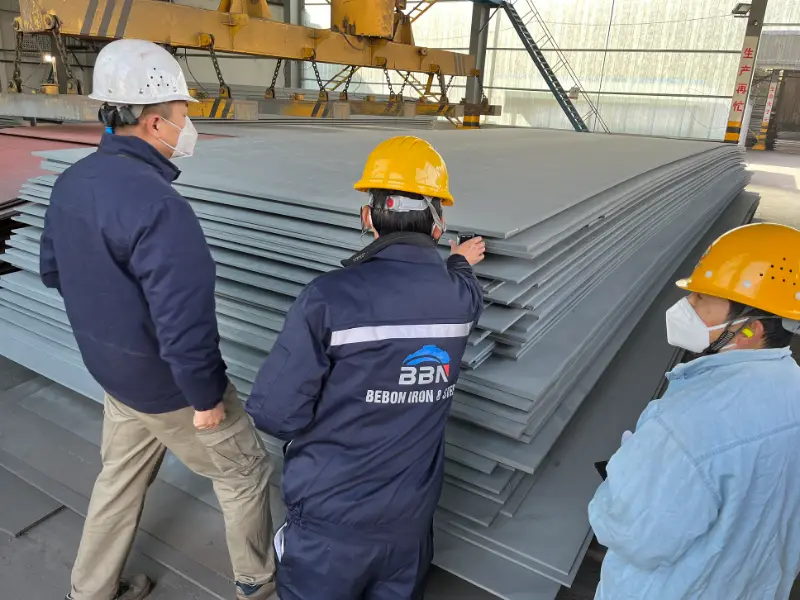
Austenitic 201LN (S20153) Stainless Steel Plate/Coil
Austenitic 201LN (S20153) Stainless Steel - High Strength, Low-Nickel Plate & Coil
Comprehensive technical data for 201LN (UNS S20153) stainless steel plate/coil: chemical composition, mechanical properties, physical properties, international equivalents, similar grades, and application guidelines based on ASTM A240.
Hot rolling, cold rolling, annealing, pickling, forming, welding, machining
- Phone : +8618037372205
- Email : [email protected]
- WhatsApp: Contact via Whtsapp
- WeChat: +8618037372205
Austenitic 201LN Stainless Steel Plate/Coil Introduction
Austenitic 201LN (UNS S20153) is a low-nickel, nitrogen-strengthened stainless steel offering a combination of high strength, good ductility, and excellent corrosion resistance comparable to Type 304 in many environments. It is designed as a cost-effective alternative to traditional Cr-Ni grades, utilizing manganese and nitrogen to partially replace nickel.
Key characteristics:
- High strength: Minimum yield strength 310 MPa (45 ksi) and tensile strength 655 MPa (95 ksi) in annealed condition, significantly higher than Type 304.
- Good formability: Despite high strength, it retains good stretch formability and can be deep drawn.
- Corrosion resistance: Comparable to Type 304 in mild atmospheres, potable water, and many chemical environments; not suitable for severe chloride pitting conditions.
- Low nickel content (~4.0–5.0%): Reduces cost sensitivity to nickel price fluctuations.
- Weldable: Using common fusion and resistance welding techniques with proper filler metals (e.g., AWS E/ER308L).
Available as plate, sheet, and coil in various finishes, 201LN is widely used in transportation, architecture, kitchen equipment, and industrial applications where high strength-to-weight ratio and cost efficiency are critical.
Austenitic 201LN Stainless Steel Plate/Coil Chemical Composition
Chemical composition according to ASTM A240/A240M for UNS S20153 (201LN). The alloy is designed with low carbon to prevent intergranular corrosion after welding, manganese and nitrogen to increase strength and maintain austenitic structure, and controlled nickel and chromium for corrosion resistance.
Note: Low sulfur content ensures good hot workability and improved surface quality.
| Element | Standard Value (wt%) | Remarks |
|---|---|---|
| Carbon (C) | ≤0.03 | Max |
| Manganese (Mn) | 6.4–7.5 | |
| Phosphorus (P) | ≤0.045 | Max |
| Sulfur (S) | ≤0.015 | Max |
| Silicon (Si) | ≤0.75 | Max |
| Chromium (Cr) | 16.0–17.5 | |
| Nickel (Ni) | 4.0–5.0 | |
| Nitrogen (N) | 0.10–0.25 | Strengthening element |
| Copper (Cu) | ≤1.0 | Informal residual limit (if specified) |
Austenitic 201LN Stainless Steel Plate/Coil Thermal and Electrical Physical Properties
Typical physical properties for 201LN in the annealed condition. These values are for reference and may vary slightly with processing and temperature. Data collected from recognized stainless steel handbooks and laboratory tests.
Note: The coefficient of thermal expansion is relatively high, typical of austenitic stainless steels, which must be considered for thermal cycling applications.
| Property | Typical Value | Unit | Test Condition |
|---|---|---|---|
| Density (ρ) | 7.8 | g/cm³ | At 20°C |
| Elastic Modulus (E) | 193 | GPa | Tension, at 20°C |
| Shear Modulus (G) | 77 | GPa | At 20°C |
| Poisson's Ratio (ν) | 0.29 | – | At 20°C |
| Thermal Expansion Coefficient (α) | 16.5 | 10⁻⁶/K | 0–100°C |
| Thermal Expansion Coefficient (α) | 17.5 | 10⁻⁶/K | 0–315°C |
| Thermal Conductivity (λ) | 16.2 | W/(m·K) | At 100°C |
| Thermal Conductivity (λ) | 21.5 | W/(m·K) | At 500°C |
| Specific Heat Capacity | 500 | J/(kg·K) | At 0–100°C |
| Electrical Resistivity (ρ_e) | 0.72 | μΩ·m | At 20°C |
| Melting Range | 1400–1450 | °C | Approximate |
Austenitic 201LN Stainless Steel Plate/Coil Mechanical Properties
Room temperature tensile properties per ASTM A240 for annealed plate/coil at room temperature. All values are minimum unless noted. Higher strength levels are achievable through cold working.
Elongation: Measured on a 50 mm (2 in) gauge length for thicknesses up to 19 mm. Hardness values are maximums.
| Property | Standard Requirement | Unit | Test Condition |
|---|---|---|---|
| Yield Strength (ReH, 0.2% offset) | ≥310 (or ≥310) | MPa (ksi) | Annealed, room temperature |
| Tensile Strength (Rm) | ≥655 (or ≥655) | MPa (ksi) | Annealed, room temperature |
| Elongation (A) in 50 mm | ≥40 | % | Thickness ≤19 mm, annealed |
| Hardness (Rockwell B) | ≤100 | HRB | Annealed (max value) |
| Hardness (Brinell) | ≤241 | HBW | Annealed (max value) |
| Bend Test | Not specified by standard | – | Not mandatory in ASTM A240 for this grade |
| Impact Toughness (KV) | Not specified | J (ft·lbf) | Austenitic grades generally do not have impact test requirements unless agreed |
Austenitic 201LN Stainless Steel Plate/Coil Fully Equivalent International Standards and Substitutable Grades
| Country/Region | Standard | Grade | Remarks |
|---|---|---|---|
| USA | ASTM A240/A240M | UNS S20153 (201LN) | Original specification |
| European Union | EN 10088-2 | 1.4372 (X2CrMnNiN18-7-5) | Chemical composition and properties essentially identical |
| China | GB/T 3280, GB/T 24511 | 022Cr17Mn6Ni4N2 (S20153) | Direct equivalent to UNS S20153 |
| International | ISO 15510 | X2CrMnNiN18-7-5 | Matches 1.4372 and 201LN |
Austenitic 201LN Stainless Steel Plate/Coil Application Introduction
201LN stainless steel is chosen where a combination of higher strength than Type 304 and lower cost than high-nickel grades is required. Its good formability and weldability make it suitable for a wide range of fabricated products.
Key application areas and typical products include:
Product Applications: Railway passenger coach bodies and structural members, Highway trailer panels and chassis components, Architectural curtain wall panels and roofing sheets, Commercial kitchen sinks and work tables, Storage tanks for potable water, wine, and light chemicals, Welded pipe and tube for general service, Automotive exhaust hangers and heat shields
Processed into products: Deep-drawn sink bowls, Stamped and formed brackets, Laser-cut structural parts, Roll-formed profiles, Welded assemblies and frames, Pressed cookware bodies, Corrugated roofing and siding sheets
Application industries: Transportation (railcars, trailers, truck bodies), Architecture & Construction (cladding, roofing, structural panels), Catering & Food Processing (kitchen sinks, countertops, food containers), Chemical & Petrochemical (tanks, process vessels for mild environments), Automotive (exhaust systems, trim, structural parts), Consumer Goods (appliance panels, holloware)
Austenitic 201LN Stainless Steel Plate/Coil Similar or Alternative Grades
| Country/Region | Standard | Grade | Remarks |
|---|---|---|---|
| USA | ASTM A240 | 201 (S20100) | Higher carbon (≤0.15), lower strength, no mandatory nitrogen; lower cost but reduced corrosion resistance |
| USA | ASTM A240 | 301LN (S30153) | Higher chromium and nickel, nitrogen strengthened; better formability but higher cost; often used in railcar bodies |
| USA | ASTM A240 | 304 (S30400) | Classic 18/8 stainless; better general corrosion resistance but lower strength and higher nickel cost |
| EU | EN 10088-2 | 1.4310 (X10CrNi18-8) | 301 type; high work hardening, used for springs; not a direct substitute for 201LN |
| China | GB/T 3280 | 12Cr17Mn6Ni5N (201) | Similar chemistry but higher carbon, no nitrogen requirement; lower strength |
Notes:
Special considerations:
- The alloy is magnetic in cold-worked condition due to martensite formation during deformation; this can be advantageous for magnetic sensing but may require annealing for non-magnetic applications.
- Weldability: Use low heat input and filler metals such as ER308L to maintain corrosion resistance. Post-weld annealing is not required for thin sections but may be beneficial for maximum ductility.
- Corrosion resistance: Comparable to Type 304 in many environments but less resistant to pitting in chlorides; for marine or aggressive chlorine exposure, consider upgrading to Type 316L.
- Machining: Due to high work hardening rate, use rigid machines, sharp tools, and adequate cooling; lower speeds than for carbon steel.
- Share



