
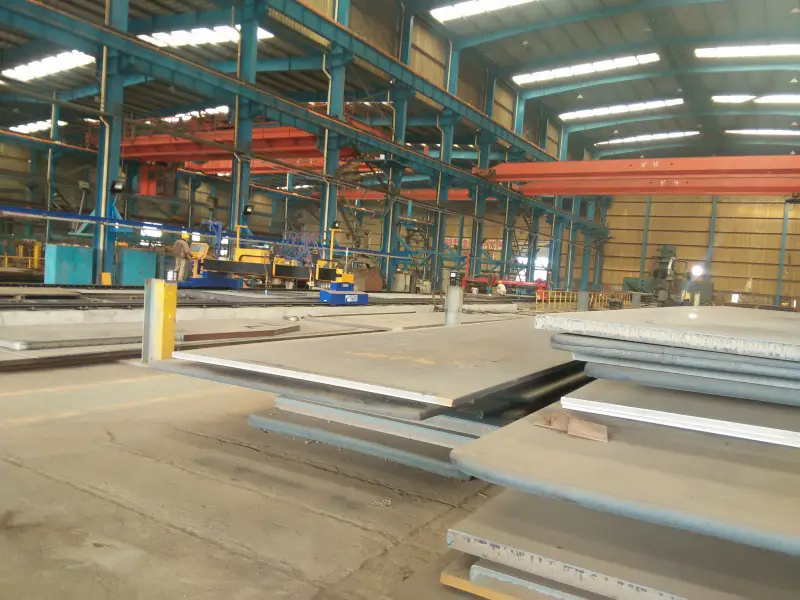
Austenitic 201L (S20103) Stainless Steel Plate/Coil
Austenitic 201L (S20103) Stainless Steel Plate/Coil - Low Carbon, High Strength
Detailed material data for 201L (UNS S20103) austenitic stainless steel plate and coil including chemical composition, mechanical properties, and physical characteristics.
Cold rolling, hot rolling, annealing, pickling, slitting, cutting, forming, deep drawing, bending, welding
- Phone : +8618037372205
- Email : [email protected]
- WhatsApp: Contact via Whtsapp
- WeChat: +8618037372205
Austenitic 201L Stainless Steel Plate/Coil Introduction
Austenitic 201L (S20103) is a low-carbon version of the standard 201 stainless steel. It belongs to the chromium-manganese-nickel-nitrogen austenitic stainless steel family. The reduced carbon content improves intergranular corrosion resistance after welding or stress relieving. This alloy offers an excellent combination of strength, ductility, and formability, maintaining its austenitic structure at room temperature. It is fully non-magnetic when annealed and can become slightly magnetic after cold working. 201L provides higher yield and tensile strength compared to 304 stainless steel, making it a cost-effective alternative for applications where high strength and moderate corrosion resistance are required. It is widely produced in the form of coils and plates for further fabrication.
Austenitic 201L Stainless Steel Plate/Coil Chemical Composition
The chemical composition requirements for 201L (S20103) are specified in ASTM A240/A240M. The low carbon content (<0.030%) enhances weldability and resistance to sensitization. Manganese and nitrogen partially replace nickel to stabilize the austenitic structure, while chromium provides corrosion resistance. Note that phosphorus and sulfur are controlled as impurities.
| Element | Standard Value (%) | Remarks |
|---|---|---|
| Carbon (C) | ≤0.030 | Low carbon for improved weldability |
| Manganese (Mn) | 5.50 – 7.50 | Austenite stabilizer |
| Phosphorus (P) | ≤0.060 | Impurity, maximum limit |
| Sulfur (S) | ≤0.030 | Impurity, maximum limit |
| Silicon (Si) | ≤1.00 | Deoxidizer |
| Chromium (Cr) | 16.00 – 18.00 | Primary element for corrosion resistance |
| Nickel (Ni) | 3.50 – 5.50 | Austenite stabilizer, improves ductility |
| Nitrogen (N) | ≤0.25 | Strengthener and austenite stabilizer |
Austenitic 201L Stainless Steel Plate/Coil Thermal and Electrical Physical Properties
Physical properties provided are typical room-temperature values unless otherwise noted. Thermal expansion and conductivity data are critical for design in environments with temperature cycling. The properties below represent the annealed condition and may slightly vary based on exact composition and processing.
| Property | Standard Reference Value | Unit | Test Condition / Temperature |
|---|---|---|---|
| Density (ρ) | 7.8 | g/cm³ | Room temperature |
| Elastic Modulus (E) | 197 | GPa | Room temperature |
| Shear Modulus (G) | 76 | GPa | Room temperature |
| Poisson's Ratio (ν) | 0.27 – 0.30 | Room temperature | |
| Thermal Expansion Coefficient (α) | 16.0 | 10⁻⁶/K | 0 – 100°C |
| Thermal Conductivity (λ) | 15.0 | W/m·K | At 100°C |
| Specific Heat Capacity | 500 | J/kg·K | 0 – 100°C |
| Electrical Resistivity (ρ_e) | 0.72 | µΩ·m | Room temperature |
Austenitic 201L Stainless Steel Plate/Coil Mechanical Properties
Mechanical properties are based on ASTM A240/A240M for annealed plate, sheet, and strip. The values listed are representative for thickness ranges typically up to 0.25 inches (6.35 mm). Properties may vary with cold work level; for tempers, refer to ASTM A666. Higher strength can be achieved through cold rolling.
| Property | Standard Required Value | Unit | Test Condition |
|---|---|---|---|
| Tensile Strength (Rm) | ≥ 655 | MPa | Room temperature, annealed |
| Yield Strength (ReH, 0.2% offset) | ≥ 260 | MPa | Room temperature, annealed |
| Elongation (A) in 50 mm (2 in.) | ≥ 40 | % | Room temperature, annealed |
| Hardness | ≤ 219 (or ≤ 95 HRB) | HBW (or HRB) | Annealed condition |
Austenitic 201L Stainless Steel Plate/Coil Equivalent Material Standards and Substitute Grade Recommendations
| Country/Region | Standard | Grade | Remarks |
|---|---|---|---|
| USA | ASTM A240/A240M, ASTM A666 | UNS S20103 (201L) | Base specification; low carbon 201 |
| Japan | JIS G4304, G4305 | SUS201L | Equivalent low-carbon grade |
| China | GB/T 3280, GB/T 4237 | 022Cr17Mn6Ni5N (S20103) | Chinese equivalent, same UNS |
| European Union | EN 10088-2 | 1.4372 (X2CrMnNiN17-7-5) | Close equivalent; Mn range slightly wider (6.0–8.0%) |
Austenitic 201L Stainless Steel Plate/Coil Application Introduction
201L stainless steel is selected when higher strength and moderate corrosion resistance are needed at a lower cost than traditional 300-series chromium-nickel grades. Its low carbon content provides superior resistance to intergranular corrosion in welded structures, making it ideal for fabricated components. The alloy is available in a wide range of coils and plates, allowing efficient sheet metal processing.
Product Applications: Drawn parts such as sinks and cookware, Automotive window frames, hub caps, and decorative trim, Elevator panels and interior cladding, Storage tanks and pressure vessels (non-critical service), Formed brackets and support structures
Processed into products: Deep-drawn kitchen sinks, Automotive exhaust system hangers and braces, Architectural flashings and copings, Stamped electronic enclosures, Curtain wall support profiles
Application industries: Kitchenware and household appliances, Automotive trim and structural components, Architecture and building cladding, Transportation (railway cars, trailers), General manufacturing and sheet metal fabrication
Austenitic 201L Stainless Steel Plate/Coil Similar and Alternative Materials
| Country/Region | Standard | Grade | Remarks |
|---|---|---|---|
| USA | ASTM A240 | 201 (S20100) | Standard 201 with higher carbon (≤0.15%); slightly lower corrosion resistance after welding |
| USA | ASTM A240 | 201LN (S20153) | Low carbon with higher nitrogen (≤0.25%) for strength; very close to 201L but with controlled nitrogen minimum |
| USA | ASTM A240 | 301 (S30100) | Higher nickel, lower manganese; higher work hardening rate, used for springs |
| China | GB/T 20878 | 12Cr17Mn6Ni5N (201) | Standard 201 grade, carbon up to 0.15% |
| EU | EN 10088-2 | 1.4310 (X10CrNi18-8) | 301 type, often used as alternative for structural applications |
Notes:
Welding: 201L has good weldability with common processes (TIG, MIG, resistance welding). Filler metals such as 308L or 201-specific electrodes are recommended. Corrosion resistance: Similar to 304 in mild environments but less resistant in acidic chloride solutions. Cold working: Cold rolling and forming can significantly increase strength; intermediate annealing may be required for severe deformation. Magnetism: Non-magnetic in annealed condition; may become slightly magnetic after cold working. Ordering information: Specify finish (2B, BA, No.4 etc.), temper (annealed, 1/4 hard, etc.), and applicable standard.
- Share



