
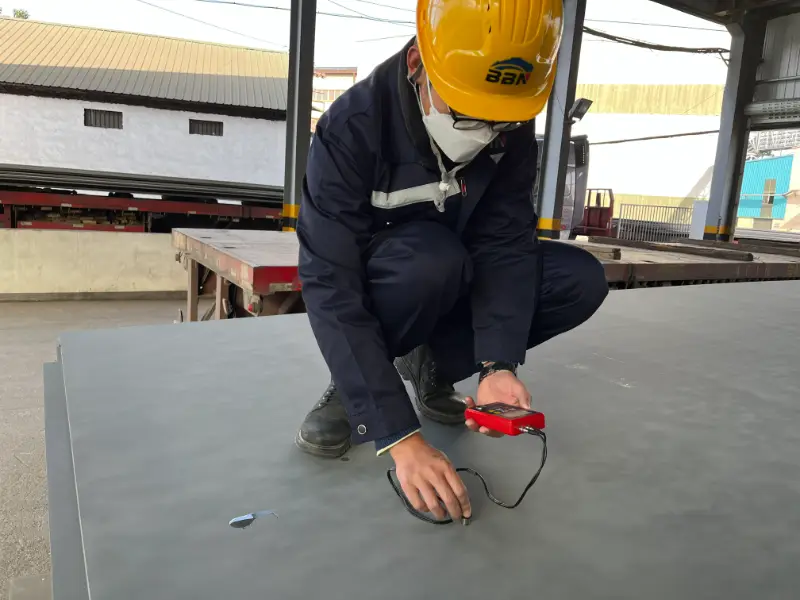
X5CrNiCuNb16-4 (1.4542/17-4PH) Stainless Steel Plate/Coil
X5CrNiCuNb16-4 (1.4542/17-4PH) Stainless Steel Plate/Coil - EN 10088-1 Martensitic CRS
Comprehensive material data for X5CrNiCuNb16-4 (EN 10088-1) martensitic precipitation hardening stainless steel in plate and coil forms. Includes chemical, mechanical and physical properties, international equivalents, and application guidance.
Hot rolling, cold rolling, solution annealing, aging, welding (with precautions), machining (in solution-annealed condition), forming
- Phone : +8618037372205
- Email : [email protected]
- WhatsApp: Contact via Whtsapp
- WeChat: +8618037372205
X5CrNiCuNb16-4 Stainless Steel Plate/Coil Introduction
X5CrNiCuNb16-4, designated 1.4542 and widely known as 17-4PH, is a martensitic precipitation-hardening stainless steel standardized in EN 10088-1. It offers an exceptional combination of high strength, good corrosion resistance, and ease of fabrication in the solution-annealed condition. After simple low-temperature aging, the alloy achieves tensile strengths up to 1300 MPa while retaining toughness. The corrosion resistance is comparable to Type 304 in most environments, and it exhibits excellent resistance to stress-corrosion cracking. This grade is commonly supplied as hot-rolled or cold-rolled plate and coil, suitable for subsequent forming and machining before final hardening heat treatment.
X5CrNiCuNb16-4 Stainless Steel Plate/Coil Chemical Composition
The chemical requirements according to EN 10088-1 for grade X5CrNiCuNb16-4 (1.4542). All elements are controlled within the specified ranges to achieve the desired precipitation hardening response and corrosion resistance.
- Iron (Fe) constitutes the balance.
- Niobium (Nb) is the key hardening element, forming fine precipitates during aging.
- Copper (Cu) contributes to precipitation strengthening.
| Element | Standard Value (wt.%) | Remarks |
|---|---|---|
| Carbon (C) | ≤ 0.07 | |
| Silicon (Si) | ≤ 0.70 | |
| Manganese (Mn) | ≤ 1.50 | |
| Phosphorus (P) | ≤ 0.040 | |
| Sulfur (S) | ≤ 0.015 | |
| Chromium (Cr) | 15.00 – 17.00 | Primary corrosion resistance element |
| Nickel (Ni) | 3.00 – 5.00 | Promotes martensite and toughness |
| Copper (Cu) | 3.00 – 5.00 | Precipitation strengthening |
| Niobium (Nb) | 0.15 – 0.45 | Fine carbide/carbo-nitride former |
| Iron (Fe) | Balance | Remainder |
X5CrNiCuNb16-4 Stainless Steel Plate/Coil Thermal and Electrical Properties
Typical physical data for X5CrNiCuNb16-4 (1.4542) in the aged condition. These values are representative for engineering calculations and are valid at the stated temperatures.
- Melting range: 1400–1440 °C.
- Magnetic: Martensitic, therefore magnetic in all conditions.
| Property | Standard Typical Value | Unit | Test Condition |
|---|---|---|---|
| Density (ρ) | 7.8 | g/cm³ | At 20 °C |
| Elastic Modulus (E) | 196 | GPa | At 20 °C, tension |
| Shear Modulus (G) | 75 | GPa | Calculated from E and ν at 20 °C |
| Poisson's Ratio (ν) | 0.31 | – | At 20 °C |
| Thermal Expansion Coefficient (α) | 10.8 | 10⁻⁶ /K | 20 – 100 °C |
| Thermal Expansion Coefficient (α) | 11.2 | 10⁻⁶ /K | 20 – 200 °C |
| Thermal Conductivity (λ) | 18 | W/(m·K) | At 20 °C |
| Thermal Conductivity (λ) | 21 | W/(m·K) | At 200 °C |
| Specific Heat Capacity (cp) | 460 | J/(kg·K) | At 20 °C |
| Electrical Resistivity (ρe) | 0.80 | µΩ·m | At 20 °C |
X5CrNiCuNb16-4 Stainless Steel Plate/Coil Mechanical Properties
Typical mechanical properties for plate/coil of X5CrNiCuNb16-4 (1.4542) according to EN 10088-2 for the precipitation hardened condition H900 (482 °C aging). Data are for transverse test pieces unless otherwise noted. The alloy is usually supplied in the solution-annealed (soft) condition and hardened by the fabricator; properties in the fully hardened state are therefore relevant for design.
- Condition A (solution annealed): Rp0.2 ≈ 600–800 MPa, Rm ≈ 900–1100 MPa, A ≈ 10% (informative).
- Hardness after aging is typically 40–47 HRC.
| Property | Standard Requirement Value | Unit | Test Condition |
|---|---|---|---|
| 0.2% Yield Strength (Rp0.2) | min. 1170 | MPa | Transverse, H900 condition (482 °C / 1h air cool), thickness ≤ 75 mm |
| Tensile Strength (Rm) | 1310 – 1620 | MPa | Transverse, H900 condition (482 °C / 1h air cool), thickness ≤ 75 mm |
| Elongation (A) | min. 5 | % | Transverse, H900 condition, gauge length 5.65√So, thickness ≤ 75 mm |
| Hardness (HBW) | 420 – 480 (typical) | HBW | H900 condition (informative, from material data sheet) |
| Hardness (HRC) | 40 – 47 (typical) | HRC | H900 condition (informative) |
X5CrNiCuNb16-4 Stainless Steel Plate/Coil Fully Equivalent Material Standards and Replaceable Designations
| Country/Region | Standard | Designation | Remarks |
|---|---|---|---|
| EU | EN 10088-1/2 | X5CrNiCuNb16-4 (1.4542) | Original specification |
| USA | ASTM A564/A564M | Grade 630 (UNS S17400) | Identical chemistry and mechanical properties; H900/H1025 etc. |
| Japan | JIS G4303 | SUS630 | Equivalent to 17-4PH |
| China | GB/T 1220 | 05Cr17Ni4Cu4Nb | Same precipitation hardening steel |
| International | ISO 15510 | X5CrNiCuNb16-4 | Harmonized designation |
X5CrNiCuNb16-4 Stainless Steel Plate/Coil Application Introduction
X5CrNiCuNb16-4 (17-4PH) is chosen for components that demand high mechanical strength coupled with moderate corrosion resistance in both atmospheric and mildly acidic environments. Its machinability in the solution-annealed condition, combined with a simple aging heat treatment (usually 480–620 °C) that causes minimal distortion and scaling, makes it ideal for complex precision parts.
- Do not use in heavily sensitizing environments (e.g., hot, concentrated HCl) as it may suffer from stress corrosion cracking.
- Welding is possible with matching filler and post-weld aging, but attention to hydrogen embrittlement is required.
Product Applications: Structural components for aircraft and helicopters, Valves, valve stems, and pump shafts, Fasteners (bolts, screws, studs) for high-strength applications, Centrifuge bowls, nozzles, and screens, Surgical instruments and orthopaedic implants (martensitic series), Mould inserts for plastic injection moulding, Pressure vessel parts (supports, internal fittings), Filtration equipment and separator plates
Processed into products: Landing gear parts, Actuator rods and torque tubes, Compressor blades and discs, High-pressure pump bodies and impellers, Nuclear waste container racks, Precision machined pins and bushes, Wave springs and Belleville washers, Custom flanges and sealing faces
Application industries: Aerospace and defense, Chemical and petrochemical processing, Food processing and beverage equipment, Oil and gas exploration, Marine engineering, Medical devices, Power generation (including nuclear), General engineering (moulds, fasteners)
X5CrNiCuNb16-4 Stainless Steel Plate/Coil Similar or Alternative Material Recommendations
| Country/Region | Standard | Designation | Remarks |
|---|---|---|---|
| EU | EN 10088-1 | X5CrNiCu15-5 (1.4545) | 15-5PH: Cr 14.0–15.5, Ni 3.5–5.5, Cu 2.5–4.5, no Nb; similar strength and corrosion, slightly better transverse toughness |
| USA | ASTM A564/A564M | Grade XM-12 (UNS S15500) | 15-5PH, comparable to X5CrNiCu15-5; often used where transverse toughness is critical |
| USA | ASTM A313/A313M | Type 631 (UNS S17700) | 17-7PH: semi-austenitic, requires different heat treatment; higher strength possible but more complex processing |
| USA | AMS 5604 | 17-4PH (S17400) | Same as grade 630; alternate aerospace specification |
Notes:
Special considerations:
- To avoid stress corrosion cracking, the aged hardness should generally not exceed 33 HRC for sour service (NACE MR0175). If used in H2S environments, the H1150M condition (760 °C double aging) is recommended.
- Solution annealing: 1020–1060 °C, quenching in air or oil (depending on section size).
- Aging: Typical cycles are H900 (482 °C, 1 h), H1025 (552 °C, 4 h), H1075 (580 °C, 4 h), H1150 (620 °C, 4 h). Higher temperatures reduce strength but improve ductility and toughness.
- Magnetic permeability: The alloy is ferromagnetic, which may be relevant for electromagnetic applications.
- Surface condition: Plate and coil are often supplied descaled and pickled; cold-rolled variants may also be available bright annealed.
- Further heat treatment details are governed by EN 10088-2 (plate/coil) and EN 10088-3 (bars, forgings).
- Share



