
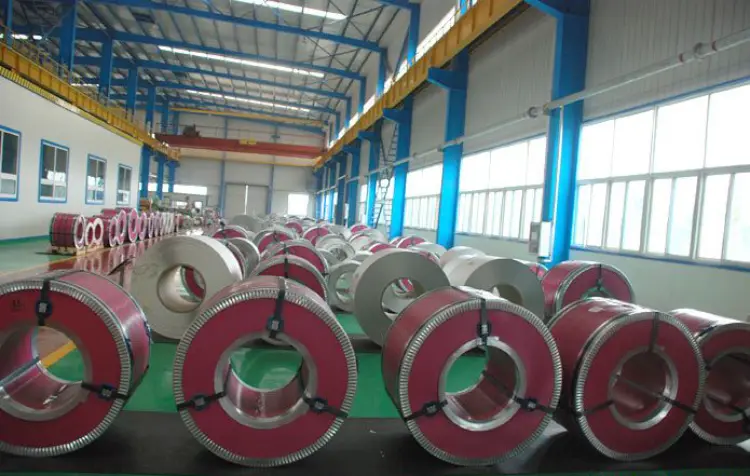
AG380CL Hot Rolled Steel Coil
AG380CL Hot Rolled Steel Coil - Q/BQB 310-2009 Advanced High-Strength Complex Phase Steel for Automotive
Detailed material data for AG380CL hot rolled steel coil under Baosteel standard Q/BQB 310-2009, including chemical composition, mechanical properties, physical properties, international equivalents, and application guidance.
Suitable for cold forming (bending, drawing, flanging), blanking, welding (spot, laser, arc), and fatigue-critical applications. Not intended for heat treatment that alters the original microstructure.
- Phone : +8618037372205
- Email : [email protected]
- WhatsApp: Contact via Whtsapp
- WeChat: +8618037372205
AG380CL Hot Rolled Steel Coil Introduction
AG380CL is a hot-rolled complex-phase (CP) steel grade defined in the Baosteel enterprise standard Q/BQB 310-2009 for automotive structural components. It belongs to the advanced high-strength steel (AHSS) family, offering an excellent balance of high strength, good formability, and superior fatigue resistance. The microstructure consists of ferrite, bainite, and small amounts of martensite and retained austenite, which provides a minimum yield strength of 380 MPa and tensile strength above 550 MPa. This grade is specifically designed for applications where high dynamic loads and weight reduction are critical, such as automotive wheels, chassis parts, and suspension components. It exhibits a high strain hardening rate (n-value) and good hole expansion capacity. The steel is supplied as hot-rolled pickled or unpickled coils with improved surface quality and thickness tolerance, ensuring reliable processing in subsequent forming and welding operations.
AG380CL Hot Rolled Steel Coil Chemical Composition
The chemical composition specified in Q/BQB 310-2009 for AG380CL is designed to achieve the complex-phase microstructure. Low carbon content ensures weldability, while additions of Mn, Si, and microalloying elements (Nb, Ti) provide grain refinement and precipitation strengthening. Tight control on P and S improves formability and fatigue life.
| Element | Standard Value | Remarks |
|---|---|---|
| C | ≤0.12 | Ladle analysis |
| Si | ≤0.50 | |
| Mn | ≤1.80 | |
| P | ≤0.030 | |
| S | ≤0.025 | |
| Alt (total Al) | ≥0.015 | Minimum for fully killed steel |
| Nb | ≤0.09 | Optional microalloying element |
| Ti | ≤0.15 | Optional microalloying element |
| Cr+Mo | ≤0.50 | Sum of chromium and molybdenum if deliberately added |
| N | ≤0.012 |
AG380CL Hot Rolled Steel Coil Thermal and Electrical Physical Properties
The following physical properties are typical for low-alloy complex-phase steels at room temperature unless otherwise stated. These values are provided for engineering calculations and are not part of the delivery specification. They may vary slightly with actual chemical composition and processing history.
| Property | Typical Value | Unit | Test Condition |
|---|---|---|---|
| Density (ρ) | 7.85 | g/cm³ | At 20 °C |
| Elastic modulus (E) | 210 | GPa | Tensile, room temp. |
| Shear modulus (G) | 80 | GPa | Calculated from E and ν |
| Poisson's ratio (ν) | 0.30 | — | Room temp. |
| Thermal expansion coefficient (α) | 11.0 – 12.0 | 10⁻⁶/K | 20–100 °C; average value |
| Thermal expansion coefficient (α) | 12.0 – 13.0 | 10⁻⁶/K | 20–200 °C |
| Thermal expansion coefficient (α) | 13.0 – 14.0 | 10⁻⁶/K | 20–400 °C |
| Thermal conductivity (λ) | 36 – 42 | W/(m·K) | At 20 °C |
| Specific heat capacity (cp) | 450 – 480 | J/(kg·K) | At 20 °C |
| Electrical resistivity (ρe) | 0.20 – 0.25 | µΩ·m | At 20 °C |
AG380CL Hot Rolled Steel Coil Mechanical Properties
The mechanical properties comply with Q/BQB 310-2009 for AG380CL. Values are guaranteed for the transverse direction unless otherwise agreed. The minimum elongation depends on specimen type and thickness. The high n-value and bake-hardening potential contribute to final part strength after forming and paint baking.
| Property | Standard Requirement | Unit | Test Condition / Remarks |
|---|---|---|---|
| Yield strength (ReH) | 380 – 530 | MPa | Transverse; 0.2% proof strength may apply if yield point is not pronounced |
| Tensile strength (Rm) | ≥550 | MPa | Transverse |
| Elongation after fracture (A80) | ≥14 | % | For thickness <3.0 mm, gauge length 80 mm |
| Elongation after fracture (A50) | ≥17 | % | For thickness 3.0–6.0 mm, gauge length 50 mm |
| Elongation after fracture (A50) | ≥20 | % | For thickness >6.0 mm (typical value) |
| Bend test (bending angle 180°) | d=0a | — | Mandrel diameter equal to zero times specimen thickness; no cracks |
| Strain hardening exponent n (10–20% strain) | ≥0.16 | — | Transverse; not mandatory but indicative for formability |
| Hole expansion ratio λ | ≥30 | % | Typical minimum value for edges without pre-damage |
AG380CL Hot Rolled Steel Coil Exact Equivalent Material Standards and Substitutable Grades
| Country/Region | Standard | Grade | Remarks |
|---|---|---|---|
| China | Q/BQB 310-2009 | AG380CL | Original specification, complex phase |
| Europe | EN 10346:2015 | HCT600C (+CP) | Close equivalent: min yield 380–530 MPa, min tensile 600 MPa; verify exact ranges |
| International (ISO) | ISO 20835:2016 | HR660Y380T-CP | Hot rolled complex phase steel; tensile ≥660 MPa, yield 380–530 MPa |
| Japan | JIS G 3134:2018 | SPFH590 (selected) | Ferrite-bainite type, tensile ≥590 MPa, yield typically ≥400 MPa; not fully identical in microstructure but can substitute in many applications |
AG380CL Hot Rolled Steel Coil Application Introduction
AG380CL is optimized for lightweight automotive structural parts subjected to cyclic loading and demanding forming operations. Its complex-phase microstructure provides high energy absorption, excellent fatigue life, and good weldability with standard resistance welding and laser processes. The steel can be used in the as-supplied condition, eliminating the need for post-forming heat treatment, although a bake-hardening effect during paint curing can further increase yield strength.
Product Applications: Automotive wheel rims (steel wheels), Wheel discs and spiders, Control arms and suspension links, Chassis subframes and engine cradles, Cross members and longitudinal beams, Seat frames and reinforcement panels, Bumper beams and crash boxes (where yield strength requirement is moderate)
Processed into products: Deep-drawn and flow-formed wheel rims, Flanged and holed wheel discs, Hydroformed or press-formed control arms, Laser welded tailored blanks for B-pillar reinforcements, Bent and welded tube for stabilizer bars (alternative applications)
Application industries: Automotive (passenger cars and commercial vehicles), Agricultural and construction machinery (lightweight components), Railway and transport equipment (structural brackets), Wind energy (small structural parts)
AG380CL Hot Rolled Steel Coil Similar / Alternative Material Recommendations
| Country/Region | Standard | Grade | Remarks |
|---|---|---|---|
| China | GB/T 20887.6 | HR600F | Ferrite-bainite AHSS with comparable tensile and yield strength; lower hole expansion |
| Europe | EN 10346 | HCT690T (+TRIP/GI) | Higher tensile strength (690 MPa min), multiphase steel with good formability; potential downgauge option |
| Japan | JIS G 3135 | SPFC590Y | Cold-rolled high-strength IF steel; close strength but different production route; suitable for thinner gauges |
| USA | SAE J2745 | HSLA 380/550 | Conventional HSLA grade with similar mechanical values; lower strain hardening and fatigue resistance |
| Korea | POSCO PFC | PFC590R | Ferrite-bainite hot rolled steel for automotive structural use |
Notes:
Processing notes: AG380CL shows a pronounced Bauschinger effect; design of multi-step forming operations should consider this. The steel is delivered with a controlled mill edge (or trimmed edge on request). Pickled and oiled surface provides temporary corrosion protection; long-term storage requires additional measures. Welding parameters should be adapted to the higher carbon equivalent (CEV ≈ 0.25–0.35) compared to mild steel. For critical fatigue applications, edge quality after blanking must be assessed; fine blanking or shaving may improve performance.
- Share



