
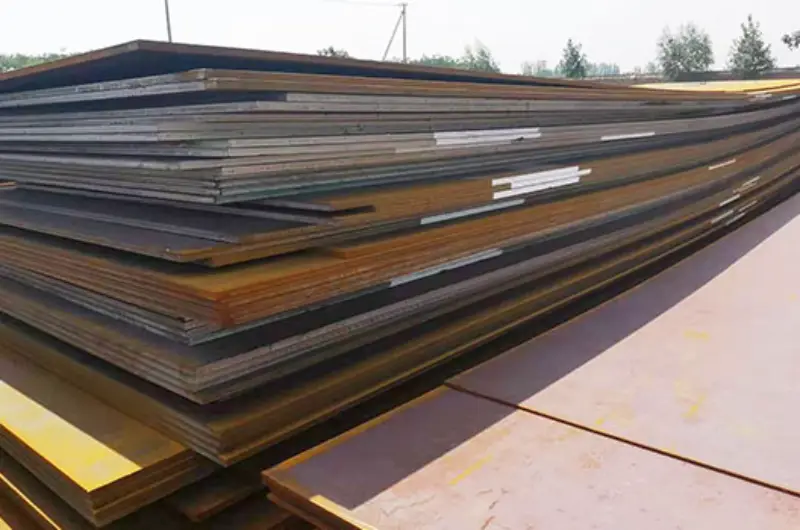
Q/BQB 310-2009 AG330CL Hot Rolled Steel
Q/BQB 310-2009 AG330CL Hot Rolled Steel: High-Strength Automotive Structural Grade
Detailed material data for AG330CL hot rolled steel coil under Baosteel standard Q/BQB 310-2009, featuring high yield strength, excellent formability, and fatigue resistance for automotive structural components.
Cold forming, bending, stamping, punching, welding, blanking, shearing
- Phone : +8618037372205
- Email : [email protected]
- WhatsApp: Contact via Whtsapp
- WeChat: +8618037372205
Q/BQB 310-2009 AG330CL Hot Rolled Steel Introduction
AG330CL is a hot-rolled, high-strength low-alloy (HSLA) steel grade specified under the Baosteel enterprise standard Q/BQB 310-2009. Characterized by a minimum yield strength of 330 MPa, this ferritic-pearlitic steel is microalloyed with niobium, titanium, or vanadium to achieve grain refinement and precipitation strengthening. It offers an optimal combination of high strength, excellent cold formability, superior fatigue resistance, and good weldability. AG330CL is primarily designed for demanding automotive applications such as chassis frames, longitudinal beams, and wheel components, where high load-bearing capacity and durability are critical. The controlled rolling process ensures a fine and homogeneous microstructure, guaranteeing consistent mechanical properties across the coil width and length.
Q/BQB 310-2009 AG330CL Hot Rolled Steel Chemical Composition
The chemical composition of AG330CL is carefully balanced to achieve the required mechanical properties while ensuring good weldability and cold formability. Key elements include carbon for strength, manganese for solid solution strengthening, and microalloying elements such as niobium and titanium for grain refinement and precipitation hardening. Phosphorus and sulfur are controlled at low levels to maintain ductility and toughness.
| Chemical Element | Specified Value | Remarks |
|---|---|---|
| C | ≤ 0.12 % | For strength and weldability balance. |
| Si | ≤ 0.50 % | For deoxidation and strength. |
| Mn | ≤ 1.00 % | For solid solution strengthening. |
| P | ≤ 0.030 % | For ductility. |
| S | ≤ 0.025 % | For formability and toughness. |
| Alt (total aluminum) | ≥ 0.015 % | For grain refinement and deoxidation. |
| Nb, Ti, V, etc. | Appropriate amounts may be added singly or in combination. | Microalloying elements for grain refinement and precipitation strengthening. |
Q/BQB 310-2009 AG330CL Hot Rolled Steel Thermal and Electrical Physical Properties
The following physical properties are typical for HSLA steel grades like AG330CL. These values are essential for engineering calculations involving structural design, thermal processing, and component simulation. Slight variations may occur depending on the exact chemical composition and processing history.
| Property | Typical Reference Value | Unit | Test Condition / Remarks |
|---|---|---|---|
| Density (ρ) | ~7.85 | g/cm³ | At 20 °C |
| Modulus of Elasticity (E) | ~210 | GPa | At 20 °C |
| Shear Modulus (G) | ~80 | GPa | At 20 °C |
| Poisson's Ratio (ν) | ~0.3 | - | At 20 °C |
| Thermal Expansion Coefficient (α) | ~11.5 - 12.5 | 10⁻⁶/K | Range for 20 °C to 100 °C / 200 °C |
| Thermal Conductivity (λ) | ~42 - 51 | W/(m·K) | At 20 °C |
| Specific Heat Capacity (c) | ~0.46 | kJ/(kg·K) | At 20 °C |
| Electrical Resistivity (ρ_e) | ~0.22 - 0.28 | Ω·mm²/m | At 20 °C |
Q/BQB 310-2009 AG330CL Hot Rolled Steel Mechanical Properties
The mechanical properties are determined on test pieces taken transverse to the rolling direction in accordance with applicable standards. The minimum yield strength is the defining property of this grade. The values ensure a reliable balance of strength for structural integrity and ductility for cold forming operations during manufacturing.
| Property | Specified Requirement Value | Unit | Test Condition / Remarks |
|---|---|---|---|
| Minimum Yield Strength (ReH/ReL) | ≥ 330 | MPa | Nominal thickness (t) < 3.0 mm: ReL (Lower yield strength) applies. |
| Minimum Tensile Strength (Rm) | 400 - 520 | MPa | A range ensures consistent formability. |
| Minimum Elongation after fracture (A) | A80mm: ≥ 22 | % | For nominal thickness t < 3.0 mm, gauge length L0=80 mm. |
| Minimum Elongation after fracture (A) | A5.65√S0: ≥ 26 | % | For nominal thickness t ≥ 3.0 mm, gauge length proportional to specimen area. |
| 180° Bending Test (Bend Diameter) | d = 0.5a | mm | a = specimen thickness; No cracking permitted. |
Q/BQB 310-2009 AG330CL Hot Rolled Steel Identical/Equivalent Material Standards and Substitute Grades
| Country/Region | Standard | Grade/Designation | Remarks |
|---|---|---|---|
| China | Q/BQB 310-2009 | AG330CL | The original specified grade. |
| China | GB/T 3077 (Modified/Referenced for similar HSLA concepts) | QSTE340TM | Close equivalent from some Chinese automaker standards. |
| European Union | EN 10149-2: 2013 | S355MC | Direct functional equivalent with a minimum 355 MPa yield, falls within same application range. |
| Japan | JIS G 3113:2018 | SAPH370 | Functional equivalent for automotive structural use with min. 370 MPa tensile strength. |
| International | ISO 6930-2:2004 | FeE355 | International standard equivalent for high yield strength cold-forming steels. |
Q/BQB 310-2009 AG330CL Hot Rolled Steel Application Introduction
AG330CL is optimized for components requiring a high fatigue life under dynamic loading combined with good cold formability. Its design allows for direct stamping into complex shapes without intermediate annealing. Key application areas include:
Product Applications: Vehicle chassis and subframes, Longitudinal beams and side rails, Cross members and frame stiffeners, Steel wheels (rims and discs), Suspension system components (control arms, spring brackets), Seat frames, slides, and recliner mechanisms, Tubular products for structural applications
Processed into products: Stamped and bent chassis frame rails, Formed and welded cross-car beams, Deep-drawn or flow-formed wheel rims, Multi-stage stamped suspension arms, Hydroformed engine cradles, Pierced and punched seat bracket assemblies, Roll-formed structural profiles
Application industries: Automotive and light truck manufacturing, Commercial vehicle and bus construction, Trailer and semi-trailer engineering, Industrial machinery and material handling, Agricultural equipment manufacturing
Q/BQB 310-2009 AG330CL Hot Rolled Steel Similar/Closely Matching Alternative Material Recommendations
| Country/Region | Standard | Grade/Designation | Remarks |
|---|---|---|---|
| China - Baosteel | Q/BQB 310-2009 | AG310CL | Lower yield strength class (≥310 MPa), similar formability. Suitable for lighter duty components if 330 MPa is not mandatory. |
| China - Baosteel | Q/BQB 310-2009 | AG380CL | Higher yield strength class (≥380 MPa). Can be a downgauge replacement, but formability will be reduced compared to AG330CL. |
| USA | ASTM A1011/A1011M | HSLAS Grade 340, Class 1 | Similar minimum yield (340 MPa) and tensile strength bands. Microalloying strategy may differ slightly. |
| European Union | EN 10149-2 | S315MC | Slightly lower minimum yield strength (315 MPa) but very close chemical and formability profile, offering a performance-reserve tradeoff. |
Notes:
Welding: AG330CL has excellent weldability using conventional resistance spot, MIG/MAG, and laser welding processes, with minimal risk of cold cracking due to its low carbon equivalent (CEV typically < 0.23). Pre-heating is generally not required for thicknesses below 10 mm.
Fatigue: This grade exhibits a high endurance limit, making it ideal for dynamically loaded chassis and suspension parts. The fine-grained microstructure effectively inhibits fatigue crack initiation.
Surface condition: It is commonly supplied with a pickled and oiled surface (AG330CL PO) to provide a clean surface for immediate forming and welding, though an un-pickled (black) condition is also available.
Certification: Material is typically supplied with an inspection certificate to EN 10204 type 3.1.
- Share



