
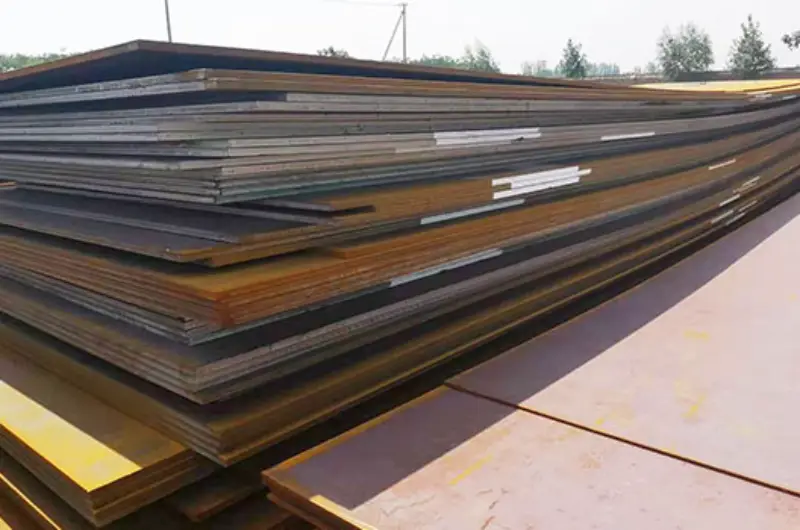
(TB/T 1979)09CuPTiRE-B Weather Resistant Steel
09CuPTiRE-B Weather Resistant Steel (TB/T 1979) - China Railway Vehicle Structural Plate
Comprehensive datasheet of 09CuPTiRE-B weather resistant steel plate as per China railway industry standard TB/T 1979, including chemical composition, mechanical properties, physical properties, equivalent grades and applications.
Hot rolling, cold forming, bending, shearing, punching, welding (with appropriate low-hydrogen procedures), machining
- Phone : +8618037372205
- Email : [email protected]
- WhatsApp: Contact via Whtsapp
- WeChat: +8618037372205
09CuPTiRE-B Weather Resistant Steel Introduction
09CuPTiRE-B is a copper-phosphorus-titanium-rare earth weather resistant structural steel plate specified in TB/T 1979, the Chinese railway industry standard for atmospheric corrosion-resisting steel. It is a low-alloy high-strength steel designed for excellent resistance to atmospheric corrosion by forming a dense, protective patina. The addition of phosphorus and copper enhances weathering properties, while titanium and rare earths refine grain structure and improve toughness. This grade is mainly supplied in hot-rolled condition and is widely used for manufacturing railway freight cars, passenger coaches and other exposed structural components.
09CuPTiRE-B Weather Resistant Steel Chemical Composition
Chemical composition requirements as specified in TB/T 1979 for grade 09CuPTiRE-B. All values represent ladle analysis unless otherwise noted. Rare earth (RE) is added to improve toughness and sulfide shape control; the given range indicates the amount added. Residual elements such as Cr, Ni are not explicitly specified but are limited to common levels in low-alloy steelmaking.
| Element | Specified Value | Remarks |
|---|---|---|
| Carbon (C) | ≤ 0.12 % | max |
| Silicon (Si) | 0.20 – 0.40 % | |
| Manganese (Mn) | 0.25 – 0.55 % | |
| Phosphorus (P) | 0.07 – 0.12 % | |
| Sulfur (S) | ≤ 0.020 % | max |
| Copper (Cu) | 0.25 – 0.45 % | |
| Titanium (Ti) | ≤ 0.03 % | max |
| Rare Earth (RE) | 0.01 – 0.04 % | added amount, may be expressed as RE elements |
09CuPTiRE-B Weather Resistant Steel Thermal & Electrical Physical Properties
These values are typical for low-alloy Cu-P-RE weathering steels at room temperature unless otherwise indicated. They are provided for design guidance and are not part of the minimum acceptance criteria in TB/T 1979. Variations may occur depending on exact composition and heat treatment condition.
| Property | Typical Value | Unit | Test Condition / Temperature |
|---|---|---|---|
| Density (ρ) | 7.85 – 7.87 | g/cm³ | Room temperature |
| Modulus of Elasticity (E) | 205 – 210 | GPa | Room temperature, tension test |
| Shear Modulus (G) | 79 – 81 | GPa | Calculated from E and ν |
| Poisson's Ratio (ν) | 0.29 – 0.30 | — | Room temperature |
| Thermal Expansion Coefficient (α) | 11.5 – 12.5 | ×10⁻⁶/K | 20 °C to 200 °C |
| Thermal Conductivity (λ) | 45 – 52 | W/(m·K) | At 100 °C |
| Specific Heat Capacity (c) | 460 – 480 | J/(kg·K) | Room temperature to 100 °C |
| Electrical Resistivity (ρₑ) | 0.15 – 0.25 | μΩ·m | Room temperature |
09CuPTiRE-B Weather Resistant Steel Mechanical Properties
Mechanical properties for 09CuPTiRE-B steel plates as per TB/T 1979. Tested on transverse samples for plate thickness ≤6 mm (the most common thickness range for railway vehicle skins). For thicker plates, the values may be adjusted according to the standard. Impact test is mandatory for grade B at -40 °C.
Bending test is performed with 180° bending angle on a mandrel diameter equal to the plate thickness (a), without cracking on the outer surface.
| Property | Specified Value | Unit | Test Condition |
|---|---|---|---|
| Yield Strength (ReH) | ≥ 295 | MPa | Thickness ≤6 mm, transverse |
| Tensile Strength (Rm) | ≥ 430 | MPa | Thickness ≤6 mm, transverse |
| Elongation after fracture (A) | ≥ 24 | % | Gauge length L₀=50 mm (or proportional L₀=5.65√S₀), transverse |
| Bend Test | Crack-free | — | Bend angle 180°, mandrel dia. = plate thickness (a) |
| Impact Energy (KV₂) | ≥ 27 | J | Charpy V-notch, -40 °C, longitudinal |
09CuPTiRE-B Weather Resistant Steel Completely Equivalent Material Standards and Grades
| Country/Region | Standard | Grade | Remarks |
|---|---|---|---|
| China | TB/T 1979 | 09CuPTiRE-B | The only standard defining this exact grade |
09CuPTiRE-B Weather Resistant Steel Application Introduction
09CuPTiRE-B is primarily used in the railway transportation sector where unpainted weathering steel is desired to reduce maintenance costs. The steel forms a stable, protective rust layer after exposure to the atmosphere, which slows further corrosion. Its good toughness at -40 °C makes it suitable for severe cold regions. Typical applications include:
Product Applications: Open-top hopper wagon bodies (side walls, end walls, hopper plates), Flat wagon decks and side frames, Tank wagon shells and head plates, Passenger coach body panels and underframe members, Corrugated sheets for boxcar roofs and walls
Processed into products: Side wall sheets and stiffness corrugations, End wall panels and corner posts, Roof panels and roof hat sections, Underframe longitudinal and cross beams, Draft sill and coupler carrier plates, Container corner castings (combined with cast steel) and container wall sheets, Cargo floor plates with anti-slip pattern, Bracket and gusset plates for welded assemblies
Application industries: Railway rolling stock manufacturing, Freight container fabrication, Highway and railway bridges (secondary members), Architectural cladding and façades, Mining and industrial equipment exposed to outdoor environment
09CuPTiRE-B Weather Resistant Steel Materials with Similar Properties
| Country/Region | Standard | Grade | Remarks |
|---|---|---|---|
| China | TB/T 1979 | 09CuPTiRE-A | Lower impact toughness grade (0 °C instead of -40 °C); same base composition |
| China | GB/T 4171 | Q355GNH | Cu-P-Cr-Ni weathering steel (without Ti and RE); higher strength (yield 355 MPa) and slightly different P range |
| China | GB/T 4171 | Q345GNHL | Weathering steel with similar corrosion resistance; used for welded structures |
| Europe | EN 10025-5 | S355J2WP | Cu-P-Cr-Ni based weather resistant steel; comparable weathering performance but without Ti and RE addition |
| Japan | JIS G3125 | SPA-H | High phosphorus atmospheric corrosion resistant steel; widely used for railway vehicles and containers |
| USA | ASTM A588 | Grade B | High-strength low-alloy weathering steel with minimum yield 345 MPa; commonly used in bridges, without rare earth additions |
Notes:
Welding considerations: Due to the elevated phosphorus content (0.07-0.12%), this steel grade requires careful welding procedure control to avoid hot cracking. Low heat input, low-hydrogen electrodes, and preheating above 100 °C are recommended. Post-weld normalizing may be applied if toughness restoration is needed. Corrosion protection: In dry atmospheric conditions, the protective patina develops within 6-18 months; wet and heavily contaminated environments may delay formation. Unpainted surfaces should be free from mill scale for uniform weathering.
- Share



