
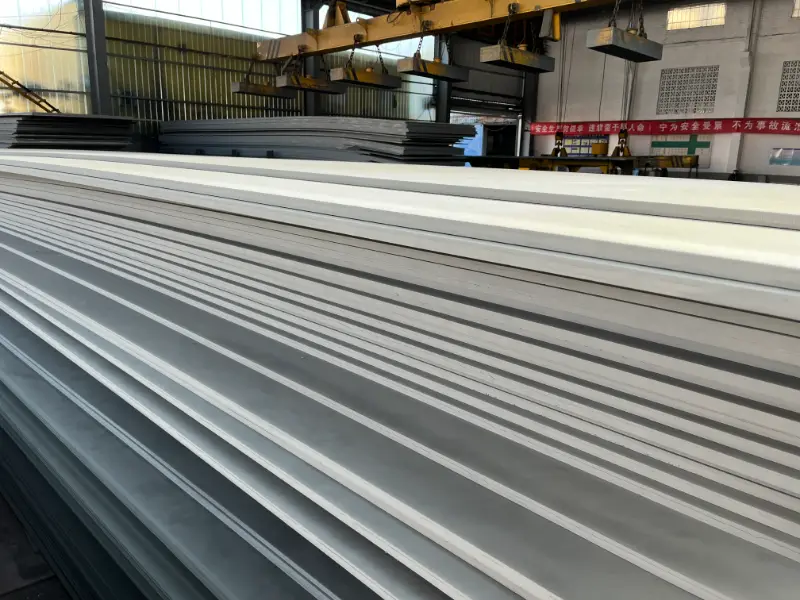
SUS447J1 Stainless Steel
SUS447J1 Super Ferritic Stainless Steel | High Cr-Mo Corrosion Resistant Alloy
Discover SUS447J1 super ferritic stainless steel with 30% chromium, 2% molybdenum, and niobium stabilization. Ideal for severe chloride environments and high-temperature applications.
Welding (with suitable filler, e.g., nickel-base or matching composition), bending, forming, machining
- Phone : +8618037372205
- Email : [email protected]
- WhatsApp: Contact via Whtsapp
- WeChat: +8618037372205
SUS447J1 Stainless Steel Introduction
SUS447J1 is a super ferritic stainless steel standardized under JIS G 4304, characterized by very high chromium content (28.5–32%), molybdenum addition (1.5–2.5%), and stabilization with niobium. It offers exceptional resistance to pitting, crevice corrosion, and stress corrosion cracking in chloride-containing media, outperforming standard ferritic grades like SUS430. With an ultra-low carbon and nitrogen content, it maintains excellent toughness and ductility after welding. Key features:
- Outstanding resistance to localized corrosion in seawater and acidic chlorides
- Good high-temperature oxidation resistance up to about 900°C
- Low thermal expansion and high thermal conductivity compared to austenitic grades
- Magnetic and weldable with proper filler materials
SUS447J1 Stainless Steel Chemical Composition
The chemical composition of SUS447J1 as per JIS G 4304 is designed to maximize resistance to chloride-induced corrosion. Key elements:
- Very high chromium builds a stable passive layer
- Molybdenum enhances pitting and crevice corrosion resistance
- Niobium (or Nb+Ta) ties up carbon and nitrogen, preventing sensitization and intergranular attack
Ultra-low carbon and nitrogen levels ensure ductility and weldability.
| Element | Specified Value (%) | Remarks |
|---|---|---|
| Carbon (C) | ≤0.025 | Max, for corrosion resistance and toughness |
| Silicon (Si) | ≤1.00 | Max |
| Manganese (Mn) | ≤1.00 | Max |
| Phosphorus (P) | ≤0.040 | Max |
| Sulfur (S) | ≤0.030 | Max |
| Chromium (Cr) | 28.50 – 32.00 | Key element for passivity |
| Molybdenum (Mo) | 1.50 – 2.50 | Improves pitting resistance |
| Nitrogen (N) | ≤0.025 | Max, kept low to avoid embrittlement |
| Niobium (Nb) or Nb+Ta | 5×C% – 0.80 | Stabilizing element; prevents intergranular corrosion |
SUS447J1 Stainless Steel Thermal and Electrical Physical Properties
Physical property data for SUS447J1 are based on published literature for similar high-chromium ferritic stainless steels. These values assist in thermal design and material selection. Compared to austenitic grades: thermal expansion is lower and thermal conductivity is higher, reducing thermal stresses in cyclic service.
| Property | Typical Value | Unit | Condition / Temperature |
|---|---|---|---|
| Density (ρ) | 7.7 | g/cm³ | At 20°C |
| Modulus of Elasticity (E) | 200 | GPa | At 20°C |
| Shear Modulus (G) | 78 | GPa | At 20°C, typical for ferritic steels |
| Poisson's Ratio (ν) | 0.28 | – | At 20°C |
| Thermal Expansion Coefficient (α) | 10.5 | 10⁻⁶/K | 20–100°C |
| Thermal Expansion Coefficient (α) | 11.0 | 10⁻⁶/K | 20–200°C |
| Thermal Expansion Coefficient (α) | 11.5 | 10⁻⁶/K | 20–400°C |
| Thermal Conductivity (λ) | 17 | W/(m·K) | At 20°C |
| Thermal Conductivity (λ) | 19 | W/(m·K) | At 100°C |
| Specific Heat Capacity (c_p) | 460 | J/(kg·K) | At 20°C |
| Electrical Resistivity (ρ_e) | 0.60 | µΩ·m | At 20°C |
SUS447J1 Stainless Steel Mechanical Properties
Mechanical properties are specified in the solution-annealed condition per JIS G 4304. The alloy combines high strength with good ductility. Note: values depend on plate thickness; the listed requirements apply to hot-rolled plates up to a certain thickness. Elongation is typically measured using a gauge length of 50 mm.
| Property | Specified Requirement | Unit | Test Condition |
|---|---|---|---|
| Yield Strength (0.2% offset) | ≥ 450 | MPa | At room temperature, annealed |
| Tensile Strength | ≥ 620 | MPa | At room temperature, annealed |
| Elongation (A) | ≥ 20 | % | Gauge length 50 mm, thickness ≤ 5 mm |
| Elongation (A) | ≥ 18 | % | Gauge length 50 mm, thickness > 5 mm |
| Bend Test (180°) | D = t | – | Bend diameter equals plate thickness; no cracks |
| Hardness | ≤ 219 | HBW | Annealed condition |
SUS447J1 Stainless Steel Direct Equivalent Standards and Replaceable Grades
SUS447J1 is a proprietary grade mainly specified in Japanese standards. The following table lists the applicable JIS standards where the exact designation SUS447J1 appears. There is no identical grade in ASTM, EN, or other international standards; therefore, direct equivalents are limited to the Japanese system.
| Country/Region | Standard | Grade | Remarks |
|---|---|---|---|
| Japan | JIS G 4304 | SUS447J1 | Hot-rolled stainless steel plate, sheet and strip |
| Japan | JIS G 4305 | SUS447J1 | Cold-rolled stainless steel plate, sheet and strip |
| Japan | JIS G 4312 | SUS447J1 | Stainless steel wire rods |
| Japan | JIS G 3459 | SUS447J1 | Stainless steel pipes |
SUS447J1 Stainless Steel Application Introduction
SUS447J1 is ideally suited for aggressive chloride-containing environments where standard austenitic grades like SUS316L would suffer pitting or stress corrosion cracking. Its high thermal conductivity and low expansion also make it favorable for heat exchanger applications. Typical service conditions:
- Seawater and brackish water up to moderate temperatures
- Acidic chloride solutions (e.g., chemical processing)
- Oxidizing environments at elevated temperatures
Product Applications: Seawater-cooled heat exchangers, Chlorine-containing chemical reactors, Connectors and flanges for corrosive piping, Welded tubes for evaporators in desalination plants, Food processing tanks and conveyors
Processed into products: Tube sheets and baffles for shell-and-tube heat exchangers, Pump shafts and impellers in brine service, Expansion joints and bellows for corrosive gas ducts, Valve bodies and trim for chlorinated systems, Welded assemblies in pickling tanks
Application industries: Chemical and petrochemical processing, Desalination and water treatment, Heat exchanger and condenser manufacturing, Flue gas desulfurization (FGD) in power plants, Marine and offshore engineering, Food and beverage processing (acidic/corrosive media)
SUS447J1 Stainless Steel Similar / Alternative Material Recommendations
When SUS447J1 is not available, the following international grades offer comparable corrosion resistance in many environments, though they have slightly different compositions. Note that differences in Mo and Ni content may affect specific properties (e.g., pitting resistance equivalent PREN).
| Country/Region | Standard | Grade | Remarks |
|---|---|---|---|
| USA | ASTM A240 / A240M | UNS S44700 (29-4) | Super ferritic: 28.0–30.0 Cr, 3.5–4.2 Mo, ≤0.15 Ni. Higher Mo gives higher PREN, but careful welding required. |
| USA | ASTM A240 / A240M | UNS S44735 (29-4-2?) | Similar composition to SUS447J1 but with slight Ni addition. |
| Europe (EN) | EN 10088-2 | 1.4592 (X2CrNiMoTi 29-4) | Super ferritic with 2–3% Ni; exhibits higher toughness but may be more sensitive to sigma phase. |
| Japan | JIS G 4304 | SUSXM27 | 26Cr-1Mo ferritic; lower corrosion resistance but more economical for mild chloride conditions. |
Notes:
SUS447J1 is a fully ferritic grade that does not experience chloride stress corrosion cracking. It is magnetic in all conditions. Welding considerations: use low heat input and consumables matching the base metal composition (e.g., AWS ER447) or nickel-base fillers. Post-weld heat treatment may not be necessary for corrosion resistance, but a solution anneal can restore toughness. Machining: because of its ferritic structure, machining is similar to other ferritic stainless steels; chip-breaking may be improved with higher sulfur variants if permitted by the specification.
- Share



