
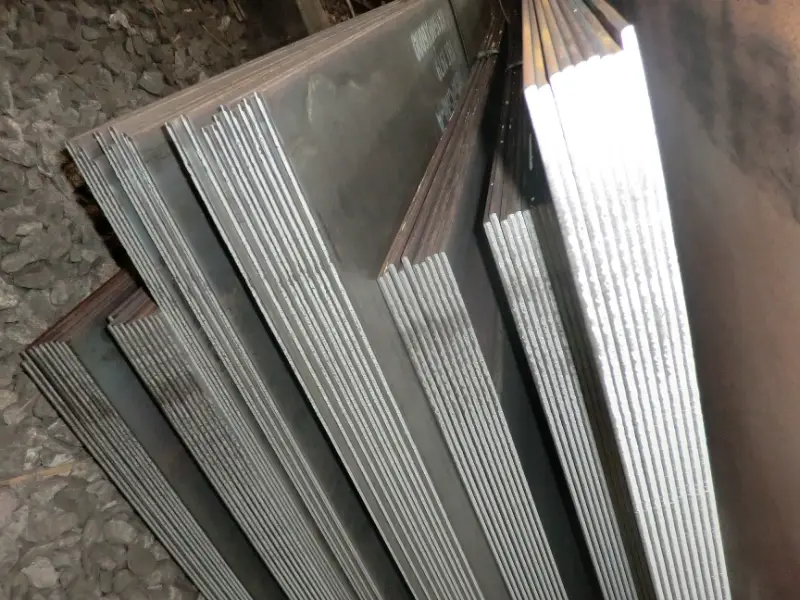
SUS444 Ferritic Stainless Steel
SUS444 Ferritic Stainless Steel: High Corrosion Resistance & Heat Resistance
Comprehensive data on SUS444 stainless steel, a low-carbon ferritic grade with molybdenum for excellent chloride pitting and stress corrosion cracking resistance. Compare equivalents and find application guidance.
Cold rolling, Hot rolling, Welding, Forming, Bending, Deep drawing, Laser cutting, Punching
- Phone : +8618037372205
- Email : [email protected]
- WhatsApp: Contact via Whtsapp
- WeChat: +8618037372205
SUS444 Ferritic Stainless Steel Introduction
SUS444 is a ferritic stainless steel developed to offer corrosion resistance comparable to austenitic 316L, but with the distinct advantages of a ferritic structure: immunity to stress corrosion cracking, higher thermal conductivity, and lower thermal expansion. It contains about 18% chromium and 2% molybdenum, with low carbon and nitrogen, stabilized by titanium and niobium additions. This ensures excellent intergranular corrosion resistance even after welding. Key characteristics:
- Superior resistance to pitting and crevice corrosion in chloride environments
- Excellent resistance to stress corrosion cracking
- Good formability and weldability with no need for post-weld annealing
- Attractive surface finish and magnetic properties
- Cost-effective alternative to 316L in many applications
SUS444 Ferritic Stainless Steel Chemical Composition
The chemical composition of SUS444 is tightly controlled to ensure a fully ferritic microstructure with stabilization. Low carbon and nitrogen contents prevent sensitization, while the addition of titanium and niobium fixes residual carbon and nitrogen, maintaining corrosion resistance after welding. Molybdenum significantly enhances resistance to pitting and crevice corrosion.
| Chemical Element | Standard Value (%) | Remarks |
|---|---|---|
| Carbon (C) | ≤ 0.025 | |
| Silicon (Si) | ≤ 1.00 | |
| Manganese (Mn) | ≤ 1.00 | |
| Phosphorus (P) | ≤ 0.040 | |
| Sulfur (S) | ≤ 0.030 | |
| Chromium (Cr) | 17.00 – 20.00 | |
| Molybdenum (Mo) | 1.75 – 2.50 | |
| Nitrogen (N) | ≤ 0.025 | |
| Titanium + Niobium (Ti+Nb) | 0.20+4(C+N) to 0.80 | Stabilizing elements |
| Iron (Fe) | Balance |
SUS444 Ferritic Stainless Steel Thermal and Electrical Physical Properties
Physical properties of SUS444 at room temperature and elevated temperatures. The ferritic structure provides higher thermal conductivity and lower thermal expansion compared to austenitic steels, making it advantageous for heat transfer applications and thermal cycling.
| Performance Item | Typical Value | Unit | Test Condition |
|---|---|---|---|
| Density (ρ) | 7.7 | g/cm³ | At 20°C |
| Modulus of Elasticity (E) | 200 | GPa | At 20°C |
| Shear Modulus (G) | 77 | GPa | At 20°C (calculated) |
| Poisson's Ratio (ν) | 0.30 | – | At 20°C |
| Thermal Expansion Coefficient (α) | 10.4 | 10⁻⁶/K | 20–100°C |
| Thermal Expansion Coefficient (α) | 10.8 | 10⁻⁶/K | 20–200°C |
| Thermal Expansion Coefficient (α) | 11.2 | 10⁻⁶/K | 20–300°C |
| Thermal Conductivity (λ) | 26.0 | W/m·K | At 100°C |
| Thermal Conductivity (λ) | 27.0 | W/m·K | At 300°C |
| Specific Heat Capacity | 460 | J/(kg·K) | At 20°C |
| Electrical Resistivity | 0.60 | µΩ·m | At 20°C |
SUS444 Ferritic Stainless Steel Mechanical Properties
Mechanical properties of SUS444 in the annealed condition, as specified in JIS G 4305 for cold-rolled sheet. The material offers moderate strength with good ductility, suitable for cold forming operations. Values depend on thickness; elongation requirements vary slightly for very thin gauges.
| Performance Item | Standard Value | Unit | Test Condition |
|---|---|---|---|
| 0.2% Yield Strength (Rp0.2) | ≥ 205 | MPa | Annealed, thickness 0.3–6.0 mm |
| Tensile Strength (Rm) | ≥ 415 | MPa | Annealed, thickness 0.3–6.0 mm |
| Elongation (A) | ≥ 22 | % | Annealed, thickness 0.6–6.0 mm, gauge length 50 mm |
| Hardness | ≤ 88 HRB / ≤ 200 HV | HRB / HV | For reference (not mandatory) |
| Bend Test (180°, mandrel diameter = thickness) | No cracks | - | Annealed, thickness ≤ 8 mm |
SUS444 Ferritic Stainless Steel Fully Equivalent Material Standards and Replaceable Grades
| Country/Region | Standard | Grade | Remarks |
|---|---|---|---|
| Japan | JIS G 4305 / G 4304 | SUS444 | Original grade |
| USA | ASTM A240/A240M | UNS S44400 | Ferritic stainless steel plate, sheet, and strip |
| Europe | EN 10088-2 | 1.4521 (X2CrMoTi18-2) | Stainless steel – technical delivery conditions for sheet/plate |
| China | GB/T 3280 / GB/T 20878 | S11972 (019Cr19Mo2NbTi) | Ferritic stainless steel cold-rolled sheet and strip |
| International | ISO 15510 | X2CrMoTi18-2 | Stainless steel – chemical composition |
SUS444 Ferritic Stainless Steel Application Introduction
SUS444 is widely used in applications demanding high corrosion resistance, especially resistance to chloride-induced stress corrosion cracking, combined with efficient heat transfer. Its ferritic structure provides lower thermal expansion and higher thermal conductivity than austenitic grades, making it ideal for thermal cycling environments. It is a cost-effective substitute for 316L in many non-severe chloride environments where stress corrosion cracking is a concern.
Product Applications: Hot water storage tanks, Solar water heater absorber plates and panels, Shell and tube heat exchangers, Automotive exhaust flexible couplings and mufflers, Food processing machinery (tanks, conveyors), Condenser and evaporator tubes, Commercial kitchen sinks and countertops
Processed into products: Welded tubes and pipes, Tank shells and bottoms, Baffle plates, Flanges and fittings, Stamped and deep-drawn parts (e.g., sink bowls), Laser-cut brackets and supports, Roll-formed profiles
Application industries: Building & Construction, Automotive, Heat Exchangers & Pressure Vessels, Food & Beverage Processing, Water Treatment & Distribution, Chemical Processing
SUS444 Ferritic Stainless Steel Similar/Alternative Material Recommendations
| Country/Region | Standard | Grade | Remarks |
|---|---|---|---|
| Japan | JIS G 4305 | SUS436L | 18Cr-1Mo-Ti; lower Mo, reduced pitting resistance compared to 444 |
| Europe | EN 10088-2 | 1.4526 (X2CrMoNb18-2) | Similar 18Cr-2Mo, stabilized with Nb only; comparable corrosion resistance |
| Japan | JIS G 4305 | SUS445J1 | 22Cr-1Mo; higher Cr, lower Mo; good heat exchanger material |
| Japan | JIS G 4305 | SUS445J2 | 22Cr-2Mo; higher Cr, same Mo; improved general and pitting corrosion |
Notes:
SUS444 can be welded by common methods (TIG, MIG, resistance welding) without preheating. Post-weld annealing is not required due to stabilization with Ti/Nb. The steel is magnetic in all conditions. Prolonged exposure at 400–550°C may cause 475°C embrittlement; operating temperatures should be managed accordingly. For severe chloride environments, higher molybdenum grades like superferritics may be considered.
- Share



