
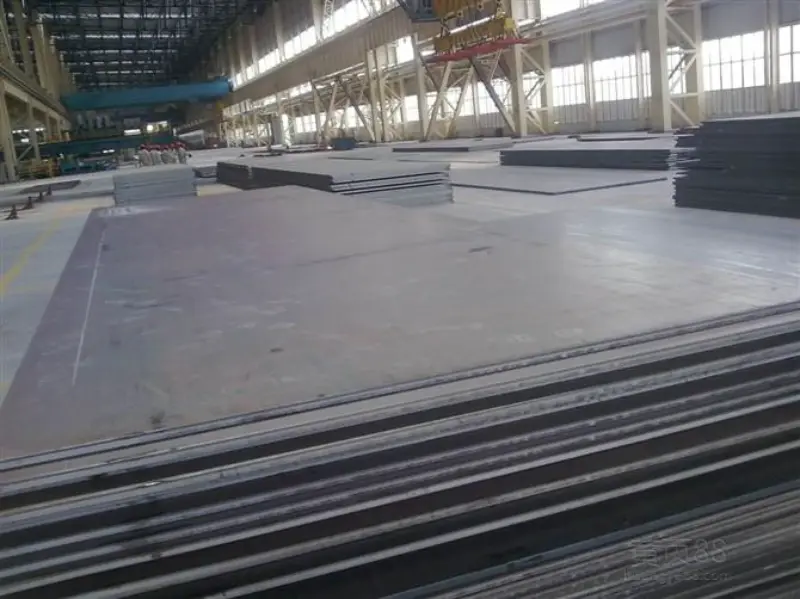
SUS445 J1 Ferritic Stainless Steel Plate/Coil
SUS445 J1 Ferritic Stainless Steel Plate/Coil - JIS G4304 Composition, Properties & Uses
Complete technical reference for SUS445 J1 ferritic stainless steel plate and coil: chemical composition, mechanical and physical properties, equivalent grades, and typical applications in solar energy and chemical equipment.
Hot rolling, cold rolling, annealing, pickling, cutting, bending, drawing, welding
- Phone : +8618037372205
- Email : [email protected]
- WhatsApp: Contact via Whtsapp
- WeChat: +8618037372205
SUS445 J1 Ferritic Stainless Steel Plate/Coil Introduction
SUS445 J1 is a high-chromium, molybdenum-bearing ferritic stainless steel specified in JIS G4304 (hot-rolled) and JIS G4305 (cold-rolled). It is stabilized with titanium and/or niobium to prevent intergranular corrosion. The alloy combines excellent resistance to chloride stress corrosion cracking, pitting, and crevice corrosion with good formability and weldability. Typical applications include
- solar water heater panels and heat exchanger tubing
- chemical process equipment
- automotive exhaust components
The material is normally supplied in the annealed and pickled condition.
SUS445 J1 Ferritic Stainless Steel Plate/Coil Chemical composition
The composition of SUS445 J1 provides a ferritic structure with high resistance to localised corrosion. Controlled low carbon and nitrogen, together with stabilising additions, ensure intergranular corrosion resistance after welding. The table lists the requirements according to JIS G4304.
- Values are % by mass.
- Ti and Nb may be added individually or in combination within the range 0.10–0.30 each.
| Element | Standard value (%) | Remarks |
|---|---|---|
| C | ≤ 0.025 | Low carbon for weldability |
| Si | ≤ 1.00 | Deoxidiser |
| Mn | ≤ 1.00 | Austenite stabiliser |
| P | ≤ 0.040 | Impurity |
| S | ≤ 0.030 | Impurity |
| Cr | 23.00 – 26.00 | Key ferrite former, corrosion resistance |
| Mo | 1.00 – 1.50 | Pitting and crevice corrosion resistance |
| Ni | ≤ 0.60 | Maintains ferritic structure |
| Cu | 0.30 – 0.80 | Improved corrosion resistance |
| N | ≤ 0.025 | Kept low to avoid sensitisation |
| Ti | 0.10 – 0.30* | Stabilising element (optional) |
| Nb | 0.10 – 0.30* | Stabilising element (optional) |
SUS445 J1 Ferritic Stainless Steel Plate/Coil Physical properties
The physical data represent typical values for a 25% Cr–1.5% Mo ferritic stainless steel in the annealed condition.
- Thermal expansion and conductivity are given for selected temperature ranges.
- Electrical resistivity is for the annealed condition.
| Property | Value | Unit | Condition / Temperature range |
|---|---|---|---|
| Density (ρ) | 7.70 | g/cm³ | At 20 °C |
| Elastic modulus (E) | 200 | GPa | At 20 °C |
| Shear modulus (G) | 77 | GPa | Calculated from E and ν |
| Poisson's ratio (ν) | 0.30 | — | Within elastic range |
| Thermal expansion (α) | 10.4 | 10⁻⁶/K | 20–100 °C |
| Thermal expansion (α) | 10.8 | 10⁻⁶/K | 20–200 °C |
| Thermal expansion (α) | 11.2 | 10⁻⁶/K | 20–300 °C |
| Thermal expansion (α) | 11.5 | 10⁻⁶/K | 20–400 °C |
| Thermal expansion (α) | 11.8 | 10⁻⁶/K | 20–500 °C |
| Thermal conductivity (λ) | 23.0 | W/(m·K) | At 20 °C |
| Thermal conductivity (λ) | 23.5 | W/(m·K) | At 200 °C |
| Thermal conductivity (λ) | 24.0 | W/(m·K) | At 300 °C |
| Thermal conductivity (λ) | 24.5 | W/(m·K) | At 400 °C |
| Thermal conductivity (λ) | 25.0 | W/(m·K) | At 500 °C |
| Specific heat capacity | 460 | J/(kg·K) | At 20 °C |
| Electrical resistivity (ρₑ) | 0.60 | µΩ·m | At 20 °C, annealed |
SUS445 J1 Ferritic Stainless Steel Plate/Coil Mechanical properties at room temperature
The mechanical properties are specified in JIS G4304 for hot-rolled and JIS G4305 for cold-rolled products. The values below correspond to the annealed condition. Elongation and bend test requirements may vary with thickness; the table gives the most common requirements for plate thickness ≤6.0 mm. Hardness values are representative for annealed material.
| Property | Standard requirement | Unit | Test condition / Thickness |
|---|---|---|---|
| 0.2% proof stress (yield strength) | ≥ 205 | MPa | Room temperature, all thicknesses |
| Tensile strength (Rm) | ≥ 415 | MPa | Room temperature, all thicknesses |
| Elongation (A) | ≥ 22 | % | Gauge length 50 mm, thickness ≤ 5.0 mm |
| Elongation (A) | ≥ 20 | % | Thickness 5.0–8.0 mm |
| Hardness | ≤ 88 | HRBW | Annealed, all thicknesses |
| Hardness | ≤ 200 | HV | Annealed, all thicknesses |
| Bend test (180°) | d = 1t (no cracks) | — | Thickness < 8 mm |
SUS445 J1 Ferritic Stainless Steel Plate/Coil Identical material designation — no exact international equivalents
| Country / Region | Standard | Grade | Remarks |
|---|---|---|---|
| Japan | JIS G4304 / G4305 | SUS445J1 | Original specification; ferritic, stabilised with Nb/Ti |
SUS445 J1 Ferritic Stainless Steel Plate/Coil Application Introduction
SUS445 J1 is chosen for applications demanding excellent resistance to chloride stress corrosion cracking combined with high thermal conductivity and low thermal expansion – properties that are superior to austenitic grades like SUS304. Its stabilised ferritic structure permits use in welded constructions without post‑weld heat treatment.
- Ideal for thin‑walled heat‑exchanger tubing and solar collector panels
- Readily deep drawn, bent, and formed at room temperature
- Weldable by TIG, MIG, and resistance welding with low heat input
Product Applications: Flat‑plate solar collectors, Evaporator and condenser tubing, Hot‑water storage tanks, Heat exchanger shells and channels, Exhaust silencers and catalytic converter shells
Processed into products: Solar absorber strips (roll‑bonded panels), Welded tube for heat exchangers, Deep‑drawn sink bowls and hygienic components, Bent structural brackets in corrosive atmospheres, Flanges and pipe fittings for chemical plants
Application industries: Solar thermal energy, Chemical and petrochemical processing, Automotive (exhaust systems), Household appliances (water heaters), Food and beverage equipment
SUS445 J1 Ferritic Stainless Steel Plate/Coil Similar grades suitable for substitution
| Country / Region | Standard | Grade | Remarks |
|---|---|---|---|
| USA | ASTM A240/A240M | UNS S44660 | Higher Ni (1.5–3.5 %) and Cu (0.50–2.00 %); otherwise similar corrosion resistance |
| China | GB/T 3280 | 019Cr23Mo2CuNbTi | Very close composition; verify Ti/Nb limits against specification |
| Europe | EN 10088-2 | 1.4521 (X2CrMoTi18-2) | Lower Cr (~18 %) and Mo (~2 %); not fully equivalent but often used in similar environments |
| International | ISO 15510 | X2CrNiMo25-3-2 ? | Possibly duplex; ferritic grade not explicitly matching in ISO |
Notes:
Corrosion resistance: The combination of ~25% Cr and 1.0–1.5% Mo gives excellent resistance to pitting (PRE ≈ 30–33) and crevice corrosion in chloride‑containing environments.
Welding: Use low heat input and matching or higher alloy filler (e.g., 25% Cr‑4% Ni‑4% Mo if available) to retain corrosion resistance. Post‑weld picking is advised.
Formability: Though a ferritic grade, the low C+N and stabilisation give good deep‑drawability comparable to some austenitic steels.
Limitations: Service temperature is typically limited to about 300 °C to avoid 475 °C embrittlement; impact toughness at sub‑zero temperatures is lower than austenitic grades.
- Share



