
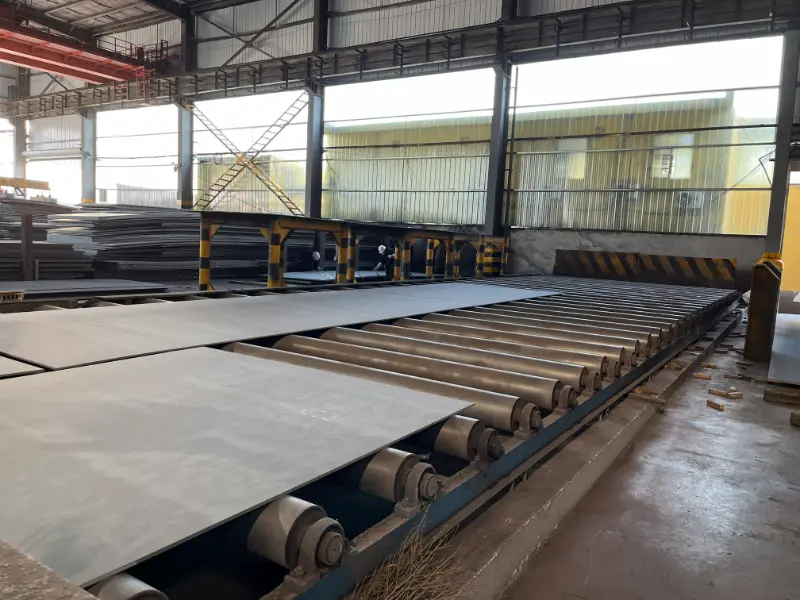
SUS430LX Ferritic Stainless Steel Plate/Coil
SUS430LX Ferritic Stainless Steel Plate/Coil: Stabilized 17Cr Alloy for Superior Fabrication
Explore the properties and applications of SUS430LX, a titanium or niobium stabilized ferritic stainless steel with enhanced corrosion resistance and formability, designed for exhaust systems and appliances.
Stamping, deep drawing, bending, welding, cutting, roll forming
- Phone : +8618037372205
- Email : [email protected]
- WhatsApp: Contact via Whtsapp
- WeChat: +8618037372205
SUS430LX Ferritic Stainless Steel Plate/Coil Introduction
SUS430LX is a low-carbon, titanium or niobium stabilized ferritic stainless steel defined in JIS G4305 for cold-rolled stainless steel plates and sheets. By adding strong carbide and nitride formers such as Ti or Nb, the alloy suppresses sensitization during welding and high-temperature exposure, ensuring excellent resistance to intergranular corrosion. This grade exhibits good ductility, deep drawability, and high-temperature oxidation resistance up to approximately 800°C. Compared to standard SUS430, SUS430LX offers improved weldability, reduced stress corrosion cracking susceptibility, and stable mechanical properties. It is non-hardenable by heat treatment and typically supplied in the annealed condition.
- Excellent intergranular corrosion resistance after welding
- Good formability for deep drawing and bending
- High-temperature strength and oxidation resistance
- Cost-effective alternative to austenitic grades in many environments
SUS430LX Ferritic Stainless Steel Plate/Coil Chemical Composition
Chemical composition per JIS G4305:2012 for SUS430LX. The low carbon content and addition of stabilizing elements (titanium and/or niobium) prevent chromium carbide precipitation during welding, ensuring superior intergranular corrosion resistance. The chromium range provides adequate oxidation and corrosion resistance.
- Typical stabilization uses Ti or Nb individually; combined addition also possible.
- Residual nitrogen is controlled to optimize stabilization.
| Element | Standard Value (wt%) | Remarks |
|---|---|---|
| Carbon (C) | ≤ 0.03 | Low carbon to prevent sensitization |
| Silicon (Si) | ≤ 1.00 | Deoxidizer; improves oxidation resistance |
| Manganese (Mn) | ≤ 1.00 | Deoxidizer and sulfide former |
| Phosphorus (P) | ≤ 0.040 | Impurity control |
| Sulfur (S) | ≤ 0.030 | Impurity control |
| Chromium (Cr) | 16.00 – 19.00 | Primary corrosion and oxidation resistance element |
| Titanium (Ti) | 0.10 – 0.25 | Stabilizer (used alone or in combination) |
| Niobium (Nb) | 0.10 – 0.25 | Stabilizer (used alone or in combination) |
| Nitrogen (N) | ≤ 0.030 | Controlled for effective stabilization |
SUS430LX Ferritic Stainless Steel Plate/Coil Thermal and Electrical Physical Properties
Typical physical properties at room temperature and elevated temperatures for SUS430LX in the annealed condition. The alloy exhibits moderate thermal conductivity and a coefficient of thermal expansion close to that of carbon steels, which facilitates joining with dissimilar metals. Electrical resistivity is suitable for resistance heating applications.
- Properties are representative but may vary slightly with specific processing.
- Thermal expansion and conductivity are important for exhaust system design.
| Property | Typical Value | Unit | Test Condition |
|---|---|---|---|
| Density (ρ) | 7.70 | g/cm³ | 20°C |
| Elastic modulus (E) | 200 | GPa | 20°C |
| Shear modulus (G) | 77 | GPa | 20°C |
| Poisson's ratio (ν) | 0.28 | – | 20°C |
| Thermal expansion coefficient (α) | 10.5 | 10⁻⁶/K | 20–100°C |
| Thermal expansion coefficient | 11.0 | 10⁻⁶/K | 20–300°C |
| Thermal expansion coefficient | 11.5 | 10⁻⁶/K | 20–500°C |
| Thermal conductivity (λ) | 25.0 | W/(m·K) | 100°C |
| Thermal conductivity | 26.5 | W/(m·K) | 500°C |
| Specific heat capacity | 460 | J/(kg·K) | 0–100°C |
| Electrical resistivity (ρₑ) | 0.60 | μΩ·m | 20°C |
SUS430LX Ferritic Stainless Steel Plate/Coil Mechanical Properties
Mechanical properties according to JIS G4305 for annealed SUS430LX plates and coils at room temperature. The values apply to thickness up to 8.0 mm (cold-rolled) unless otherwise noted. The alloy maintains good ductility and moderate strength suitable for forming operations. Hardness values provide indirect guidance on formability.
- Elongation measured on 50 mm gauge length for standard test pieces.
- Bend test performed over diameter equal to plate thickness for ductility verification.
| Property | Standard Requirement | Unit | Test Condition |
|---|---|---|---|
| 0.2% Yield Strength (ReH) | ≥ 205 | N/mm² | Room temperature, thickness ≤ 8 mm |
| Tensile Strength (Rm) | ≥ 420 | N/mm² | Room temperature, thickness ≤ 8 mm |
| Elongation (A) | ≥ 22 | % | 50 mm gauge, thickness ≤ 8 mm |
| Hardness (HRB) | ≤ 88 | HRB | Annealed condition |
| Hardness (HV) | ≤ 200 | HV | Annealed condition |
| Bend Test (180°) | d = t | – | Bend diameter equal to specimen thickness (t), no cracks |
SUS430LX Ferritic Stainless Steel Plate/Coil Fully Equivalent Material Standards and Substitutable Grades
| Country/Region | Standard | Grade/Designation | Remarks |
|---|---|---|---|
| Japan | JIS G4305 | SUS430LX | Original specification |
| USA | ASTM A240/A240M | UNS S43035 (Type 439) | Chemistry and properties align closely |
| European Union | EN 10088-2 | X3CrTi17 (1.4510) | Ti-stabilized 17%Cr ferritic |
| China | GB/T 3280 | 019Cr18Ti | Equivalent to 1.4510 / Type 439 |
| International | ISO 15510 | X3CrTi17 (1.4510) | Adopts European designation |
SUS430LX Ferritic Stainless Steel Plate/Coil Application Introduction
SUS430LX is widely adopted where a combination of moderate corrosion resistance, high ductility, and cost efficiency is required. Its stabilized chemistry permits extensive welding without post-weld heat treatment, making it ideal for long-life components subjected to thermal cycling.
- Preferred for thin-gauge deep-drawn parts
- Excellent oxidation resistance in dry air up to 800°C
- Resistant to stress corrosion cracking in chloride environments
Product Applications: Automotive mufflers, exhaust pipes, catalytic converter shells, Dishwasher inner tanks and drying elements, Oven and microwave oven interiors, Kitchen sinks and countertops (in some cost-sensitive designs), Architectural panels and roofing sheets
Processed into products: Deep-drawn cups, bowls, and housings, Stamped brackets and flanges, Welded tubes and exhaust manifolds, Heat exchanger fins and plates, Formed trim pieces and decorative profiles
Application industries: Automotive (exhaust systems, fuel systems), Home appliances (dishwasher tubs, oven liners), Architecture (roofing, cladding, decorative trim), Heat exchanger and boiler making, Food processing equipment (where moderate corrosion resistance suffices)
SUS430LX Ferritic Stainless Steel Plate/Coil Similar or Alternative Materials for Reference
| Country/Region | Standard | Grade/Designation | Remarks |
|---|---|---|---|
| Japan | JIS G4305 | SUS430 | Standard 17Cr; lacks stabilization, lower weldability |
| Japan | JIS G4305 | SUS430J1L | Nb-stabilized variant; similar performance but narrower Nb requirement |
| USA | ASTM A240 | Type 430Ti | Ti-stabilized version similar to 439 but may have different C limits |
| USA | ASTM A240 | Type 441 | Dual-stabilized (Ti+Nb) 18Cr with better high-temp strength |
| EU | EN 10088-2 | X2CrTiNb18 (1.4509) | Dual-stabilized 18Cr, slightly higher corrosion resistance |
Notes:
SUS430LX is magnetic and cannot be hardened by heat treatment. It provides a cost-effective alternative to austenitic grades such as SUS304 in non-severe corrosive environments. Post-weld annealing is generally not required for most applications, but if maximum ductility is needed, a brief anneal may be beneficial. Available surface finishes include 2B, BA, and polished surfaces. Compliance with JIS G4305 also ensures traceability and reliable mechanical performance.
- Share



