
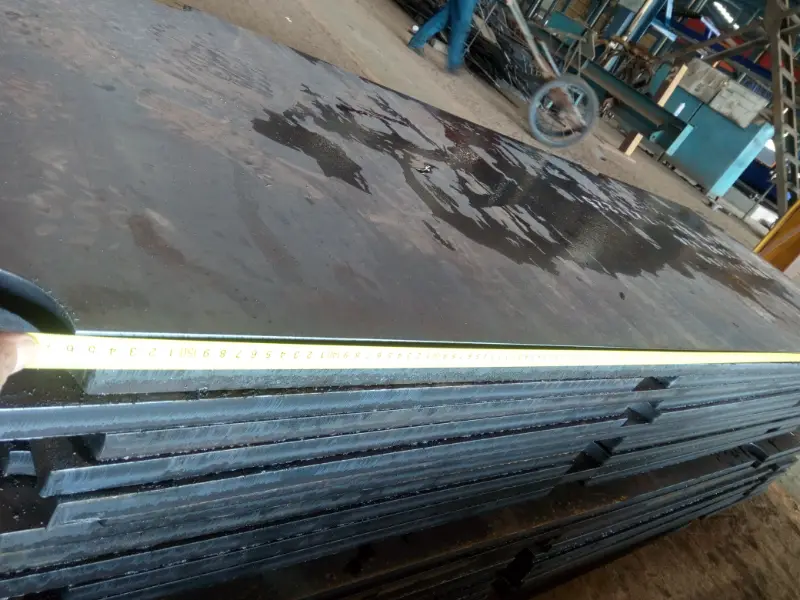
ASTM A533 GRBCL3 Quenched & Tempered Steel Plate for Pressure Vessels
ASTM A533 GRBCL3 Quenched & Tempered Steel Plate for Pressure Vessels | Complete Data
In-depth material properties, chemical composition, mechanical performance, physical properties, equivalent grades, and application guide for ASTM A533 Grade B Class 3 quenched and tempered boiler and pressure vessel steel plate.
Hot rolling, quenching and tempering (Q&T)
- Phone : +8618037372205
- Email : [email protected]
- WhatsApp: Contact via Whtsapp
- WeChat: +8618037372205
ASTM A533 GRBCL3 Quenched & Tempered Steel Plate for Pressure Vessels Introduction
ASTM A533 Grade B Class 3 (GRBCL3) is a low-alloy, quenched and tempered steel plate specifically designed for the fabrication of pressure vessels and boilers. Classified under ASTM A533/A533M, this grade delivers very high tensile strength (690–860 MPa) and excellent yield strength (≥570 MPa), making it suitable for thick-walled, high-pressure equipment. Its chemistry includes controlled additions of manganese, molybdenum, and nickel to enhance hardenability and toughness. The material is supplied in the quenched and tempered condition, ensuring a uniform tempered martensite/ bainite microstructure that provides an optimal balance of strength and ductility.
- Designed for pressure-retaining parts in critical service
- Excellent weldability with proper procedures
- Available in plate form up to 63.5 mm thickness for Class 3
- Can be certified to supplementary impact test requirements
Typical applications include reactor shells, heat exchanger bodies, and large boiler drums. Its combination of high strength and good notch toughness at low temperatures makes it a preferred choice in the petrochemical, power generation, and nuclear industries.
ASTM A533 GRBCL3 Quenched & Tempered Steel Plate for Pressure Vessels Chemical Composition
The chemical composition of ASTM A533 Grade B Class 3 is tightly controlled to achieve the required mechanical properties after quenching and tempering. Molybdenum and nickel are key alloying elements that improve hardenability and toughness. Maximum limits apply to residual elements like phosphorus and sulfur to ensure cleanliness and weldability. All values are as per ASTM A533/A533M for Type B.
| Element | Standard Value (wt%) | Remarks |
|---|---|---|
| C | 0.25 max | Ladle analysis |
| Mn | 1.15 - 1.50 | Ladle analysis (Grade B range) |
| P | 0.025 max | Ladle analysis |
| S | 0.025 max | Ladle analysis |
| Si | 0.15 - 0.40 | Ladle analysis |
| Mo | 0.45 - 0.60 | Ladle analysis |
| Ni | 0.40 - 0.70 | Ladle analysis (Type B) |
ASTM A533 GRBCL3 Quenched & Tempered Steel Plate for Pressure Vessels Thermal & Electrical Physical Properties
The following physical properties are typical reference values for a quenched and tempered Mn-Mo-Ni pressure vessel steel like ASTM A533 Grade B Class 3. These numbers are not part of the standard specification but are often used during engineering design. Actual values may slightly vary with exact composition and heat treatment condition.
| Property | Standard Value | Unit | Test Condition |
|---|---|---|---|
| Density (ρ) | 7.85 | g/cm³ | At 20°C |
| Elastic Modulus (E) | 205 | GPa | At room temperature |
| Shear Modulus (G) | 80 | GPa | At room temperature |
| Poisson's Ratio (ν) | 0.30 | — | At room temperature |
| Thermal Expansion Coefficient (α) | 12.0 × 10⁻⁶ | /°C | 20 – 100 °C range |
| Thermal Conductivity (λ) | 38 | W/(m·K) | At 100 °C |
| Specific Heat Capacity (cp) | 460 | J/(kg·K) | At 20 °C |
| Electrical Resistivity (ρe) | 0.25 × 10⁻⁶ | Ω·m | At 20 °C |
ASTM A533 GRBCL3 Quenched & Tempered Steel Plate for Pressure Vessels Mechanical Properties
Tensile properties are determined in accordance with ASTM A370 using standard transverse specimens. For plates up to 63.5 mm thick (Class 3 maximum thickness), the following minimum/maximum values apply. Yield strength is measured at 0.2% offset, while elongation is based on a 50 mm gauge length. Impact toughness requirements (Charpy V-notch) may be specified as a supplementary requirement.
| Property | Standard Value | Unit | Test Condition |
|---|---|---|---|
| Yield Strength (ReH, 0.2% offset) | ≥ 570 (83 ksi) | MPa | Room temperature, transverse specimen |
| Tensile Strength (Rm) | 690 – 860 (100 – 125 ksi) | MPa | Room temperature, transverse specimen |
| Elongation in 2 in. (50 mm), A | ≥ 16 | % | Gauge length 50 mm, transverse or longitudinal |
ASTM A533 GRBCL3 Quenched & Tempered Steel Plate for Pressure Vessels Fully Equivalent Material Standards & Recommended Substitutions
| Country/Region | Standard | Grade | Remarks |
|---|---|---|---|
| USA | ASME SA533/SA533M | SA533 Grade B Class 3 | Identical to ASTM A533 GRBCL3; adopted by ASME Boiler and Pressure Vessel Code. Fully interchangeable. |
ASTM A533 GRBCL3 Quenched & Tempered Steel Plate for Pressure Vessels Application Introduction
ASTM A533 Grade B Class 3 is specifically engineered for the fabrication of heavy-wall pressure equipment. Its high strength allows for reduced wall thickness compared to lower strength grades, leading to weight savings and improved transportability. Excellent weldability is achieved through low carbon equivalent and strict cleanliness, though preheating and post-weld heat treatment (PWHT) are often required depending on thickness and service conditions. The material is widely used in critical pressure boundaries where 100% inspection and high reliability are mandatory.
Product Applications: Pressure vessels, Boilers, Heat exchangers, Storage tanks, Reactor pressure vessels, Separators
Processed into products: Shell plates, Heads, Flanges, Nozzles, Tube sheets, Manhole covers, Transition rings
Application industries: Oil & Gas, Chemical Processing, Power Generation, Nuclear, Petrochemical, Energy
ASTM A533 GRBCL3 Quenched & Tempered Steel Plate for Pressure Vessels Similar / Alternative Material Recommendations
| Country/Region | Standard | Grade | Remarks |
|---|---|---|---|
| European Union | EN 10028-6 | P690Q | High-strength quenched & tempered pressure vessel steel (min yield 690 MPa). Different alloy design (e.g., Cr, Mo, Ni levels vary). Requires re-qualification if substituted. |
| USA | ASTM A517/A517M | Grade B (or other grades) | High-strength quenched & tempered alloy steel plate for pressure vessels. Not directly equivalent; composition and delivery condition differ. Can be considered for similar applications with careful engineering assessment. |
Notes:
ASTM A533 Grade B Class 3 represents the highest strength level within the A533 family. Charpy V-notch impact testing can be specified by purchasing the material with supplementary requirement S5, where the minimum test temperature and absorbed energy are agreed upon. The steel is suitable for fusion welding by all common processes, provided that qualified welding procedures and qualified welders are used. For nuclear applications, additional requirements of ASME BPVC Section III may be mandatory. The material is usually delivered in the normalized (or quenched) and tempered condition; Class 3 plates are limited to a maximum thickness of 2.5 inches (63.5 mm).
- Share



