
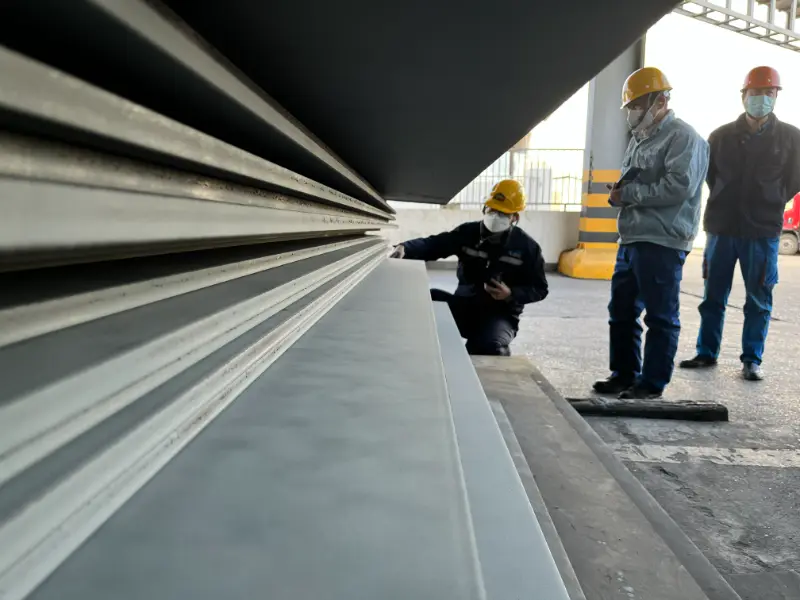
ASTM A533 Grade C Class 1 Pressure Vessel Steel
ASTM A533 Grade C Class 1 Pressure Vessel Steel - High Strength Mn-Mo-Ni Alloy for Critical Service
Explore the properties, chemical composition, mechanical and thermal data for ASTM A533 Grade C Class 1 quenched and tempered Mn-Mo-Ni alloy steel plate. Widely used in nuclear and conventional pressure vessels, boilers, and heavy fabrication requiring high strength and toughness.
Hot rolling, quenching, tempering, welding, cutting, forming (hot or cold, limited cold forming after Q&T)
- Phone : +8618037372205
- Email : [email protected]
- WhatsApp: Contact via Whtsapp
- WeChat: +8618037372205
ASTM A533 Grade C Class 1 Pressure Vessel Steel Introduction
ASTM A533 Grade C Class 1 is a manganese-molybdenum-nickel alloy steel plate intended primarily for welded pressure vessels and boilers in low and moderate temperature service. It belongs to the family of quenched and tempered (Q&T) steels standardized under ASTM A533/A533M. The 'Class 1' designation indicates a minimum yield strength of 345 MPa (50 ksi) in the quenched and tempered condition, with tensile strength ranging from 550 to 690 MPa (80–100 ksi).
This grade offers an excellent combination of high strength, good toughness, and weldability, making it suitable for thick-section components in nuclear reactor pressure vessels, steam drums, chemical reactors, and heavy structural applications. The addition of nickel (0.70–1.00%) enhances low-temperature notch toughness, while molybdenum (0.45–0.60%) improves hardenability and elevated-temperature strength.
Typical supply forms include plates in thicknesses up to 300 mm, often with additional supplementary requirements for Charpy V-notch impact testing, ultrasonic examination, and stress relief heat treatment. Delivery condition is usually quenched and tempered. It is widely recognized and used internationally, with close equivalents in EN 10028-2 (13MnNiMo5-4) and ISO 9328-2.
ASTM A533 Grade C Class 1 Pressure Vessel Steel Chemical Composition
The chemical composition limits for ASTM A533 Grade C Class 1 as per ASTM A533/A533M standard. Values represent heat analysis; product analysis may vary within specified tolerances. Key alloying elements: Manganese (1.15–1.50%), Molybdenum (0.45–0.60%), and Nickel (0.70–1.00%) provide balanced strength and toughness.
| Element | Standard Value (max unless range) | Remarks |
|---|---|---|
| Carbon, C | 0.25 | Maximum |
| Manganese, Mn | 1.15 – 1.50 | Range |
| Phosphorus, P | 0.035 | Maximum |
| Sulfur, S | 0.035 | Maximum |
| Silicon, Si | 0.15 – 0.40 | Range |
| Molybdenum, Mo | 0.45 – 0.60 | Range |
| Nickel, Ni | 0.70 – 1.00 | Range |
| Iron, Fe | Balance | 97.0 – 97.55 approx. |
ASTM A533 Grade C Class 1 Pressure Vessel Steel Thermal and Electrical Physical Properties
Typical physical properties for ASTM A533 Grade C Class 1 in the quenched and tempered condition. Values are representative for low-alloy Mn-Mo-Ni steels at room temperature unless indicated otherwise. Thermal expansion and thermal conductivity are important for design in thermal cycling applications.
| Property | Typical Value | Unit | Test Condition / Remarks |
|---|---|---|---|
| Density (ρ) | 7850 | kg/m³ | Room temperature |
| Modulus of Elasticity (E) | 200 – 210 | GPa | Room temperature; decreases at elevated temperature |
| Shear Modulus (G) | 80 – 81 | GPa | Typical for low-alloy steels |
| Poisson's Ratio (ν) | 0.29 – 0.30 | dimensionless | Room temperature |
| Thermal Expansion Coefficient (α) | 11.7 | 10⁻⁶/K | 20–100°C; 12.3 at 20–200°C; 12.9 at 20–300°C |
| Thermal Conductivity (λ) | 42 – 44 | W/(m·K) | At 20°C; decreases with temperature |
| Specific Heat Capacity (c) | 460 – 480 | J/(kg·K) | At 20°C |
| Electrical Resistivity (ρ_e) | 0.20 – 0.25 | µΩ·m | Room temperature |
ASTM A533 Grade C Class 1 Pressure Vessel Steel Mechanical Properties
Mechanical properties required by ASTM A533 Grade C Class 1 for plate thicknesses up to specified limits. Data valid for plates in quenched and tempered condition. Tensile test values are transverse to rolling direction unless otherwise specified. Charpy V-notch impact values are supplementary and may be agreed upon customer requirements.
| Property | Standard Requirement | Unit | Test Condition / Remarks |
|---|---|---|---|
| Tensile Strength (Rm) | 550 – 690 | MPa | Thickness ≤ 65 mm; for thicker sections refer to standard |
| Yield Strength (ReH, 0.2% offset) | ≥ 345 | MPa | Thickness ≤ 65 mm |
| Elongation (A, 2 in. gauge length) | ≥ 22 | % | For plates ≤ 50 mm; 50 mm to 100 mm: ≥ 20% |
| Elongation (A, 8 in. gauge length) | ≥ 18 | % | For plates ≤ 50 mm |
| Charpy V-notch Impact Energy | Typically ≥ 27 (20) at -30°C | J | Supplementary requirement S5; values often specified for nuclear applications |
| Hardness (Brinell) | ≤ 235 | HBW | Typical; not mandatory in standard |
ASTM A533 Grade C Class 1 Pressure Vessel Steel Completely Equivalent Material Standards & Substitute Grades
| Country/Region | Standard | Grade/Designation | Remarks |
|---|---|---|---|
| Europe | EN 10028-2 | 13MnNiMo5-4 (1.4302) | Direct equivalent for many thickness ranges; similar composition and mechanical properties |
| International | ISO 9328-2 | 13MnNiMo5-4 | Adopts the same designation as EN |
| China | GB/T 713.2 | 13MnNiMoR (Q345RC) | Comparable pressure vessel steel; yield strength min. 345 MPa; check specifics for thickness limits |
| USA | ASME SA533 | SA533 Grade C Class 1 | Identical to ASTM A533; ASME adoption for boiler and pressure vessel code |
ASTM A533 Grade C Class 1 Pressure Vessel Steel Application Introduction
ASTM A533 Grade C Class 1 is primarily used in heavy pressure-retaining components where high strength and good fracture toughness are essential. The material can be fabricated by welding, forming, and machining, but hot forming or post-weld heat treatment is often required to restore mechanical properties. Common applications include: nuclear reactor pressure vessels; steam generators; chemical and petrochemical reactors; high-pressure separators; and thick-shell heat exchangers. It is suitable for service temperatures ranging from -30°C to +400°C depending on design codes.
Product Applications: Reactor pressure vessels (nuclear), Steam drums and boiler shells, Hydrocracker reactors, Ammonia converters, High-pressure heat exchanger shells, Large diameter thick-wall pipes (fabricated from plate)
Processed into products: Welded vessel shells and heads, Tube sheets for heat exchangers, Flanges and nozzles (machined from plate), Support rings and reinforcement pads, Transition pieces in thick-walled piping systems
Application industries: Nuclear power generation, Thermal power boilers, Chemical and petrochemical processing, Oil and gas (refineries, hydrocrackers), Heavy machinery and pressure equipment manufacturing
ASTM A533 Grade C Class 1 Pressure Vessel Steel Similar / Comparable Materials for Reference
| Country/Region | Standard | Grade | Remarks |
|---|---|---|---|
| USA | ASTM A533 | Grade B Class 1 | Similar Mn-Mo steel without nickel; lower toughness but same strength; used where nickel is not needed |
| USA | ASTM A508 | Grade 3 Class 1 | Forging equivalent of A533 Grade C; used for thick-wall vessel shells and heads |
| Europe | EN 10028-2 | 13MnNiMo5-5 (1.4304) | Higher nickel variant (1.30–1.70%) for improved toughness; similar strength |
| Japan | JIS G3120 | SQV3A | Manganese-molybdenum-nickel steel for pressure vessels; yield strength ≥ 360 MPa; close to A533 Gr.C Cl.1 |
| China | GB/T 3531 | 15MnNiDR | Low-temperature Mn-Ni steel plate; lower strength but good toughness; alternative for some applications |
Notes:
This steel is typically supplied with supplementary requirements such as ultrasonic examination (S2), Charpy V-notch impact testing (S5), and elevated temperature tensile testing (S9). For nuclear applications, additional restrictions on copper, phosphorus, and sulfur may apply (e.g., 'non-' grade). Maximum thickness for Class 1 plates is generally limited by hardenability; consult ASTM A533/A533M for specific thickness-property tables. Post-weld heat treatment (PWHT) is mandatory for most pressure vessel codes and influences mechanical properties; PWHT parameters should be optimized to maintain toughness.
- Share



